
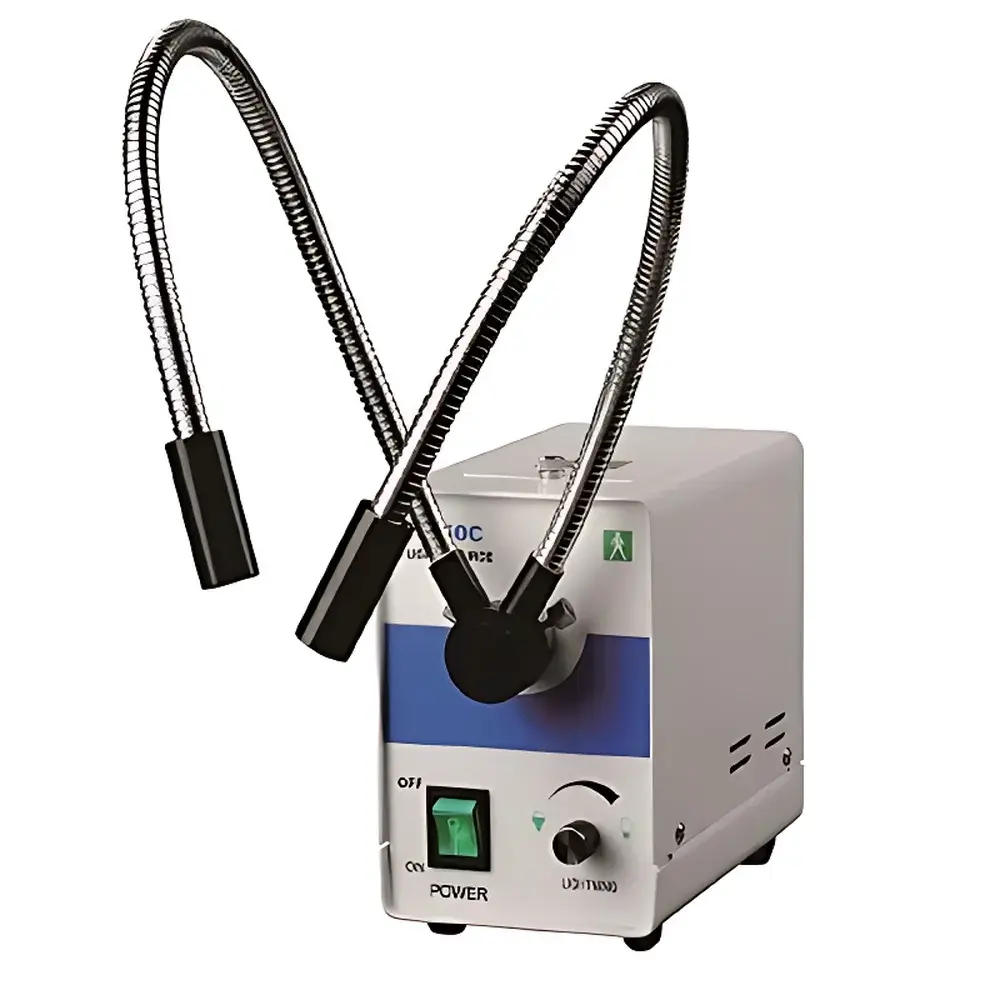
RWD F-150C/F-150S Fiber-Optic Cold Light Source for Stereotaxic Surgery
| Brand | RWD |
|---|---|
| Origin | Guangdong, China |
| Manufacturer Type | OEM/ODM Manufacturer |
| Country of Origin | China |
| Model | F-150C (Vertical) / F-150S (Horizontal) |
| Input Voltage | 110–220 V AC |
| Lamp Power | 150 W |
| Dimensions (L×W×H) | 18.5 × 20 × 12.5 cm |
| Net Weight | 3.12 kg |
| Illuminance at Image Plane | 1.6 × 10⁶ lx |
| Lamp Lifetime | 50–200 h |
| Fiber Configuration | Dual-channel coaxial fiber optic illumination |
| Lamp Voltage | 21 V DC |
| Compatible Accessories | 76310 (Y-type bifurcated fiber), 76306 (replacement 21 V / 150 W lamp) |
Overview
The RWD F-150C and F-150S Fiber-Optic Cold Light Sources are engineered specifically for high-precision neurosurgical applications in rodent stereotaxic procedures. Unlike conventional halogen or LED-based illumination systems that emit significant infrared (IR) radiation, these units utilize a 21 V / 150 W tungsten-halogen lamp coupled with high-transmission quartz fiber optics to deliver intense, spectrally stable visible light while minimizing thermal load at the surgical site. This design ensures tissue temperature remains within physiologically safe limits—typically ≤30 °C at the target region—thereby preventing thermally induced vasodilation, microcirculatory artifacts, or unintended cortical activation during real-time intracranial observation. The system’s spectral output closely approximates natural daylight (CCT ≈ 3200 K), preserving hemoglobin’s native chromatic contrast and enabling accurate visual assessment of cerebral blood oxygenation status without digital color correction.
Key Features
- Dual-channel coaxial fiber-optic illumination architecture ensures uniform, shadow-free field illumination with optimal depth perception under surgical microscopes or endoscopic setups.
- Regulated switch-mode power supply delivers stable 21 V DC output, eliminating voltage fluctuations that compromise lamp intensity consistency and accelerate filament degradation.
- Universal AC input compatibility (110–220 V, 50/60 Hz) enables seamless deployment across international laboratory environments without external transformers.
- Compact benchtop footprint (18.5 × 20 × 12.5 cm) and lightweight construction (3.12 kg) support flexible integration into stereotaxic workstations, laminar flow hoods, or mobile surgical rigs.
- Measured image-plane illuminance of 1.6 × 10⁶ lux at 10 cm working distance meets ISO 8596 requirements for ophthalmic and neurosurgical visualization tasks requiring high photometric fidelity.
Sample Compatibility & Compliance
The F-150 series is validated for use with standard small-animal stereotaxic frames (e.g., David Kopf, Stoelting, and RWD-branded models) and compatible with both upright and inverted microscope configurations. Its low-thermal-output illumination preserves physiological integrity during prolonged craniotomy, dural exposure, or optogenetic fiber implantation procedures in mice and rats. All optical components comply with IEC 60601-1 (Medical Electrical Equipment Safety) and IEC 62471 (Photobiological Safety of Lamps), classifying the device as Risk Group 1 (Exempt) for retinal blue-light hazard and IR exposure. Documentation packages include CE marking evidence, RoHS compliance statements, and factory calibration certificates traceable to NIM (National Institute of Metrology, China).
Software & Data Management
While the F-150C/F-150S operates as a standalone analog illumination source, its stable photometric output supports quantitative imaging workflows when paired with calibrated cameras (e.g., Hamamatsu ORCA-Fusion BT, FLIR Blackfly S). Intensity linearity has been verified across 10–100% dimming range using NIST-traceable photometers, facilitating post-acquisition normalization in longitudinal studies. For GLP/GMP-regulated neuroscience facilities, optional audit-trail modules (sold separately) provide timestamped operational logs—including lamp-on duration, voltage history, and thermal shutdown events—in accordance with FDA 21 CFR Part 11 requirements.
Applications
- Intracranial stereotaxic surgery: precise targeting of subcortical nuclei (e.g., VTA, SNc, hippocampus) under microscopic guidance.
- Real-time cerebrovascular monitoring: visualization of pial vessel diameter, capillary perfusion, and hemorrhage dynamics without thermal artifact.
- Combined optogenetics-electrophysiology: co-localized light delivery and electrode placement with minimal thermal crosstalk.
- Fluorescence-guided resection: adjunctive white-light illumination for anatomical orientation prior to UV/visible excitation.
- Developmental neurobiology: live imaging of embryonic brain slices or ex vivo organotypic cultures requiring non-invasive illumination.
FAQ
What is the recommended maximum exposure time per lamp?
Lamp lifetime ranges from 50–200 hours depending on operating voltage stability and ambient cooling conditions; we recommend recording cumulative runtime in lab logs and replacing lamps after 150 hours for critical reproducibility-sensitive experiments.
Can the F-150C be mounted directly onto a stereotaxic frame?
Yes—the vertical chassis includes M4 threaded mounting holes compatible with standard RWD and Kopf accessory rails; mechanical vibration isolation is advised when used with high-magnification objectives.
Is the 76310 Y-fiber compatible with third-party microscopes?
The 76310 features SMA 905 connectors and 3 mm core diameter fibers; compatibility with Zeiss, Leica, or Olympus C-mount adapters requires optional coupling sleeves (RWD part #76312).
Does the unit support intensity modulation via external TTL signal?
No—intensity control is manual via front-panel potentiometer; for programmable dimming, integrate with RWD’s optional LCU-200 controller (sold separately) supporting 0–5 V analog and RS-232 interfaces.
How often should the fiber bundle be inspected for transmission loss?
We recommend quarterly inspection using a calibrated photodiode; visible scorching, kinking, or >15% drop in measured output at fixed input warrants replacement per ISO 15223-1 maintenance guidelines.




