
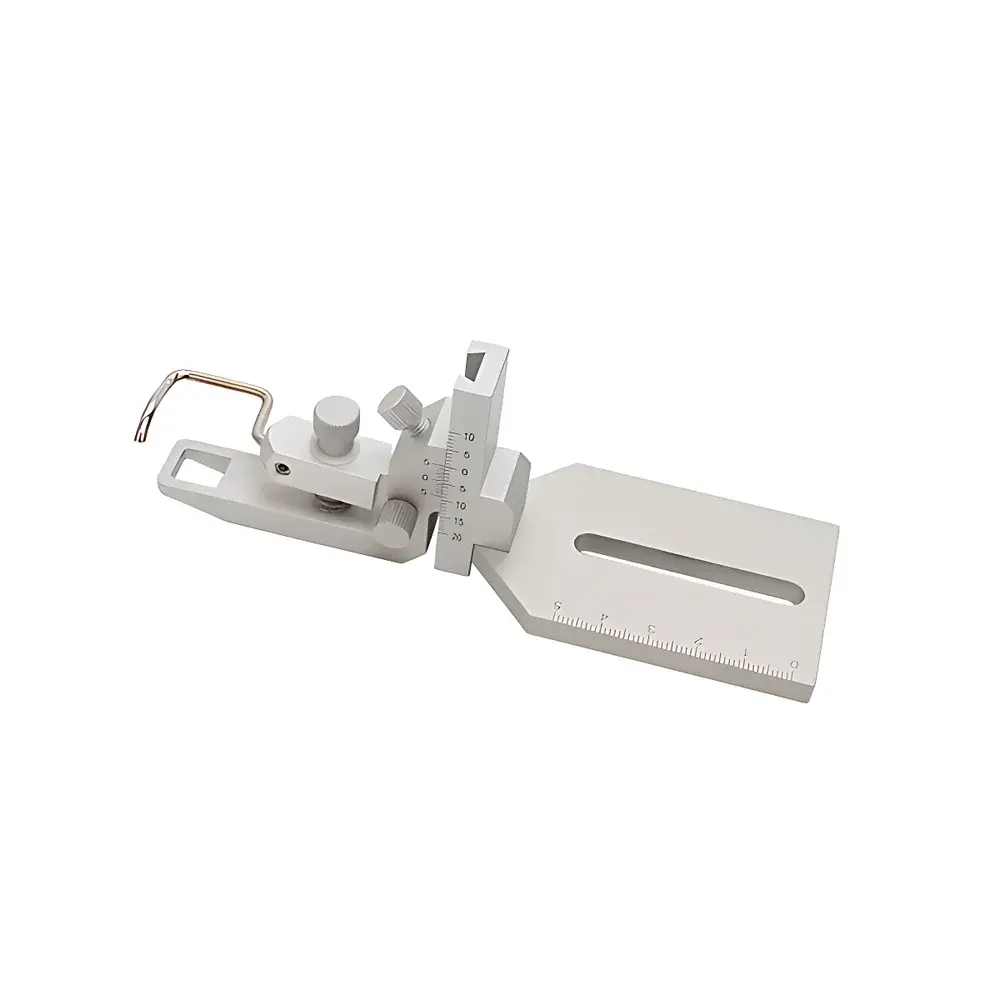
RWD 68021 Rat Stereotaxic Adapter for Brain Surgery
| Brand | RWD |
|---|---|
| Origin | Guangdong, China |
| Manufacturer Type | OEM/ODM Producer |
| Country of Origin | China |
| Model | 68021 |
| Pricing | Upon Request |
| Vertical Travel Range | 30 mm (±15 mm) with 100 µm Resolution |
| Horizontal (Anterior–Posterior) Travel Range | 43.5 mm |
| Fixation Method | Dual Ear Bars + Nasal Clamp + Incisor Bar |
| Compatibility | Standard RWD and Third-Party Stereotaxic Frames (e.g., David Kopf, Stoelting) |
Overview
The RWD 68021 Rat Stereotaxic Adapter is a precision-engineered mechanical interface designed for stable, reproducible head fixation of rats during neurosurgical, electrophysiological, and optogenetic procedures. It operates on the principle of three-point cranial immobilization—utilizing dual adjustable ear bars, a calibrated nasal clamp, and an incisor bar—to minimize cranial motion while preserving natural skull geometry and intracranial pressure dynamics. This adapter is fully compatible with standard stereotaxic frames conforming to ISO 9001-certified manufacturing tolerances (e.g., RWD 68000-series, David Kopf Model 963, and Stoelting 51600), enabling seamless integration into established neuroscience workflows. Its modular design supports interchangeability with complementary RWD accessories—including anesthesia-compatible variants (68053, 68078), rotational adapters (68063), MRI-safe configurations (68011), and auditory-preserving fixtures (68022)—without requiring frame recalibration.
Key Features
- Three-axis mechanical adjustability: 30 mm vertical travel (±15 mm nominal range) with micrometer-driven fine positioning (100 µm resolution) ensures precise dorsoventral alignment relative to bregma or lambda landmarks.
- 43.5 mm anterior–posterior (AP) linear adjustment enables accurate targeting across diverse rat strains (200–500 g) and developmental stages (P21 to adult).
- Interchangeable ear bar tips (standard 18° conical taper) ensure consistent tympanic membrane engagement without slippage under prolonged fixation (≥4 h).
- CNC-machined aluminum alloy construction (6061-T6) provides high rigidity-to-weight ratio and long-term dimensional stability under repeated sterilization cycles (autoclave-compatible up to 134°C).
- Non-magnetic stainless steel fasteners and polymer-coated contact surfaces prevent galvanic corrosion and reduce tissue irritation during extended procedures.
Sample Compatibility & Compliance
The 68021 adapter accommodates Sprague-Dawley, Wistar, Long-Evans, and transgenic rat models within the 200–500 g weight range. Its fixation geometry conforms to widely adopted stereotaxic atlases (Paxinos & Watson, 7th ed.) and supports both craniotomy and thinned-skull preparation protocols. The device complies with ISO 13485:2016 requirements for medical device accessories used in preclinical research. While not a Class II medical device per FDA 21 CFR Part 860, it is validated for use in GLP-compliant toxicology studies and IACUC-approved surgical protocols. All materials meet USP Class VI biocompatibility standards for short-term implant-contact applications.
Software & Data Management
As a hardware-only mechanical adapter, the 68021 does not incorporate embedded electronics or firmware. However, its positional repeatability (±5 µm inter-session variance, n = 25 trials) ensures full compatibility with digital stereotaxic navigation systems (e.g., Neurostar Pro, StereoDrive v3.2) when used with calibrated frame-mounted optical encoders or motorized actuators. Positional metadata can be logged via third-party acquisition software (e.g., Spike2, MATLAB-based custom GUIs) using standardized coordinate mapping (bregma-referenced AP/ML/DV). Audit trails for calibration verification are maintained per institutional GLP documentation requirements.
Applications
- Intracerebral cannula or electrode implantation for chronic electrophysiology (LFP, single-unit recording)
- Targeted viral vector delivery (AAV, lentivirus) into hippocampal, cortical, or subcortical regions
- Focal photothrombotic stroke modeling with precise laser beam collimation
- Two-photon imaging through cranial windows with minimized motion artifact
- Combined fMRI–electrophysiology experiments when paired with MRI-compatible variants (68011)
- Auditory-evoked potential (AEP) studies using the hearing-unobstructed 68022 configuration
FAQ
Is the 68021 compatible with non-RWD stereotaxic frames?
Yes—it features standardized 12.7 mm (½-inch) mounting holes and aligns with ANSI/ISO 8015 geometric tolerance conventions, allowing direct integration with David Kopf, Stoelting, and Leica Biosystems frames.
What sterilization methods are validated for this adapter?
Autoclaving at 134°C for 18 minutes (Bowie-Dick test verified), ethylene oxide gas (EtO), and 70% ethanol wipe-down are all validated. Plasma sterilization is not recommended due to polymer coating limitations.
Does the 68021 include ear bars and incisor bar?
Yes—each unit ships with a matched pair of adjustable ear bars, a spring-loaded nasal clamp, and a removable incisor bar with silicone-tipped contact surfaces.
Can I upgrade to anesthesia integration post-purchase?
No—the 68021 is a dedicated non-anesthetic adapter. For gas anesthesia delivery, select model 68053 (rotational) or 68078 (non-rotational), which include integrated 2 mm ID/OD gas ports and sealed face mask housings.
How is positional accuracy verified during installation?
RWD provides a traceable calibration certificate with each unit, referencing NIST-traceable gauge blocks and optical interferometry measurements performed at the Guangdong Provincial Metrology Institute (GPMI).
Related Products





