
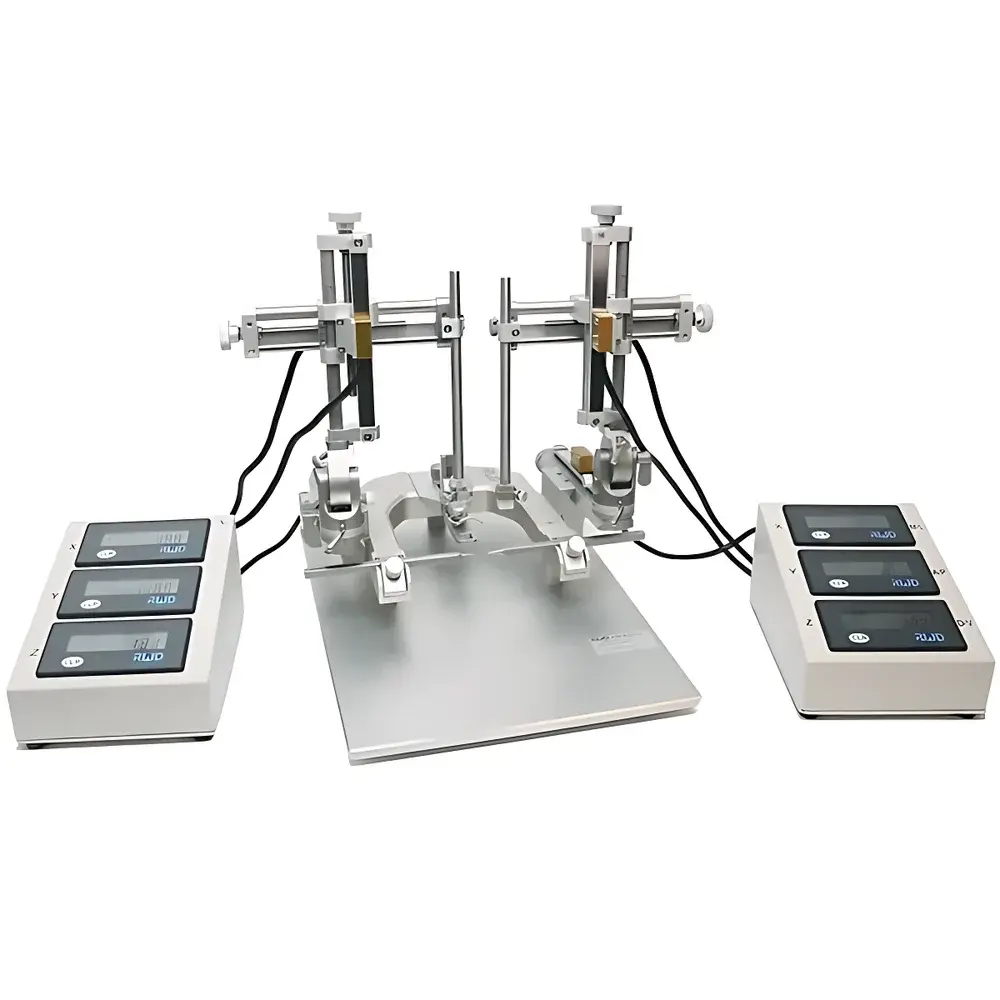
RWD 68025 Desktop Digital Stereotaxic Instrument
| Brand | RWD |
|---|---|
| Origin | Shenzhen, China |
| Manufacturer Type | Direct Manufacturer |
| Regional Classification | Domestic (China) |
| Model | 68025 |
| Pricing | Upon Request |
| X/Y/Z Axis Resolution | 10 µm |
| Display | LCD with Independent Battery Power (AA cells) |
| Arm Travel Range | ±80 mm in X, Y, and Z axes |
| Vertical Rotation | 0–180° with Locking Mechanism |
| Horizontal Rotation | 0–360° with Locking Mechanism |
| Base Dimensions | 400 mm × 255 mm |
| Sensor Source | European-sourced displacement sensors |
| Arm Drive Mechanism | Dual-lead screw design for smooth, backlash-free motion |
| Animal Adapter Compatibility | Rat, Mouse, Guinea Pig, Cat, Bird, Gecko |
| Ear Bar Angles Available | 18°, 45°, 55°, 60°, 77°, 78° |
| Bregma-Based Zeroing | Yes — arbitrary point zeroing on all three axes directly on display |
| Electro-Physiology Optimized | Battery-powered display eliminates AC-coupled noise |
Overview
The RWD 68025 Desktop Digital Stereotaxic Instrument is an engineered solution for precise intracranial targeting in rodent and small-animal neuroscientific research. Built upon the mechanical integrity of a classical stereotaxic frame, it integrates high-resolution digital metrology directly into the three-axis manipulator—enabling real-time, noise-immune positional feedback without reliance on mains power. Its measurement principle is based on contactless linear displacement sensing (via precision European-sourced potentiometric or optical encoders), coupled with a microcontroller-driven LCD interface that displays absolute and differential coordinates relative to user-defined reference points—including Bregma. This architecture supports rigorous experimental repeatability in electrophysiology, optogenetics, viral vector delivery, and microinjection protocols where sub-10 µm spatial fidelity and electromagnetic compatibility are essential.
Key Features
- Dual-lead screw drive system across all three axes ensures minimal hysteresis, smooth translation, and long-term mechanical stability—even after repeated thermal cycling between room temperature and controlled environmental chambers.
- Independent battery-powered LCD module (AA cell operation) eliminates conductive and radiative electromagnetic interference, making the instrument suitable for in vivo patch-clamp, extracellular recording, and LFP/EEG experiments requiring ultra-low-noise signal integrity.
- Full-range articulation: vertical rotation up to 180° and horizontal rotation up to 360°, each with independent mechanical locking mechanisms to maintain orientation under load during chronic cannula implantation or electrode insertion.
- Open U-shaped base (400 mm × 255 mm) accommodates multi-animal setups, auxiliary equipment integration (e.g., microinjection pumps, stereomicroscopes, cranial drill systems), and custom-stage mounting configurations.
- Modular animal adapter system with anatomically contoured head holders and pressure-plate ear bar fixation ensures consistent skull alignment across strain- and age-dependent morphologies—from neonatal mice to adult cats.
- Laser-etched scale markings combined with ergonomic rotary knob spacing (28 mm clearance between knob and U-frame) reduce operator fatigue during extended procedural sessions.
- Corrosion-resistant, non-porous surface finish enables rapid decontamination using ethanol, hydrogen peroxide vapor, or enzymatic cleaners—critical for GLP-compliant behavioral core facilities and shared-use vivarium environments.
Sample Compatibility & Compliance
The RWD 68025 supports standardized stereotaxic atlases including Paxinos & Watson (rat/mouse), Franklin & Paxinos (mouse), and Swanson (cat). Adapters are validated for skull flatness alignment per ASTM F2947-13 (Standard Practice for Stereotaxic Frame Calibration and Verification). The instrument’s mechanical repeatability (≤ ±5 µm over 1000 cycles) and thermal drift performance (< 0.5 µm/°C from 15–30°C) comply with ISO 13485-aligned manufacturing controls. While not FDA-cleared as a medical device, its design conforms to IEC 61000-4-2/3/6 immunity standards for laboratory-grade electrostatic discharge, radiated RF, and conducted immunity—ensuring stable operation near MRI suites, electrophysiology rigs, and laser ablation platforms.
Software & Data Management
The 68025 operates as a standalone hardware platform with no embedded firmware dependencies or proprietary software drivers. Coordinate data is displayed exclusively on the integrated LCD; no USB, Bluetooth, or network connectivity is present—by design—to preserve signal integrity and simplify validation. For labs requiring digital audit trails, optional third-party integration is supported via analog voltage output (0–5 V) from the sensor module (available with upgrade kit 68023), compatible with LabVIEW, MATLAB Data Acquisition Toolbox, or Python-based acquisition frameworks compliant with NIH-supported NIDDK/NIMH data standards. All calibration records, maintenance logs, and usage documentation adhere to ALF (Animal Laboratory Facility) SOP templates aligned with AAALAC International accreditation requirements.
Applications
- Precise intracerebral injection of AAV vectors, CRISPR-Cas9 components, or pharmacological agents in transgenic mouse models of neurodegeneration.
- Chronic implantation of tetrodes, silicon probes, or optrodes for longitudinal neural circuit mapping in freely behaving rats.
- Stereotactic lesioning or electrolytic ablation targeting subnuclei of the thalamus, hypothalamus, or brainstem in comparative neuroanatomy studies.
- Co-registration of histological endpoints with preoperative coordinate logging—facilitating post-hoc verification of injection spread or electrode track localization.
- Training platform for graduate neuroscience curricula, emphasizing reproducible atlas-based targeting and error minimization in coordinate transformation workflows.
FAQ
Is the digital display calibrated traceable to NIST or other national metrology institutes?
No factory calibration certificate is supplied with standard units; however, the displacement sensor module (68023) supports third-party calibration using ISO/IEC 17025-accredited service providers. Users may perform in-house verification using certified gauge blocks and optical interferometry per ISO 230-2 Annex B.
Can the instrument be used inside a Faraday cage or shielded electrophysiology rig?
Yes—the absence of internal switching power supplies, wireless modules, or ground-referenced logic circuits makes the 68025 fully compatible with RF-shielded environments. Battery-only display operation prevents ground-loop formation.
What is the recommended recalibration interval for long-term use?
Under typical academic core facility usage (≤ 20 hrs/week), mechanical zero-point verification against Bregma landmarks is advised before each experimental cohort; full sensor linearity check every 12 months or after 5,000 actuation cycles.
Are replacement ear bars and adapters available separately?
Yes—RWD offers 15+ adapter SKUs (e.g., 68045, 68055, 68077) covering species-, age-, and angle-specific configurations. All adapters feature interchangeable stainless-steel ear bars with M3 threading and passivated surfaces per ASTM A967.
Does the instrument meet vibration isolation requirements for two-photon microscopy integration?
The rigid aluminum-magnesium alloy frame (EN AW-5083) provides inherent damping; however, active or passive vibration isolation tables (e.g., Newport RS-2000 series) are recommended when coupling with high-magnification imaging systems operating below 1 Hz resonance thresholds.



