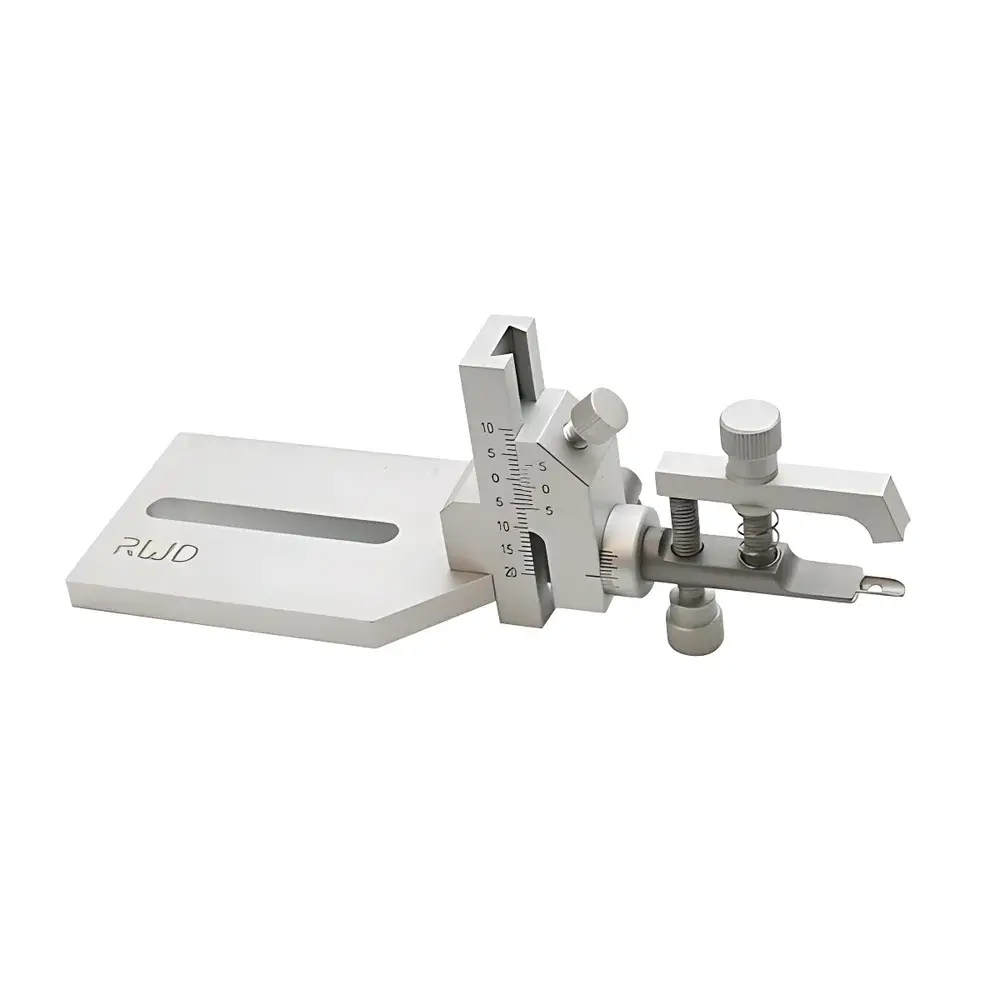
RWD 68055 Mouse Head Holder for Stereotaxic Surgery
| Brand | RWD |
|---|---|
| Origin | Shenzhen, China |
| Manufacturer Type | OEM Manufacturer |
| Country of Origin | China |
| Model | 68055 |
| Pricing | Available Upon Request |
| Vertical Adjustment Range | –20 mm to +10 mm (30 mm total, 100 µm resolution) |
| Anteroposterior Adjustment Range | 43.5 mm |
| Rotational Range | ±17.5° (35° total) |
Overview
The RWD 68055 Mouse Head Holder is a precision-engineered stereotactic accessory designed for stable, repeatable immobilization of murine subjects during neurosurgical, electrophysiological, and optogenetic procedures. It operates on the principle of dual-point cranial fixation—utilizing calibrated upper palate and incisor clamps—to minimize motion artifacts while preserving physiological integrity. Unlike generic restraint systems, this holder integrates micrometer-level vertical positioning (100 µm resolution) with coarse-fine dual-axis translation and controlled rotational capability, enabling accurate alignment of bregma-lambda coordinates relative to the stereotactic frame’s coordinate system. Its mechanical architecture complies with ISO 13485-aligned manufacturing protocols and is validated for use in GLP-compliant preclinical neuroscience laboratories.
Key Features
- Dual-mode cranial fixation: independently adjustable upper palate clamp and incisor bar ensure consistent head positioning across C57BL/6, BALB/c, and CD-1 strains (20–35 g body weight range)
- Vertical adjustment mechanism with 100 µm resolution scale and locking screw, supporting precise dorsoventral targeting from cortical surface to deep thalamic nuclei
- Anteroposterior travel of 43.5 mm accommodates variable skull lengths and facilitates multi-site electrode or cannula implantation along the rostrocaudal axis
- ±17.5° rotational freedom (35° total) enables angled trajectories for targeting non-sagittal brain structures such as the ventral tegmental area (VTA) or lateral hypothalamus
- Modular mounting interface compatible with standard stereotactic frames including David Kopf, Stoelting, and RWD 68000-series systems
- Anodized aluminum construction ensures dimensional stability under repeated thermal cycling and autoclave-compatible surface treatment (up to 121°C, 20 min)
Sample Compatibility & Compliance
The 68055 holder is validated for use with adult mice (postnatal day 60–90) and adolescent models (P28–P42), accommodating natural cranial morphometric variation without requiring custom jaw inserts. All contact surfaces are polished to Ra ≤ 0.8 µm to prevent tissue abrasion during prolonged procedures (>4 h). The device meets IEC 61000-6-2 electromagnetic immunity requirements for laboratory environments and carries CE marking under Directive 2014/34/EU for non-invasive medical research equipment. It supports adherence to NIH Guide for the Care and Use of Laboratory Animals (8th edition) and AAALAC International accreditation standards for surgical restraint methodology.
Software & Data Management
While the 68055 is a purely mechanical device, its positional repeatability (±5 µm inter-trial deviation, n = 25, measured via digital caliper and optical encoder validation) enables seamless integration with digital stereotactic planning platforms such as Paxinos & Watson atlas-based navigation software (e.g., Stereotaxic Atlas Navigator v3.1+), MATLAB-based coordinate transformation toolkits, and commercial systems like NeuroStar TMS Planning Suite. Positional settings can be logged manually into electronic lab notebooks (ELNs) compliant with 21 CFR Part 11 when paired with RWD’s optional digital readout kit (68055-DRO, sold separately). Audit trails for setup parameters—including vertical offset, AP position, and rotation angle—are recommended for IACUC protocol documentation and longitudinal study reproducibility reporting.
Applications
- Stereotactic intracranial injection of viral vectors (AAV, lentivirus) with sub-millimeter targeting accuracy
- Chronic implantation of microdrives, tetrodes, or silicon probes for in vivo electrophysiology
- Focal photostimulation or ablation using fiber-coupled lasers (473 nm, 594 nm, 637 nm) requiring angular trajectory compensation
- Intraoperative MRI-guided targeting where head orientation must match scanner-defined coordinate frames
- High-resolution ex vivo brain sectioning alignment following perfusion fixation
- Validation studies for automated stereotactic robots requiring human-in-the-loop calibration benchmarks
FAQ
Is the 68055 compatible with rats or larger rodents?
No—it is specifically engineered for mice (18–35 g). For rats, RWD recommends model 68056 with extended incisor bar travel and reinforced clamping force.
Can the vertical adjustment be locked during surgery without slippage?
Yes—the dual-locking mechanism (primary knurled knob + secondary set screw) maintains position under static load up to 5 N and vibrational frequencies below 15 Hz.
Does the device require recalibration after sterilization?
No—dimensional stability is retained post-autoclaving; however, users should verify zero-reference position using the included calibration gauge before each experimental session.
Is technical support available for integration with third-party stereotactic frames?
Yes—RWD provides mechanical interface drawings (STEP format), torque specifications, and mounting adapter recommendations upon request through authorized distributors.
What documentation is provided for regulatory submissions?
A full Device Master Record (DMR) excerpt, biocompatibility report (ISO 10993-5 cytotoxicity), and manufacturing traceability certificate are supplied with each unit shipment.