
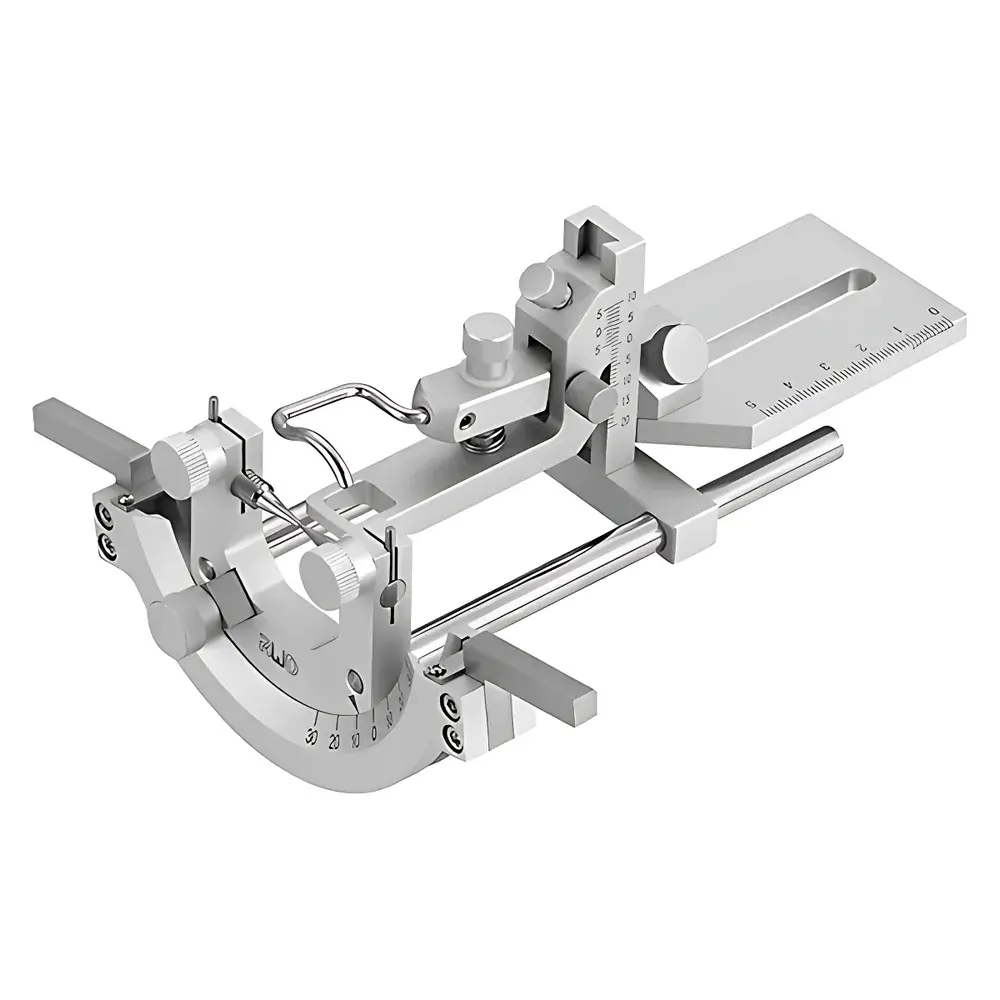
RWD 68063 Custom Rat Rotational Head Holder
| Brand | RWD |
|---|---|
| Origin | Shenzhen, China |
| Manufacturer Type | OEM Manufacturer |
| Country of Origin | China |
| Model | 68063 |
| Pricing | Upon Request |
| Vertical Adjustment Range | 30 mm |
| Vertical Adjustment Resolution | 100 µm |
| Horizontal (Anterior–Posterior) Adjustment Range | 43.5 mm |
| Head Rotation Angle | ±30° (Total 60°) |
| Ear Bar Tip Angle | 18° |
Overview
The RWD 68063 Custom Rat Rotational Head Holder is a precision-engineered stereotactic accessory designed for in vivo neuroscientific and preclinical surgical applications requiring controlled, repeatable, and stable positioning of rat heads under experimental conditions. Built upon the mechanical principles of three-axis micromanipulation—vertical (Z), horizontal (anterior–posterior, X), and rotational (yaw)—this device enables accurate reorientation of the animal’s cranium without compromising stereotactic integrity. It integrates seamlessly with standard rodent stereotactic frames (e.g., David Kopf, Stoelting, or RWD-compatible base plates) and is specifically optimized for longitudinal electrophysiology, optogenetic targeting, cranial window implantation, and bilateral intracranial injections where angular access to dorsal, lateral, or ventral skull surfaces is essential. Its rigid aluminum alloy construction ensures minimal thermal drift and mechanical hysteresis during extended procedures.
Key Features
- Precision micrometer-driven vertical adjustment with 30 mm travel range and 100 µm resolution, enabling fine-tuned elevation control for multi-layer cortical targeting.
- Anterior–posterior translation stage offering 43.5 mm linear travel, calibrated for compatibility with bregma–lambda coordinate referencing systems.
- Centered yaw rotation mechanism allowing ±30° (60° total) controlled head rotation about the interaural axis—critical for accessing non-sagittal brain regions while maintaining consistent ear bar insertion depth.
- 18° tapered ear bar tips engineered to minimize tissue compression and ensure reproducible fixation across repeated sessions in longitudinal studies.
- Modular mounting interface compatible with standard 1/4″-20 and M6 threaded base plates; includes alignment reference marks for rapid setup verification.
- Non-magnetic, autoclavable components (stainless steel ear bars, anodized aluminum housing) supporting MRI-compatible and sterile surgical workflows.
Sample Compatibility & Compliance
The 68063 adapter is validated for use with adult Sprague-Dawley and Wistar rats (250–500 g). Its adjustable geometry accommodates natural anatomical variation in skull width and interaural distance. All materials comply with ISO 10993-5 (cytotoxicity) and ISO 10993-10 (irritation/sensitization) standards for biomedical devices. The design adheres to GLP-aligned documentation practices, including traceable serial-number engraving and material certification documentation available upon request. While not a medical device per FDA 21 CFR Part 820, it meets engineering requirements referenced in NIH Guide for the Care and Use of Laboratory Animals and supports compliance with AAALAC International accreditation criteria for equipment validation.
Software & Data Management
This is a manually operated mechanical device with no embedded electronics or firmware. As such, it requires no software installation, driver configuration, or data logging integration. However, its dimensional repeatability and coordinate stability make it fully compatible with third-party stereotactic planning platforms—including NeuroNexus Stereotaxic Planner, MATLAB-based coordinate transformation toolkits, and open-source Python libraries (e.g., ratbrainatlas)—when used in conjunction with digital calipers or optical tracking systems. Full dimensional drawings (STEP/IGES), tolerance specifications, and assembly instructions are provided in English as part of the delivery package for institutional QA/QC archiving.
Applications
- Bilateral craniotomy and dual-hemisphere electrode array implantation requiring sequential access to left/right parietal cortices.
- Skull-anchored optrode or fiber photometry probe placement at oblique angles to avoid venous sinuses.
- Multi-angle two-photon imaging through thinned-skull or glass window preparations.
- Microinjection into laterally offset targets (e.g., basolateral amygdala, substantia nigra pars reticulata) without repositioning the entire stereotactic frame.
- Chronic recording setup where post-operative head angle adjustments are needed for cable management or behavioral apparatus alignment.
FAQ
Is the 68063 compatible with non-RWD stereotactic frames?
Yes—the base plate interface uses industry-standard 1/4″-20 and M6 threaded mounting patterns, ensuring interoperability with Kopf, Stoelting, and other major brands.
Can the ear bars be sterilized between uses?
Yes—stainless steel ear bars and aluminum housing withstand repeated autoclaving (121°C, 20 min, saturated steam) without dimensional or surface integrity loss.
What is the maximum recommended rat weight for safe use?
The adapter is mechanically rated for rats up to 500 g; users exceeding this mass should verify fixation stability using torque-limited ear bar tightening protocols.
Does RWD provide installation support or on-site training?
Technical documentation and video-guided setup tutorials are included; on-site application specialist visits are available globally under RWD’s preclinical support agreement.
Are custom modifications (e.g., extended travel, alternate tip angles) available?
Yes—RWD offers OEM engineering services for research institutions requiring application-specific adaptations, subject to minimum order quantities and lead-time confirmation.





