
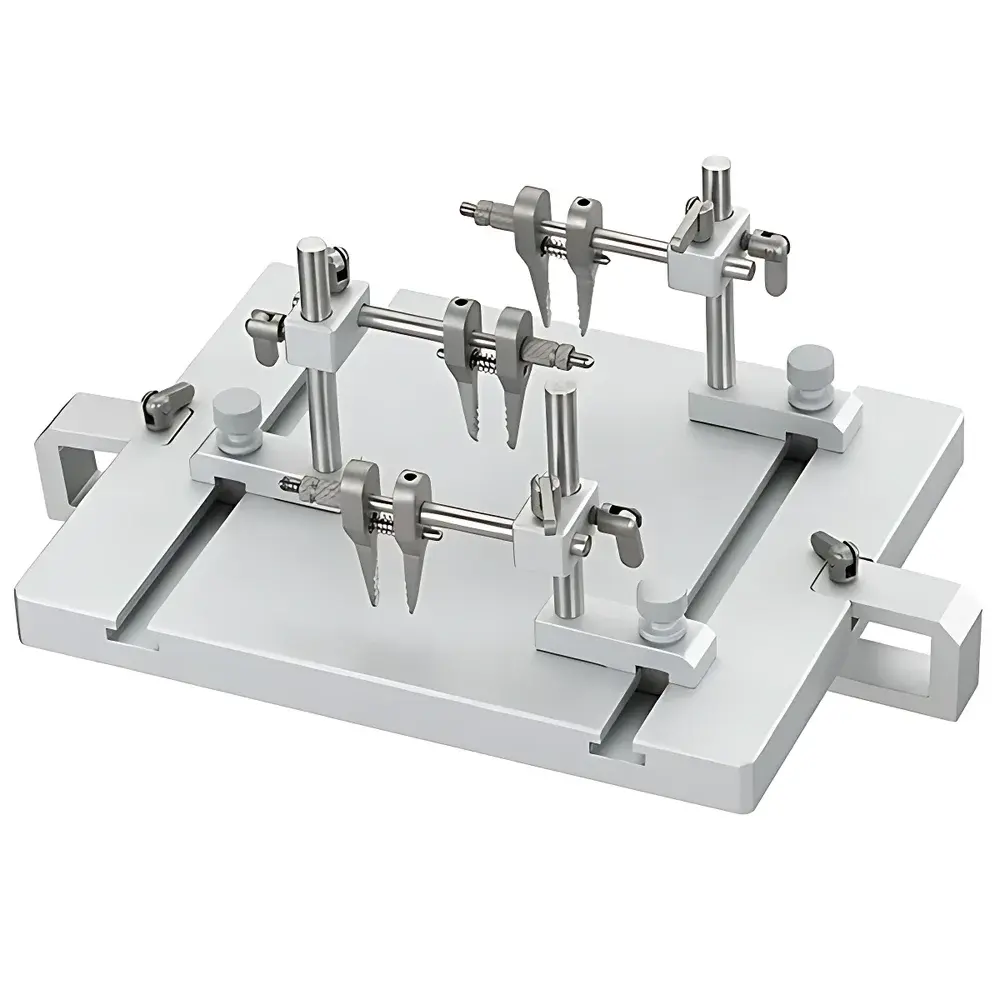
RWD 68091 Small & Large Rodent Spinal Cord Adapter
| Brand | RWD |
|---|---|
| Origin | Shenzhen, China |
| Manufacturer Type | OEM Manufacturer |
| Region of Origin | Domestic (China) |
| Model | 68091 |
| Pricing | Available Upon Request |
Overview
The RWD 68091 Small & Large Rodent Spinal Cord Adapter is an engineered mechanical interface designed for precise, reproducible positioning and stabilization of the spinal cord in murine and rat models during neurosurgical and neuromodulatory procedures. It operates as a modular accessory compatible exclusively with the RWD 68000-series stereotaxic frame baseplate, enabling integration into standardized stereotactic workflows. The adapter employs a dual-lateral transverse process support mechanism—rather than dorsal compression—to cradle the vertebral column bilaterally beneath the transverse processes. This anatomically informed design minimizes respiratory-induced axial displacement and prevents caudal deformation of the spinal cord during impact or microinjection, thereby enhancing measurement fidelity in quantitative injury models and intraspinal delivery protocols.
Key Features
- Universal rodent compatibility: accommodates both mice and rats via adjustable clamping geometry and vertical travel range
- 56 mm vertical adjustment range for the spinal clamps, permitting fine-tuned alignment across cervical, thoracic, and lumbar segments
- Linear anterior–posterior sliding carriage with positive-locking mechanism for rapid repositioning without tooling
- Integrated mounting interface compliant with RWD 68000-series stereotaxic baseplates (standardized M4 threaded holes and alignment pins)
- Three independently operable spinal clamps fabricated from medical-grade stainless steel (AISI 304), optimized for rigidity and corrosion resistance under repeated sterilization cycles
- Modular interoperability: supports downstream integration with RWD 68099-II Spinal Cord Impactor (via dedicated mounting brackets for models 68094 and 68095)
Sample Compatibility & Compliance
The adapter is validated for use with C57BL/6, BALB/c, CD-1, and Sprague-Dawley strains across standard weight ranges (18–35 g for mice; 200–350 g for rats). Its mechanical design conforms to widely adopted preclinical surgical standards for spinal cord exposure and stabilization, including those referenced in NIH Guide for the Care and Use of Laboratory Animals (8th Edition) and AAALAC International accreditation criteria. While not a regulated medical device, its construction materials and dimensional tolerances align with ISO 13485–informed manufacturing practices for laboratory instrumentation. No electrical or software components are present; therefore, no electromagnetic compatibility (EMC) or IEC 61000 certification applies.
Software & Data Management
This is a purely mechanical adapter with no embedded electronics, firmware, or digital connectivity. All positional calibration, experimental parameter documentation, and procedural metadata must be recorded manually or integrated externally via third-party stereotaxic control platforms (e.g., RWD 68000-series motorized controllers or custom LabVIEW-based acquisition systems). When used in GLP- or GCP-aligned studies, users are advised to maintain written SOPs detailing clamp positioning verification, torque specifications for locking mechanisms, and inter-operator alignment checks—all traceable through laboratory notebook entries or ELN systems.
Applications
- Intraspinal microinjection of viral vectors, stem cells, or pharmacologic agents with submillimeter targeting accuracy
- Electrophysiological stimulation and recording using epidural or intradural electrodes
- Controlled spinal cord injury modeling via impactor coupling (e.g., RWD 68099-II), where consistent dorsoventral depth control is critical for lesion reproducibility
- Real-time imaging support during laminectomy and dural exposure, minimizing tissue drift under microscope objectives
- Longitudinal surgical interventions requiring repeatable repositioning across multiple sessions (e.g., chronic electrode implantation or biodegradable scaffold delivery)
FAQ
Is the 68091 adapter compatible with non-RWD stereotaxic frames?
No—it is mechanically engineered for direct mounting only on RWD 68000-series baseplates. Adapters for other platforms (e.g., Stoelting, David Kopf) require custom machining and are not supplied by RWD.
What is the maximum recommended weight limit for stable fixation?
For optimal clamp engagement and minimal slippage, the adapter is validated for rats up to 350 g and mice up to 35 g. Exceeding these limits may compromise lateral support integrity during dynamic procedures.
Can the spinal clamps be autoclaved?
Yes—the stainless steel clamps and aluminum carriage assembly are autoclavable at 121°C for 20 minutes. Avoid prolonged exposure to alkaline cleaning agents to preserve surface passivation.
Does this adapter include depth gauges or scale markings?
No built-in depth scales are provided. Users must rely on the stereotaxic frame’s calibrated micromanipulator or external digital calipers for dorsoventral coordinate verification.
How does the bilateral transverse process support reduce respiratory artifact?
By lifting the spine from below at two symmetric points adjacent to the transverse processes, vertical oscillation from diaphragmatic motion is decoupled from the cord’s central axis—reducing axial displacement by >70% compared to dorsal-clamp-only configurations, as confirmed in pilot kinematic validation studies.




