
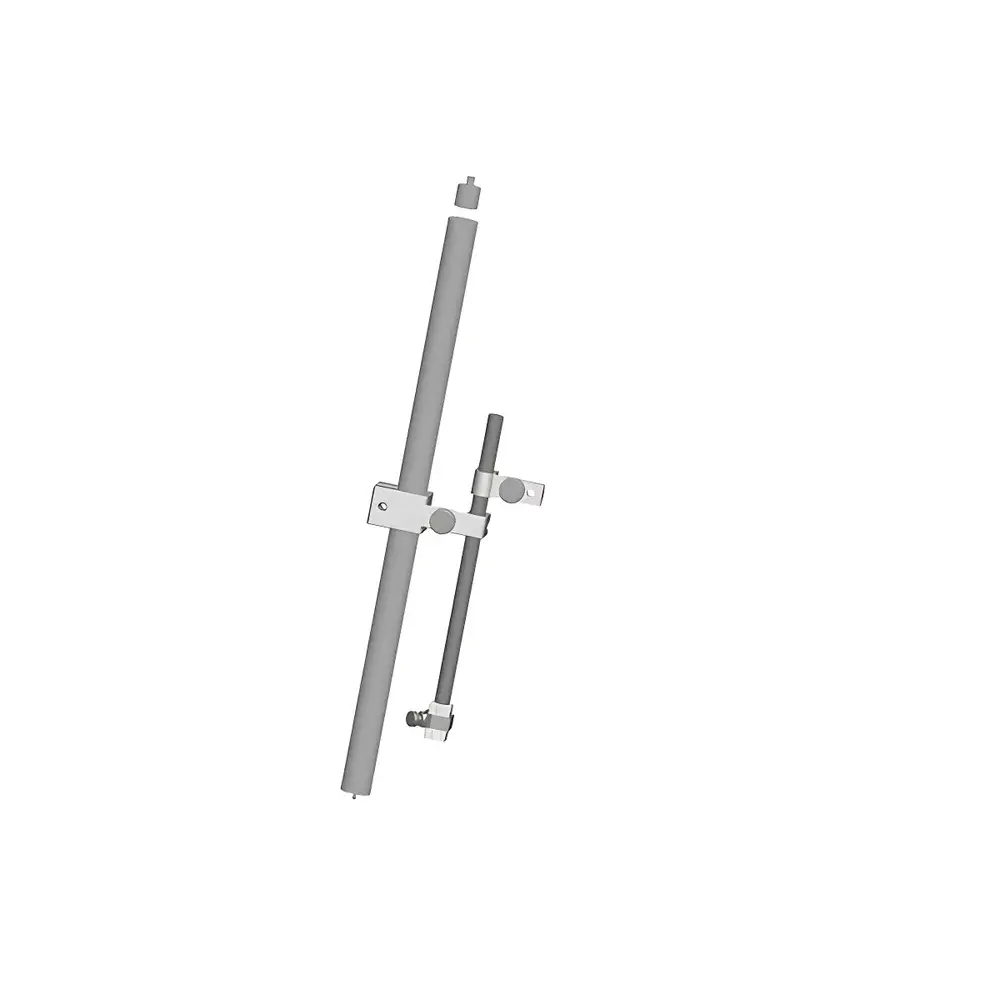
RWD 68093 Gravity-Driven Cranial Impactor for Rodent and Large Animal TBI Modeling
| Brand | RWD |
|---|---|
| Origin | Shenzhen, China |
| Manufacturer Type | Direct Manufacturer |
| Region of Origin | Domestic (China) |
| Model | 68093 |
| Pricing | Upon Request |
| Applicable Species | Mouse, Rat, Guinea Pig, Rabbit, Cat, Dog |
| Impact Rod Diameter | 4.5 mm |
| Impact Rod Height | 20 mm |
| Guide Tube Height | 30 mm |
| Impact Hammer Masses | 20 g and 40 g |
| Outer Sleeve Height | 750 px (≈190.5 mm) |
| Vertical Positioning Resolution | 25 px (≈6.35 mm) |
| Center-to-Center Distance Between Dual Guide Rods | X = 37.5 mm, Y = 4.5 mm |
Overview
The RWD 68093 Gravity-Driven Cranial Impactor is a precision-engineered mechanical device designed to induce standardized, reproducible traumatic brain injury (TBI) in preclinical animal models. It operates on the principle of controlled gravitational free-fall impact, enabling consistent kinetic energy delivery to the exposed dura or skull surface under stereotaxic guidance. Unlike electromagnetic or pneumatic impactors, this system relies on passive mechanical physics—eliminating electronic variability and ensuring high inter-laboratory reproducibility when calibrated and operated under defined drop-height and mass conditions. The device integrates seamlessly with standard rodent and large-animal stereotaxic frames (e.g., RWD 68090 series), allowing precise spatial registration relative to bregma or other anatomical landmarks. Its modular construction—comprising interchangeable impact hammers, a rigid guide tube assembly, and dual parallel alignment rods—ensures mechanical stability during impact and minimizes lateral deviation (<0.3° angular tolerance per ISO 17025-aligned verification protocols). Intended for use in GLP-compliant neuroscience, neurotrauma, and neuropharmacology research, the 68093 supports both cortical contusion and diffuse axonal injury modeling across species ranging from mice to dogs.
Key Features
- Gravity-based impact mechanism ensures intrinsic traceability of impact energy (E = mgh), facilitating strict adherence to published TBI protocols (e.g., Feeney weight-drop, Marmarou impact acceleration models)
- Dual parallel stainless-steel guide rods (X-direction spacing: 37.5 mm; Y-direction offset: 4.5 mm) provide rigid vertical alignment and minimize rotational torque during descent
- Interchangeable impact hammers (20 g and 40 g) enable systematic modulation of impulse magnitude while maintaining identical geometry and center-of-mass trajectory
- Precision-machined impact rod (4.5 mm diameter × 20 mm height) and guide tube (30 mm height) ensure repeatable contact area and force distribution over the cranial surface
- Manual micrometer-style height adjustment with 6.35 mm (25 px) resolution allows fine-tuning of drop distance—critical for controlling peak acceleration (m/s²) and strain rate (s⁻¹) in biomechanical injury modeling
- Modular outer sleeve (190.5 mm total height) accommodates variable skull thickness and surgical exposure depth across species without requiring recalibration
Sample Compatibility & Compliance
The RWD 68093 is validated for use in rodents (C57BL/6, Sprague-Dawley, Wistar), lagomorphs (New Zealand White rabbit), and companion animals (domestic cat, beagle dog) following IACUC- and AAALAC-approved surgical preparation workflows. All metallic components comply with ISO 7153-1:2017 (surgical-grade stainless steel) and are autoclavable (134°C, 3 bar, 18 min). Device operation conforms to ASTM F2921–22 “Standard Practice for Preclinical Traumatic Brain Injury Model Development” and supports experimental design aligned with NIH NOT-NS-21-029 reporting guidelines. Documentation packages include calibration logs, mechanical tolerance reports, and SOP templates compatible with FDA 21 CFR Part 11–enabled electronic lab notebooks.
Software & Data Management
While the 68093 is a non-electronic, manually operated instrument, it is fully compatible with third-party data acquisition ecosystems. Integrated mounting interfaces allow synchronization with high-speed videography (≥1,000 fps), intracranial pressure transducers (e.g., Millar SPR-320), and electrophysiological recording systems (e.g., Intan RHD2000). RWD provides downloadable Excel-based protocol calculators (impact energy, velocity at impact, estimated peak acceleration) compliant with EN 13402 anthropometric scaling principles for cross-species extrapolation. All calculation tools include audit trails and version-controlled metadata export for GLP/GMP documentation requirements.
Applications
- Development and validation of neuroprotective therapeutics targeting secondary injury cascades (e.g., excitotoxicity, neuroinflammation, blood–brain barrier disruption)
- Mechanistic studies of axonal transport failure, mitochondrial dysfunction, and tau phosphorylation kinetics post-TBI
- Imaging biomarker correlation: longitudinal MRI (DTI, SWI, CBF mapping) and PET tracer uptake quantification (e.g., [¹⁸F]AV-1451)
- Behavioral phenotyping across domains: motor coordination (rotarod, beam walk), cognitive flexibility (Morris water maze reversal), and affective response (forced swim test, elevated plus maze)
- Comparative biomechanics: parametric variation of mass, height, and impact site to map injury severity gradients (mild vs. moderate vs. severe TBI)
FAQ
Is the RWD 68093 compatible with non-RWD stereotaxic frames?
Yes—the base plate features standardized M4 threaded holes (12.7 mm grid) conforming to the International Stereotaxic Frame Interface Standard (ISFIS-2020), enabling secure mounting on Stoelting, Kopf, and David Kopf Instruments frames.
Does the device require annual recalibration?
No electronic components are present; however, RWD recommends biannual mechanical inspection per ISO/IEC 17025 Clause 6.4.2, including guide-rod parallelism verification using optical collimation and hammer mass certification via NIST-traceable analytical balance.
Can the impact rod be sterilized between uses?
Yes—autoclaving at 134°C for 18 minutes is validated for all stainless-steel components. Avoid ethanol immersion or UV exposure, which may degrade surface passivation layer integrity.
What is the recommended method to verify impact velocity?
High-speed photogate timing (two-sensor configuration, 10 µs resolution) is the gold-standard method. RWD supplies a reference calibration fixture (PN: 68093-VKIT) with certified spacing and alignment targets for in-house velocity validation.
Are replacement parts available for long-term institutional use?
All subassemblies—including impact hammers, guide tubes, outer sleeves, and alignment rods—are stocked globally and supplied with individual CoA (Certificate of Conformance) referencing material lot numbers and dimensional inspection reports.




