
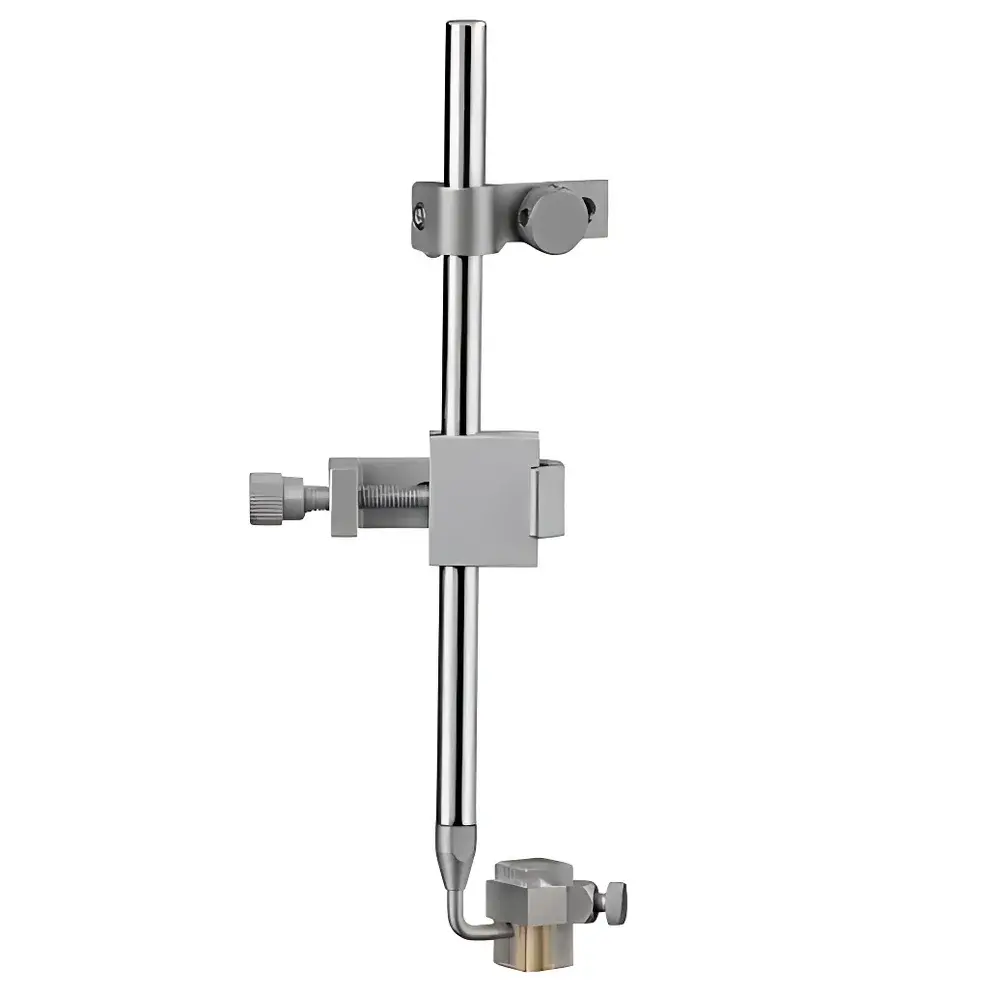
RWD 68218 Microsyringe Holder for Stereotaxic Instruments
| Brand | RWD |
|---|---|
| Origin | Shenzhen, China |
| Manufacturer | Yes |
| Region | Domestic (China) |
| Model | 68218 |
| Pricing | Upon Request |
Overview
The RWD 68218 Microsyringe Holder is a precision-engineered mechanical accessory designed for integration with stereotaxic frames used in preclinical neuroscience research. It operates on the principle of dual-point mechanical clamping—simultaneously securing both the syringe barrel and the needle hub—to eliminate axial slippage and radial wobble during intracranial microinjection procedures. Unlike single-axis clamps, this holder employs orthogonal V-groove geometry to maintain coaxial alignment between the syringe plunger axis and the stereotaxic manipulator’s vertical translation path. Its design conforms to standard 8 mm diameter vertical support rods (e.g., RWD 68207 V-joint adapter), enabling direct mounting onto RWD stereotaxic systems (e.g., 68000-series) or third-party frames with compatible rod interfaces. The device does not incorporate actuation or fluid control; it serves exclusively as a passive, static positioning interface optimized for reproducible, vibration-damped fixation under high-magnification surgical observation.
Key Features
- Dual-clamp architecture: Independent adjustment of barrel and needle clamping mechanisms ensures zero relative movement between syringe body and cannula during injection or withdrawal.
- V-groove engagement surface: Precision-machined 90° V-channel (6 mm–12 mm barrel range) provides uniform radial contact pressure across variable syringe diameters without deformation of glass or polypropylene barrels.
- Needle-hub collet system: Adjustable micro-collet (0.3 mm–1.5 mm ID) accommodates common stainless-steel injection needles (e.g., 33–26 gauge) while preserving tip integrity and minimizing torsional stress.
- Tool-free height locking: Integrated eccentric cam lever enables rapid vertical positioning and repeatable re-engagement at previously calibrated Z-coordinates.
- Material construction: Anodized aluminum alloy housing (6061-T6) with stainless-steel fasteners ensures dimensional stability under repeated thermal cycling and autoclave-compatible cleaning protocols (non-submerged).
Sample Compatibility & Compliance
The RWD 68218 is validated for use with standard Luer-lock and cemented-tip microsyringes (Hamilton, NanoFil, World Precision Instruments) ranging from 1 µL to 1000 µL capacity. It maintains mechanical compatibility with RWD stereotaxic manipulators (68000 series), Kopf models (900, 1900), and other 8 mm rod-based systems adhering to ISO 80300-2:2021 dimensional tolerances for neurosurgical instrument mounts. While not a medical device per FDA 21 CFR Part 820, its mechanical configuration supports GLP-compliant experimental workflows when used within validated animal surgery SOPs. No electrical or software components are present; therefore, no electromagnetic compatibility (EMC) or IEC 61000-4 certification applies.
Software & Data Management
This is a purely mechanical holding device with no embedded electronics, firmware, or digital interface. It generates no telemetry, requires no driver installation, and introduces no latency or calibration drift into injection timing protocols. When paired with RWD 68606 Manual Microinfusion Pump or motorized pump systems (e.g., KD Scientific LEGATO), positional repeatability is maintained independently of software control loops. Audit trails for syringe placement remain operator-documented in lab notebooks or ELN systems (e.g., LabArchives, Benchling) per institutional GLP/GCP requirements.
Applications
- Stereotaxic intracerebral microinjection of viral vectors (AAV, lentivirus), tracers (CTB, Fluoro-Gold), or pharmacological agents in rodent models (mice, rats).
- Chronic cannula-based delivery studies requiring long-term stability of injection coordinates across multiple sessions.
- Combined electrophysiology–injection paradigms where syringe alignment must remain invariant relative to implanted electrode arrays (e.g., Neuropixels, silicon probes).
- Validation of injection site accuracy using post-hoc histology (e.g., DAPI/Nissl staining) or in vivo MRI contrast tracking.
- Training platforms for stereotaxic surgery technique, emphasizing reproducible hand–eye coordination and depth control.
FAQ
Is the 68218 compatible with non-RWD stereotaxic frames?
Yes—provided the frame uses an 8 mm diameter vertical support rod and allows side-mounting via standard M4 or ¼”-20 threaded adapters.
Can it hold syringes with integrated pressure sensors or electronic feedback?
Mechanically yes, but users must verify that sensor housings do not interfere with the V-groove clearance or collet travel path; no electrical isolation or signal shielding is provided.
Does it support angled (non-vertical) injections?
No—the holder is designed for vertical-axis fixation only; angular delivery requires separate articulating arm attachments (e.g., RWD 68220).
What maintenance is required?
Wipe clean with 70% ethanol after each use; inspect V-groove for burrs annually using optical comparator; replace collet if needle grip consistency degrades beyond ±0.1 mm axial slip under 50 g load.





