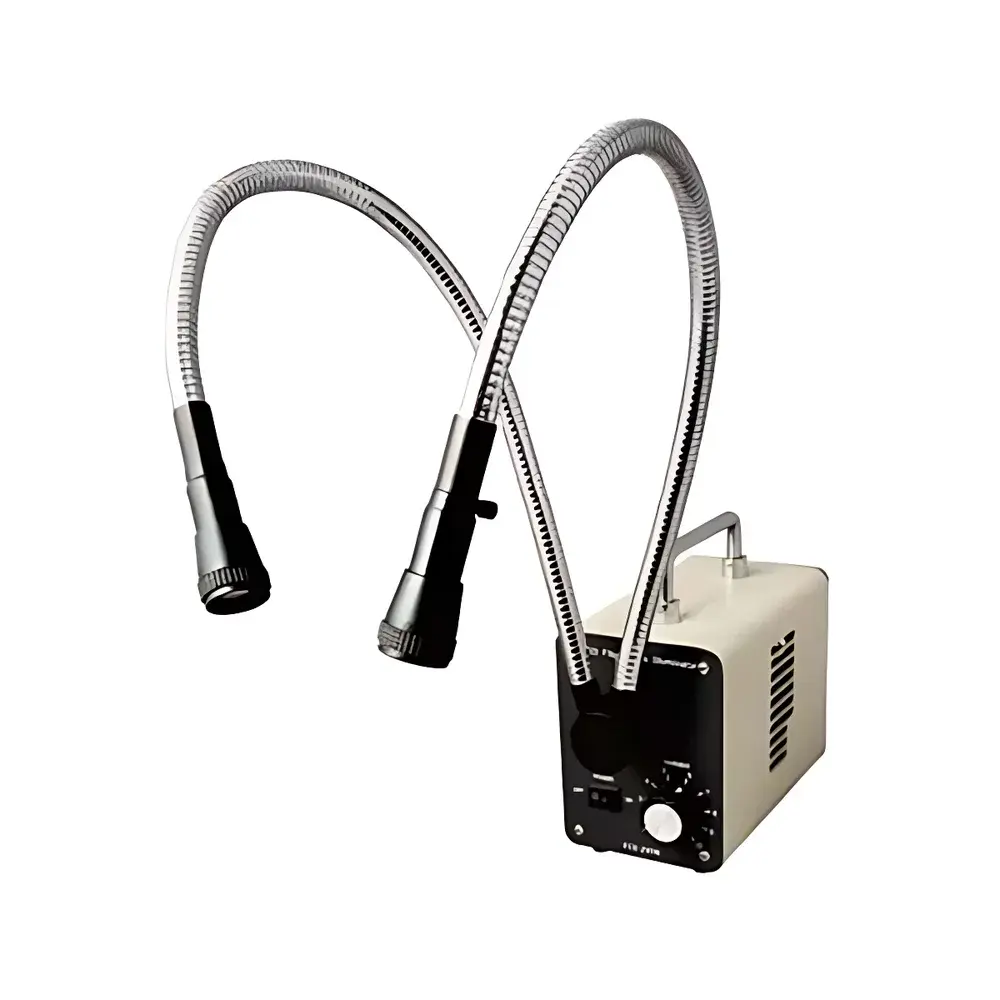
RWD 76301 Dual-Branch Fiber-Optic Cold Light Source
| Brand | RWD |
|---|---|
| Origin | Shenzhen, China |
| Manufacturer Type | OEM Manufacturer |
| Country of Origin | China |
| Model | 76301 |
| Power Input | AC 230 V / 50 Hz |
| Rated Power | 150 W |
| Lamp | 21 V / 150 W Halogen (Domestic or PHILIPS 21 V / 150 W) |
| Rated Lamp Life | ~200 h |
| Color Temperature | 3200 K (adjustable via interchangeable color temperature filters: 3000–6500 K) |
| Dimming | Continuous analog dimming |
| Cooling Method | Forced-air cooling |
| Weight | ~3.0 kg |
| Dimensions (L × W × H) | 280 × 100 × 165 mm |
| Output | Dual coaxial fiber-optic light guide interface (single-port, Y-branch configuration) |
| Compliance | GB/T 18268.1–2010 (IEC 61326-1:2012), YY/T 0664–2008 (Medical Electrical Equipment – Particular Requirements for Basic Safety and Essential Performance) |
Overview
The RWD 76301 Dual-Branch Fiber-Optic Cold Light Source is an engineered illumination system designed specifically for biomedical research applications requiring precise, low-thermal-load lighting. Unlike conventional incandescent or LED-based surgical lamps, this unit employs a high-efficiency halogen lamp coupled with optimized heat-filtering optics and dual-branch fiber-optic delivery to minimize radiant thermal energy at the target site—critical for in vivo procedures where tissue temperature must remain within physiological range (25–30 °C). Its core principle relies on spectral separation and infrared (IR) absorption within the fiber bundle and internal cold mirror system, ensuring that >90% of IR radiation is removed before light reaches the specimen. This enables stable, artifact-free visualization during microsurgery, intravital microscopy, and neurophysiological recording without inducing vasodilation or altering microcirculatory dynamics.
Key Features
- Dual coaxial fiber-optic output port supporting Y-branch bifurcated light guides—enabling simultaneous bilateral illumination or split-field targeting
- Stable DC-equivalent voltage regulation ensures consistent luminous flux across dimming range (0–100%), eliminating flicker and intensity drift during prolonged use
- Interchangeable color temperature filters (3000 K to 6500 K) allow spectral tuning to match histological contrast requirements or camera white-balance settings
- Forced-air active cooling maintains lamp junction temperature below 85 °C under continuous operation, extending halogen filament life and reducing thermal stress on optical components
- Compact vertical chassis (280 × 100 × 165 mm) integrates seamlessly into laminar flow hoods, stereomicroscope workstations, and animal surgery rigs without compromising bench space
- Compliance with GB/T 18268.1–2010 (equivalent to IEC 61326-1:2012) and YY/T 0664–2008 ensures electromagnetic compatibility and essential safety performance for laboratory-grade medical electrical equipment
Sample Compatibility & Compliance
The RWD 76301 is validated for use with standard 3.0 mm and 5.0 mm outer diameter fiber-optic light guides commonly employed in rodent stereotaxic surgery, zebrafish embryo imaging, and ex vivo organ perfusion setups. Its low-heat output prevents desiccation or thermal denaturation of delicate biological specimens—including brain slices, retinal explants, and vascular grafts—during extended observation periods. The device conforms to Chinese national standards for medical electrical equipment safety (YY/T 0664–2008) and EMC requirements (GB/T 18268.1–2010), making it suitable for GLP-compliant preclinical laboratories. While not FDA-cleared as a Class II medical device, its design adheres to foundational principles outlined in ISO 13485:2016 for quality management systems in medical device manufacturing.
Software & Data Management
As a standalone analog illumination source, the RWD 76301 does not incorporate digital control firmware or network connectivity. All operational parameters—including dimming level and filter selection—are managed manually via front-panel rotary potentiometer and mechanical filter slider. This architecture eliminates software validation overhead and ensures deterministic response time (<10 ms from dimmer adjustment to optical output change), critical for time-sensitive electrophysiology or optogenetic experiments where light onset latency must be minimized. No audit trail, user authentication, or electronic record-keeping functionality is provided; however, its passive design supports full traceability when integrated into SOP-driven workflows compliant with 21 CFR Part 11 Annex 11 expectations via external documentation protocols.
Applications
- Intracranial stereotaxic surgery in mice and rats, where consistent illumination without thermal perturbation is required for dural exposure and electrode placement
- High-magnification transillumination of transparent model organisms (e.g., zebrafish larvae, C. elegans) during behavioral phenotyping
- Support illumination for upright and inverted fluorescence microscopes equipped with fiber-coupled epi-illumination ports
- Microvascular imaging using orthogonal polarization contrast, where unaltered blood hue preservation enables accurate oxyhemoglobin saturation estimation
- Teaching laboratories performing live-tissue dissection demonstrations under stereo-microscopic guidance
FAQ
What lamp types are compatible with the RWD 76301?
The unit accepts both domestically manufactured 21 V / 150 W halogen lamps and PHILIPS-branded 21 V / 150 W halogen lamps (e.g., PHILIPS 7727 or equivalent). Substitution requires mechanical alignment verification and output calibration.
Can the color temperature be adjusted during operation?
Yes—interchangeable dichroic color temperature filters (3000 K, 4500 K, 5500 K, 6500 K) can be inserted manually into the optical path without powering down the unit.
Is the device suitable for GMP-regulated environments?
While not certified for GMP manufacturing, its robust mechanical construction, absence of embedded software, and compliance with YY/T 0664–2008 support use in GLP-aligned preclinical research facilities conducting nonclinical laboratory studies.
What is the expected service life of the included fiber-optic light guide?
With proper handling and avoidance of sharp bending radii (95% transmission efficiency for ≥12 months under daily 4-hour usage.
Does the RWD 76301 support remote dimming via external TTL or analog voltage input?
No—dimming is exclusively local, via the front-panel potentiometer. Integration with automated stages or stimulus controllers requires external relay-based switching or third-party analog-to-potentiometer interface modules.