
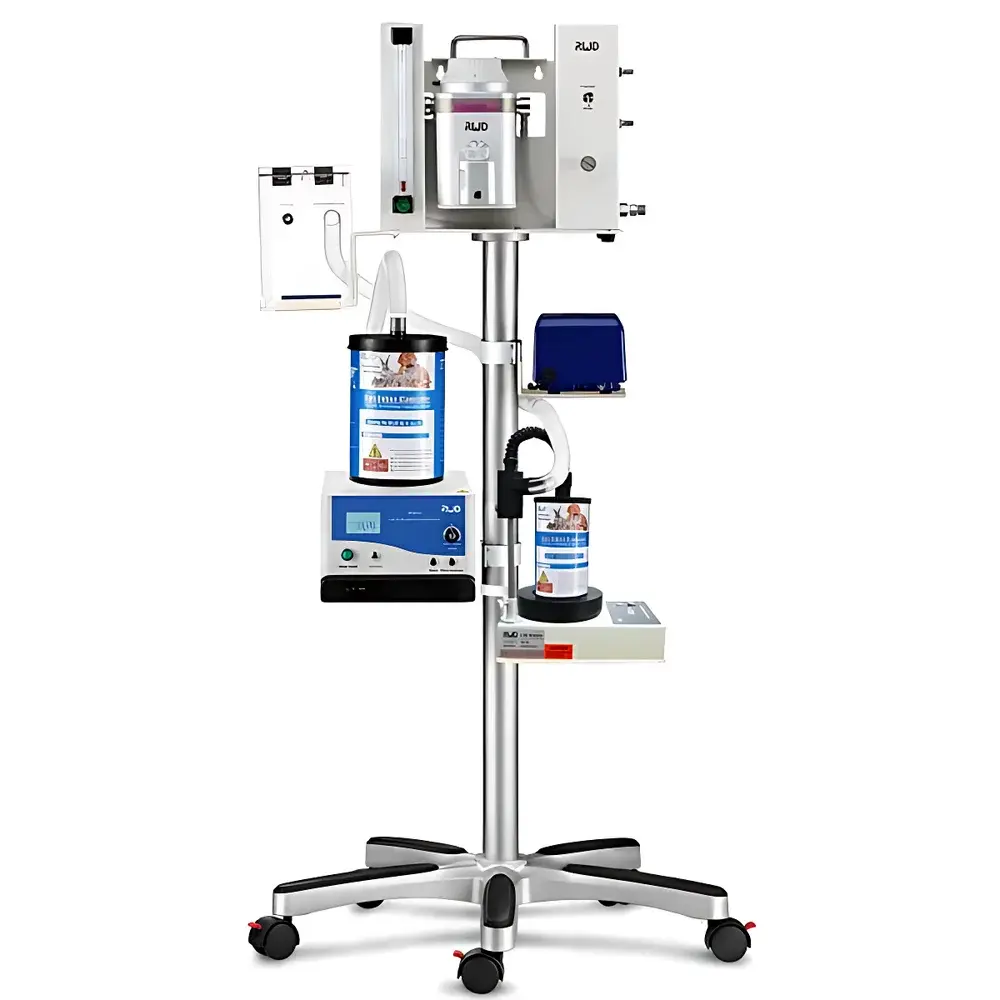
RWD R520 Mobile Small Animal Anesthesia Machine
| Brand | RWD |
|---|---|
| Origin | Guangdong, China |
| Manufacturer Type | Manufacturer |
| Country of Origin | China |
| Model | R520 |
| Price Range | USD 1,400 – 2,800 |
Overview
The RWD R520 Mobile Small Animal Anesthesia Machine is a fully integrated, portable inhalation anesthesia system engineered for precision, safety, and workflow efficiency in preclinical research laboratories and veterinary clinical settings. It operates on the principle of calibrated volatile anesthetic vaporization—delivering precise concentrations of isoflurane or sevoflurane via oxygen or medical air carrier gas—to induce and maintain surgical-plane anesthesia in small mammals. Unlike injectable agents, inhalational anesthetics provide rapid onset and offset kinetics, minimal hepatic or renal biotransformation, and real-time titratability of anesthetic depth—critical attributes for longitudinal studies, repeated procedures, and compliance with international animal welfare guidelines (e.g., NIH Guide for Care and Use of Laboratory Animals, EU Directive 2010/63/EU). The R520 is an evolution of the R540 enhanced desktop platform, reconfigured into a compact mobile architecture that consolidates the flowmeter, precision vaporizer, scavenging system, induction chamber, and integrated air pump into a single, maneuverable unit—eliminating external gas cylinder dependency and reducing footprint by >40% compared to conventional benchtop configurations.
Key Features
- Integrated Mobility: Castor-mounted chassis with locking brakes enables seamless relocation between procedure rooms, imaging suites, surgical stations, and teaching labs without disassembly.
- Zero-Leak Scavenging System: Active charcoal-based waste-gas capture compliant with OSHA PEL and NIOSH REL thresholds for halogenated anesthetics; reduces occupational exposure risk to <2 ppm.
- Multi-Animal Capacity: Supports simultaneous anesthesia delivery to up to five subjects (e.g., mice, rats, guinea pigs, hamsters, rabbits, or cats ≤7 kg) via independent flow-splitting circuits with individual flow control valves.
- Fail-Safe Design: Dual-pressure monitoring (inlet and outlet), automatic low-flow alarm, vaporizer temperature compensation, and emergency oxygen bypass ensure uninterrupted anesthetic delivery during pressure fluctuations or power interruptions.
- Modular Induction Chamber: Transparent polycarbonate chamber with adjustable ventilation ports, integrated CO₂ absorbent canister, and quick-release lid for stress-minimized animal loading and rapid recovery.
Sample Compatibility & Compliance
The R520 accommodates species-specific physiological ranges across common rodent and lagomorph models—including C57BL/6 and BALB/c mice (15–30 g), Sprague-Dawley and Wistar rats (100–500 g), New Zealand White rabbits (≤3.5 kg), and domestic cats (≤7 kg). All gas pathways are constructed from USP Class VI-certified materials resistant to halogenated anesthetic degradation. The system conforms to ISO 8536-4 (medical gas pipeline systems), EN 737-1 (anesthesia workstations), and supports GLP-compliant documentation when paired with optional audit-trail-enabled software modules. Vaporizer calibration adheres to ASTM F1850 standards for accuracy (±0.1% vol/vol at 1–5% isoflurane output).
Software & Data Management
While the R520 operates as a standalone analog-digital hybrid device, it features RS-232 and USB-C interfaces for integration with laboratory information management systems (LIMS) or electronic lab notebooks (ELN). Optional firmware upgrade enables time-stamped logging of vaporizer setting, fresh gas flow (FGF), and duration per subject—facilitating retrospective protocol review and regulatory submissions under FDA 21 CFR Part 11 (when used with validated third-party data acquisition platforms). All configuration changes are recorded with user ID, timestamp, and parameter delta—meeting ALAC and AAALAC International record-keeping expectations.
Applications
- Neurosurgical preparation for stereotaxic injection, craniotomy, or intracranial electrode implantation
- In vivo optical imaging (e.g., two-photon microscopy, fNIRS) requiring stable hemodynamic and respiratory control
- Chronic implantation studies involving microdialysis, optogenetic fiber optic cannulation, or telemetry transmitter placement
- Cardiovascular phenotyping via echocardiography or pressure-volume loop analysis
- Teaching laboratories for veterinary and biomedical graduate curricula—supporting hands-on instruction in anesthetic pharmacokinetics and physiological monitoring
- Preclinical oncology models requiring serial imaging or tumor resection under standardized anesthetic conditions
FAQ
Does the R520 require external compressed gas cylinders?
No—the integrated air pump delivers regulated medical-grade air at 0–10 L/min; optional oxygen concentrator or cylinder interface is available for hypoxic or hyperoxic protocols.
Is the vaporizer compatible with both isoflurane and sevoflurane?
Yes—the dual-calibrated dial vaporizer is factory-set for isoflurane (0–5%) and sevoflurane (0–8%), with temperature-compensated output stability across ambient conditions of 15–35°C.
How is waste anesthetic gas managed during multi-animal procedures?
Each breathing circuit connects to a centralized active scavenging manifold; exhaust passes through dual-stage charcoal absorption before venting to exterior ductwork or recirculating through secondary filtration.
Can the R520 be used in GLP-regulated toxicology studies?
Yes—when deployed with documented preventive maintenance logs, annual vaporizer calibration certificates (traceable to NIST standards), and electronic usage records, it satisfies OECD GLP Principles Section 5.2 (Equipment Qualification) and Annex III (Anesthesia Monitoring Requirements).





