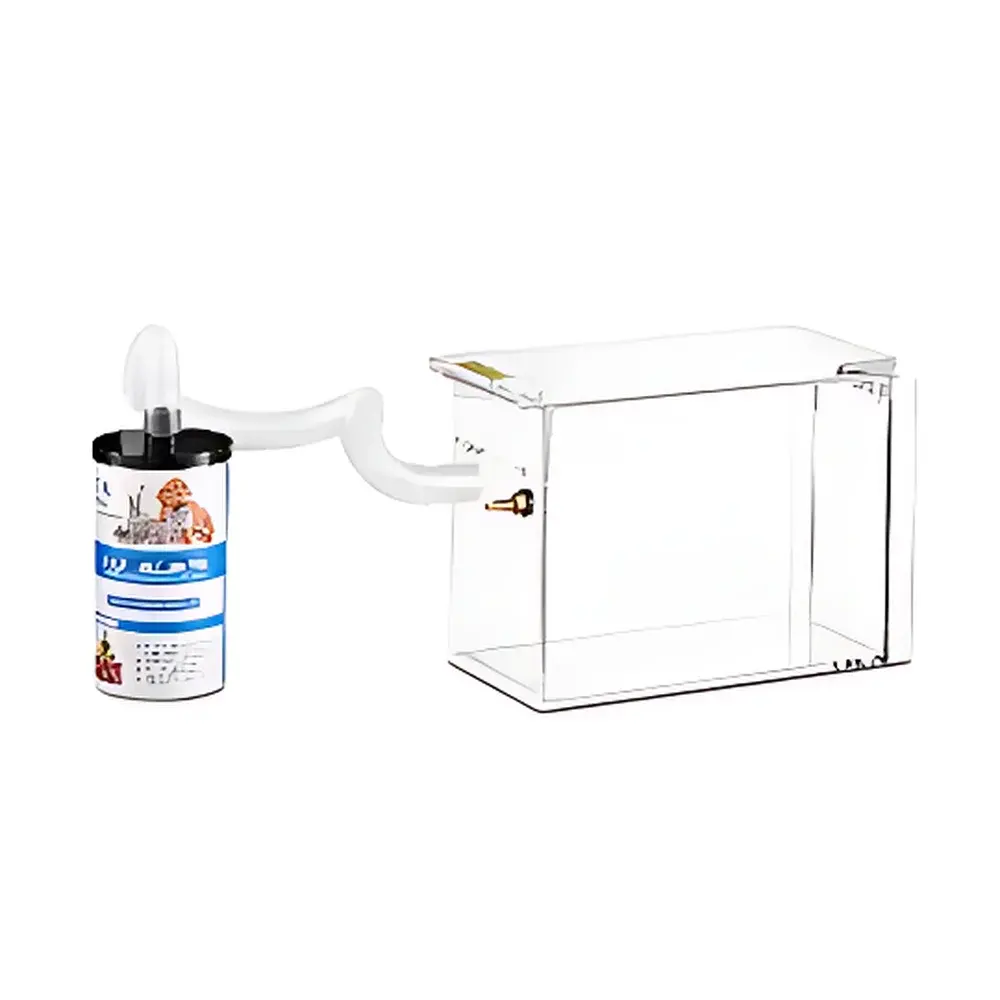
RWD V101 Transparent Anesthetic Induction Chamber for Small Laboratory Animals
| Brand | RWD |
|---|---|
| Origin | Shenzhen, China |
| Manufacturer Type | OEM Manufacturer |
| Country of Origin | China |
| Model | V101 |
| Dimensions | 240 × 120 × 180 mm |
| Material | High-Clarity Acrylic (PMMA) |
| Sealing | Integrated Plastic Gasket at Lid Interface |
| Exhaust Port | Standard 6 mm OD Barb for Active Charcoal Canister Connection |
| Compliance | Designed for ISO 10993-5 Cytotoxicity-Compatible Material Use |
Overview
The RWD V101 Transparent Anesthetic Induction Chamber is an engineered solution for controlled, rapid, and humane induction of inhalational anesthesia in small laboratory animals—including mice, rats, and guinea pigs—prior to surgical or experimental procedures. Based on standardized volatile anesthetic delivery principles, the chamber operates by introducing a calibrated mixture of carrier gas (typically oxygen or medical air) and anesthetic agent (e.g., isoflurane or sevoflurane) into a sealed acrylic environment. The high-transparency PMMA construction enables real-time visual assessment of respiratory rate, palpebral reflex, pedal withdrawal, and loss of righting reflex—key clinical endpoints defined in AVMA and NIH guidelines for anesthesia monitoring. With typical induction times ranging from 2 to 5 minutes under recommended vaporizer settings (e.g., 4–5% isoflurane in O₂), the V101 supports reproducible onset kinetics while minimizing animal stress through gradual concentration ramping.
Key Features
- Optimized chamber geometry (240 × 120 × 180 mm internal volume) balances rapid gas exchange with stable anesthetic concentration build-up, reducing induction variability across subjects.
- Reinforced flip-top lid with integrated compression gasket ensures consistent sealing integrity—critical for maintaining target anesthetic partial pressure and preventing operator exposure.
- Dedicated 6 mm OD exhaust port enables direct coupling to activated charcoal canisters (e.g., RWD AC-100 series), complying with OSHA PEL and NIOSH REL thresholds for halogenated ether exposure (e.g., ≤2 ppm isoflurane TWA).
- Lid retention stop mechanism prevents mechanical damage during repeated opening/closing cycles—extending service life beyond 10,000 operational cycles under standard lab use.
- Chemically resistant, autoclavable-grade acrylic (ISO 10993-5 tested) withstands repeated decontamination with 70% ethanol, 1% Virkon™, or hydrogen peroxide vapor without hazing or dimensional creep.
Sample Compatibility & Compliance
The V101 accommodates up to three adult mice (≤30 g each) or one adult rat (≤300 g) simultaneously, supporting weight-based dosing consistency per institutional IACUC protocols. Its design aligns with AAALAC International accreditation expectations for anesthesia equipment, including documented leak testing (per ASTM F2023), material biocompatibility reporting, and integration with UL-listed vaporizers. While not a medical device under FDA 21 CFR Part 820, the chamber is manufactured under ISO 13485-aligned quality management systems and supplied with traceable lot documentation for GLP-compliant studies.
Software & Data Management
As a passive hardware component, the V101 does not incorporate embedded electronics or software. However, it is fully interoperable with digital anesthesia workstations (e.g., Kent Scientific’s Buxco system or VetEquip’s Isoflurane Monitor) when paired with inline flow sensors and gas analyzers. Experimental metadata—including induction duration, observed reflex loss timepoints, and concurrent physiologic parameters—can be logged in compliant electronic lab notebooks (ELNs) supporting 21 CFR Part 11 audit trails. RWD provides optional SOP templates compatible with ISO/IEC 17025 documentation frameworks.
Applications
- Pre-surgical anesthesia induction in rodent models for oncology, neuroscience, and cardiovascular research.
- Standardized dosing validation in pharmacokinetic/pharmacodynamic (PK/PD) studies involving inhaled therapeutics.
- Training platform for veterinary and biomedical students mastering inhalant anesthetic titration techniques.
- Integration into automated phenotyping pipelines requiring synchronized anesthesia onset prior to imaging (e.g., MRI, PET, or micro-CT).
- Support for longitudinal studies where repeated, low-stress induction minimizes inter-session physiological drift.
FAQ
Is the V101 compatible with sevoflurane and desflurane, in addition to isoflurane?
Yes—the chamber’s PMMA construction exhibits chemical resistance to all commonly used volatile anesthetics per ASTM D543 testing; no solvent-induced crazing or stress cracking has been observed under routine exposure conditions.
Can the chamber be sterilized using ethylene oxide (EtO)?
No—EtO is not recommended due to residual gas entrapment risk in acrylic matrices; steam autoclaving (121°C, 15 psi, 20 min) or liquid disinfection remains the validated method.
What maintenance is required to ensure long-term sealing performance?
The plastic gasket should be inspected monthly for compression set or deformation; replacement gaskets (P/N: V101-GSKT) are available and require recalibration of lid closure torque to 0.35 ± 0.05 N·m.
Does RWD provide IACUC protocol language for this device?
Yes—downloadable template language, referencing NIH Guide Notice NOT-OD-15-102 and AVMA 2020 Guidelines, is available upon request from RWD Technical Support.