
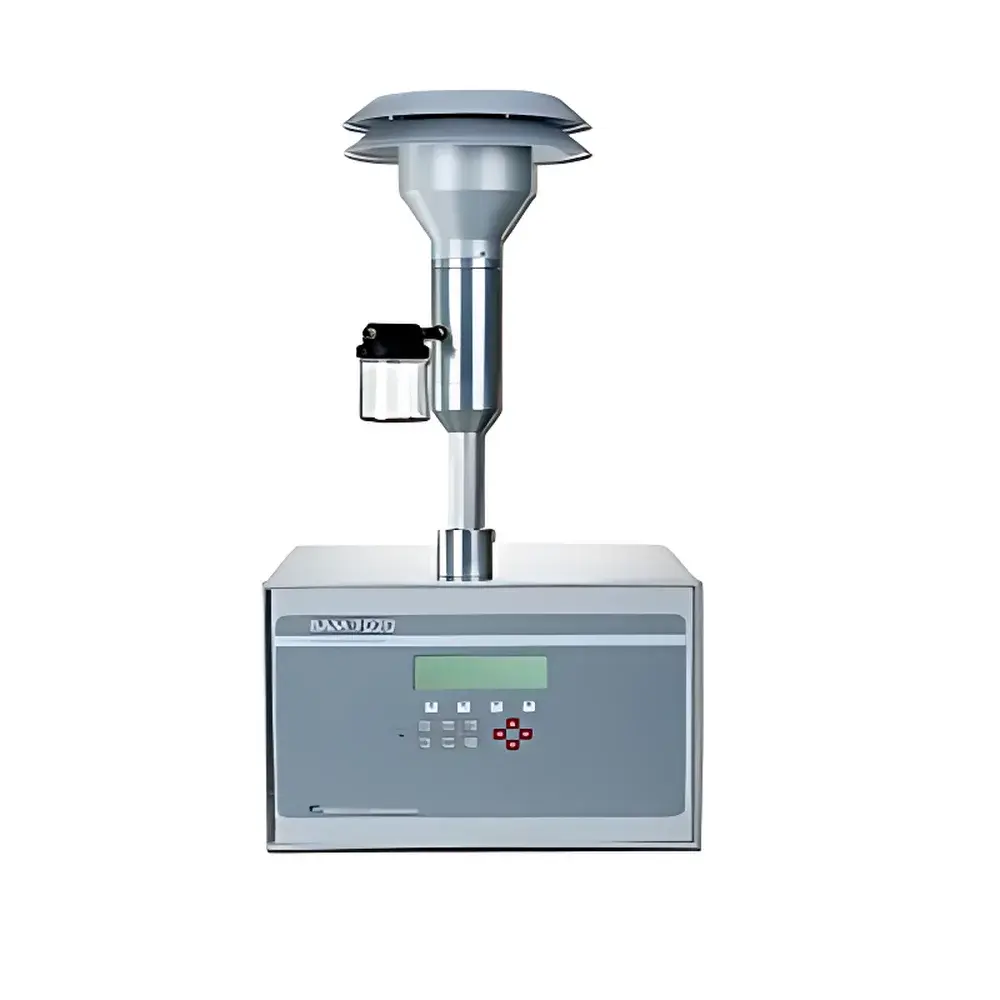
SAIL HERO BAM1020 Beta Attenuation Monitor for PM10 and PM2.5
| Brand | SAIL HERO |
|---|---|
| Origin | USA |
| Manufacturer Type | Manufacturer |
| Origin Category | Imported |
| Model | BAM1020 |
| Measurement Method | Beta Ray Attenuation |
| Measured Parameters | PM10, PM2.5 |
| EPA Certification | EQPM-0798-122 (PM10), EQPM-0308-170 (PM2.5) |
| Calibration Standard | FRM-certified calibration membrane |
| Data Storage Capacity | 182 days |
| Remote Operation Duration | Up to 60 days |
| Humidity Control | Integrated precision heater for RH conditioning |
| Communication Interface | RS-232 serial port |
| Meteorological Sensor Support | Up to 6 channels |
| Automatic Span Check Frequency | Hourly |
| Filter Exchange Interval | Hourly |
Overview
The SAIL HERO BAM1020 is a federally recognized, continuous ambient air monitoring instrument engineered for regulatory-grade measurement of particulate matter mass concentration in the PM10 and PM2.5 size fractions. It operates on the beta ray attenuation principle—an EPA-equivalent method that quantifies particle mass by measuring the attenuation of beta particles (electrons) emitted from a 14C source as they pass through a continuously collected aerosol deposit on a glass fiber filter tape. This physical measurement principle eliminates reliance on optical assumptions or environmental compensation algorithms, delivering inherently stable, traceable, and metrologically robust results. Designed and manufactured in the United States, the BAM1020 meets U.S. Environmental Protection Agency (EPA) equivalency requirements under 40 CFR Part 53, with formal certifications EQPM-0798-122 for PM10 and EQPM-0308-170 for PM2.5. Its architecture supports unattended operation in diverse climatic conditions, including high-humidity environments, via integrated relative humidity control and thermal management.
Key Features
- Regulatory-compliant beta attenuation measurement validated per EPA Performance Specifications for PM10 and PM2.5 samplers
- Automated hourly filter exchange to minimize artifacts from semi-volatile organic compound (SVOC) volatilization and nitrate dissociation
- Precision RH conditioning system utilizing an embedded heater and temperature-controlled airflow path to stabilize sample dew point prior to filtration
- Onboard microprocessor with LCD interface, real-time diagnostics, and dual-level data display (hourly and 24-hour averaged concentrations)
- Internal data logger supporting up to 182 days of high-resolution time-series storage (1-minute or 1-hour intervals configurable)
- RS-232 serial interface for integration with external data acquisition systems, modems, printers, or SCADA platforms
- Modular meteorological expansion—supports up to six analog inputs for co-located wind speed, wind direction, temperature, relative humidity, barometric pressure, and solar radiation sensors
- Remote operational capability with secure web-based access enabling configuration updates, data retrieval, and diagnostic review for up to 60 consecutive days without site visit
- Automated hourly span verification using calibrated reference sources to ensure ongoing measurement integrity
Sample Compatibility & Compliance
The BAM1020 is designed for ambient outdoor air sampling across urban, rural, industrial, and background monitoring networks. Its inlet configuration conforms to EPA Reference Method (RM) and Federal Reference Method (FRM) specifications for isokinetic sampling and particle size-selective separation using certified PM10 and PM2.5 cyclones or WINS impactors. The instrument complies with ISO 12103-1:2016 for filter media performance and ASTM D6216-21 for PM2.5 sampler evaluation protocols. All firmware and data handling routines are structured to support GLP/GMP-aligned audit trails, including timestamped event logging, user-access authentication, and immutable data records—facilitating alignment with EPA Quality Assurance Handbook Volume I and EU Directive 2008/50/EC reporting requirements.
Software & Data Management
Data output adheres to EPA’s AQS (Air Quality System) format standards, enabling direct ingestion into national air quality databases. The internal operating system provides configurable data export options—including ASCII, CSV, and binary formats—with metadata headers containing instrument ID, calibration history, filter change timestamps, and diagnostic flags. Remote data retrieval is supported via HTTP/HTTPS or FTP(S) protocols, with optional TLS 1.2 encryption for secure transmission. Firmware updates are performed over-the-air using signed packages to maintain chain-of-custody integrity. Audit logs capture all configuration changes, user logins, and maintenance events with ISO 8601 timestamps, satisfying FDA 21 CFR Part 11 electronic record and signature requirements where applicable.
Applications
- Continuous compliance monitoring for National Ambient Air Quality Standards (NAAQS) enforcement
- Source apportionment studies requiring long-term, high-fidelity PM mass time series
- Health impact research correlating fine particulate exposure with epidemiological outcomes
- Mobile monitoring deployments on vehicle-mounted or trailer-based platforms
- Background station networks for regional transport modeling and trend analysis
- Calibration reference for optical or tapered element oscillating microbalance (TEOM) instruments
FAQ
What EPA certification numbers does the BAM1020 hold?
EQPM-0798-122 for PM10 and EQPM-0308-170 for PM2.5, both issued under 40 CFR Part 53.
Does the instrument require daily manual intervention?
No—fully automated operation includes hourly filter changes, span checks, and diagnostics; remote monitoring enables 60-day unattended deployment.
Can the BAM1020 be used with non-EPA-approved inlets?
Only EPA-designated or equivalent size-selective inlets (e.g., VSCC, BGI SCC, or WINS) may be used to maintain regulatory equivalence and data defensibility.
How is humidity managed during high-moisture sampling conditions?
An integrated heater maintains sample air at a controlled temperature above dew point, preventing water condensation on the filter tape and minimizing hygroscopic growth artifacts.
Is raw beta count data accessible for secondary analysis?
Yes—the instrument outputs unprocessed beta transmission counts alongside calculated mass concentrations, supporting method validation and uncertainty budgeting per ISO/IEC 17025 guidelines.







