
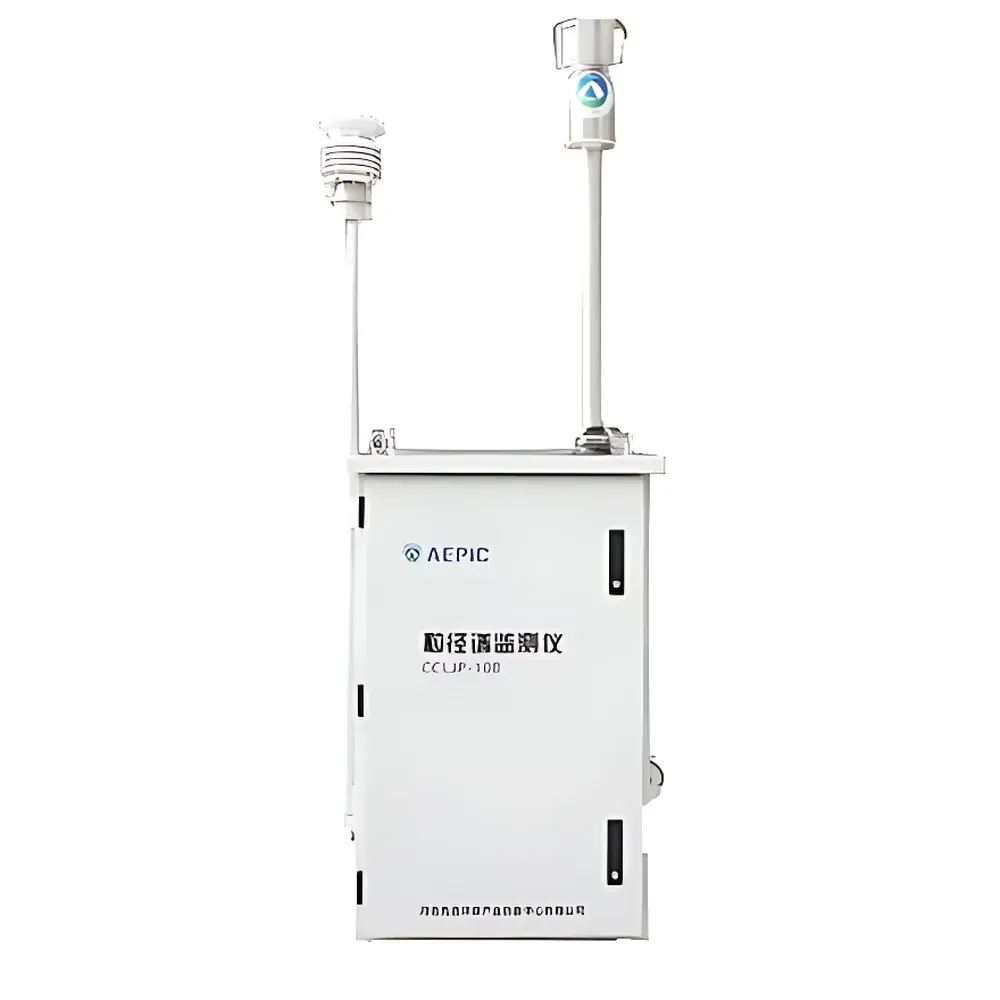
SAIL HERO CCLJP-100 High-Precision Atmospheric Particle Size Spectrometer
| Brand | SAIL HERO |
|---|---|
| Origin | Hebei, China |
| Manufacturer Type | OEM Manufacturer |
| Country of Origin | China |
| Model | CCLJP-100 |
| Pricing | Upon Request |
| Measurement Principle | Optical Light Scattering (Lorenz-Mie Theory) |
| Sampling Flow Rate | 4.8 L/min |
| Particle Size Range | 0.18–100 µm |
| Particle Number Concentration Range | 0–20,000 particles/cm³ |
| Size Channels | 64 |
Overview
The SAIL HERO CCLJP-100 High-Precision Atmospheric Particle Size Spectrometer is an advanced optical aerosol spectrometer engineered for real-time, high-resolution characterization of ambient particulate matter. It operates on the physical principle of angular-resolved Mie scattering, where individual airborne particles traversing a precisely defined optical sensing volume are illuminated by a stable multi-wavelength LED light source. Scattered light intensity at detection angles between 85° and 95° is captured and digitized; this signal amplitude correlates directly with particle diameter via Lorenz-Mie theoretical calibration. Unlike integrative mass-based PM monitors, the CCLJP-100 delivers true single-particle counting and classification across 64 logarithmically spaced size bins from 0.18 µm to 100 µm—enabling granular analysis of nucleation, Aitken, accumulation, and coarse-mode distributions under field conditions.
Key Features
- Real-time particle number concentration output with 1-second temporal resolution—suitable for dynamic emission plume tracking and rapid atmospheric process studies.
- Optically optimized sensing chamber with laminar flow control ensures minimal particle loss and high counting efficiency across the full 0.18–100 µm range.
- Factory-calibrated using NIST-traceable polystyrene latex (PSL) standards; validated against reference instruments per ISO 27891 and EN 16450 protocols.
- TÜV Rheinland certified for performance reliability and metrological traceability in environmental monitoring applications.
- Integrated thermal and humidity compensation algorithms mitigate refractive index variability effects for improved sizing accuracy in variable ambient conditions.
- Low-power design with maintenance-free optical path—no consumables, no laser alignment required, and no periodic lamp replacement.
Sample Compatibility & Compliance
The CCLJP-100 is designed for continuous unattended operation in ambient air, stack emissions, indoor environments, and mobile platforms. It accepts standard 1/4-inch OD sampling tubing and interfaces seamlessly with common dilution systems (e.g., critical orifice, porous tube) for high-concentration applications. The instrument complies with key regulatory frameworks governing air quality instrumentation, including EU Directive 2008/50/EC (PM monitoring requirements), US EPA Reference Method EQPM-03-00 (for particle counters), and ISO 29463-1:2011 (high-efficiency filter testing support). Its data structure supports audit-ready logging aligned with GLP and ISO/IEC 17025 documentation practices.
Software & Data Management
Data acquisition and visualization are managed via the proprietary SAIL HERO Aerosol Analysis Suite (SAAS), a Windows-based application supporting local storage, remote telemetry (Modbus TCP, RS-485), and cloud synchronization. Raw pulse-height histograms, time-stamped size distribution matrices, and derived metrics—including PM1, PM2.5, PM10, total number concentration (Ntot), and mode diameters—are exported in CSV, NetCDF, and HDF5 formats. The software includes built-in uncertainty propagation modeling per GUM (JCGM 100:2018) and supports FDA 21 CFR Part 11-compliant user access controls, electronic signatures, and immutable audit trails when deployed in regulated QA/QC environments.
Applications
- Ambient air quality monitoring networks requiring high-temporal-resolution size-resolved aerosol data for source apportionment and health impact modeling.
- Indoor air quality assessment in cleanrooms, hospitals, and educational facilities—particularly for ultrafine particle exposure evaluation.
- Industrial stack emission characterization, especially for combustion, metal processing, and pharmaceutical manufacturing where sub-micron particle generation is critical.
- Mobile platform deployment (e.g., vehicle-mounted or drone-integrated) for spatial mapping of urban pollution gradients and hotspot identification.
- Research applications in atmospheric chemistry, aerosol-cloud interaction studies, and inhalation toxicology where monodisperse or polydisperse particle size distribution fidelity is essential.
FAQ
What calibration standards are used for factory verification?
The CCLJP-100 is calibrated using NIST-traceable polystyrene latex spheres (PSL) spanning 0.15–100 µm, with secondary validation against aerodynamic diameter standards per ISO 11155-1.
Does the instrument require external sheath air or vacuum pumping?
No—sampling is driven by an integrated, temperature-stabilized diaphragm pump delivering a precise 4.8 L/min volumetric flow; no auxiliary gas supply is needed.
How is hygroscopic growth addressed in humid environments?
Relative humidity and temperature inputs feed a real-time Mie scattering correction model that adjusts effective refractive index assumptions, reducing sizing bias in RH >80% conditions.
Can the device be integrated into existing SCADA or EMS platforms?
Yes—Modbus TCP and ASCII serial protocols are supported out-of-the-box; custom API integration (RESTful JSON over HTTPS) is available upon request.
Is raw scatter pulse data accessible for post-processing?
Yes—full-resolution pulse-height histograms (16-bit, 64 channels) are logged alongside metadata and can be extracted for third-party inversion or machine learning training pipelines.
Related Products







