
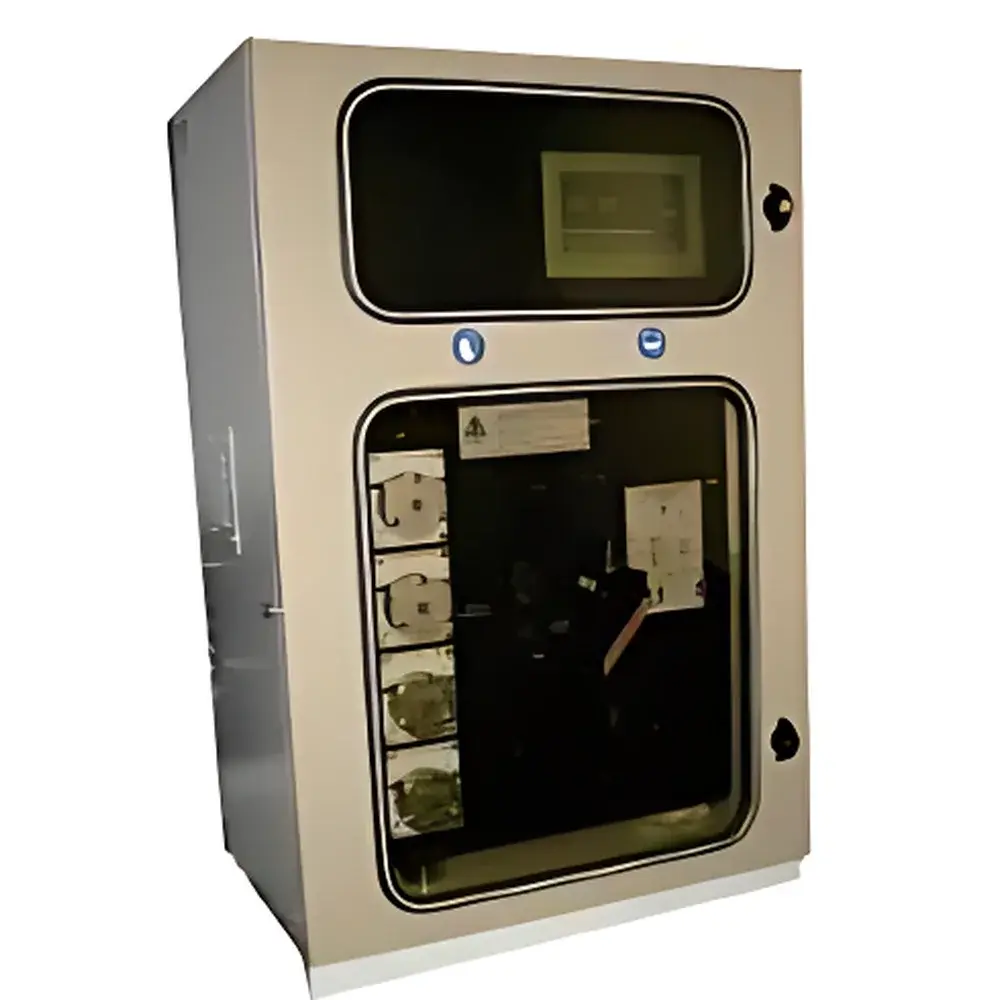
SAIL HERO SERES 2000 CODCr Online Automatic Chemical Oxygen Demand Analyzer
| Brand | SAIL HERO |
|---|---|
| Origin | Hebei, China |
| Manufacturer Type | OEM Manufacturer |
| Product Origin | Domestic (China) |
| Model | SERES 2000 CODCr |
| Instrument Type | Online Analyzer |
| Measurement Principle | Potassium Dichromate High-Temperature Closed-Vessel Digestion Coupled with Spectrophotometry |
| Wavelength | 600 nm |
| Measurement Range | 0–200 / 0–500 / 0–1000 mg/L COD (extendable to 12,000 mg/L) |
| Accuracy | ±3% of reading |
| Repeatability | ≤3% RSD |
| Limit of Detection | 3 mg/L COD |
| Cycle Time | 30 minutes per sample |
| Batch Capacity | 3 samples per cycle |
Overview
The SAIL HERO SERES 2000 CODCr Online Automatic Chemical Oxygen Demand Analyzer is an industrial-grade, continuous-monitoring instrument engineered for reliable, unattended quantification of chemical oxygen demand in aqueous matrices. It implements the standardized potassium dichromate (K₂Cr₂O₇) oxidation method under controlled high-temperature, high-pressure digestion conditions—fully compliant with internationally recognized wet-chemistry fundamentals and aligned with the analytical rigor of ISO 6060 and ASTM D1252 (Method B). Unlike conventional benchtop COD analyzers, the SERES 2000 integrates closed-vessel thermal digestion (up to 165 °C) with precise spectrophotometric detection at 600 nm, enabling rapid oxidation kinetics that reduce total reaction time to ≤15 minutes—significantly accelerating throughput without compromising stoichiometric completeness. Designed for permanent installation in wastewater treatment plants, effluent discharge points, and surface water monitoring stations, it delivers traceable, auditable data suitable for regulatory reporting under national environmental frameworks.
Key Features
- Patented pneumatic fluid control architecture: Uses a long-life air pump to generate positive pressure for reagent aspiration and waste expulsion—eliminating contact between spent digestate and precision metering components.
- Integrated high-efficiency digestion reactor: Engineered with corrosion-resistant materials and real-time temperature feedback control (±0.5 °C stability), ensuring consistent Cr(VI) reduction and minimizing interferences from chloride or nitrate.
- Triple-range auto-scaling optics: Automatically selects optimal photometric range (0–200 / 0–500 / 0–1000 mg/L) based on incoming sample concentration—enabling seamless measurement across low-strength influents and highly concentrated industrial discharges.
- Robust sampling & dosing system: Equipped with imported PTFE-reinforced peristaltic tubing and high-torque, pulse-free peristaltic pumps certified for >10,000 hours of continuous operation.
- Fully autonomous operational safeguards: Includes self-diagnostic routines for reagent depletion, power interruption recovery, tube blockage detection, and automatic post-failure system purge—restoring baseline calibration status without manual intervention.
- Onboard cleaning protocol: Executes scheduled ultrapure water flushes between analyses to prevent carryover and biofilm accumulation in flow paths and optical cells.
Sample Compatibility & Compliance
The SERES 2000 is validated for direct analysis of raw and treated municipal wastewater, industrial process effluents (including textile, pharmaceutical, and food processing streams), and ambient surface waters. It accommodates suspended solids up to 150 mg/L without pre-filtration and tolerates chloride concentrations ≤2,000 mg/L via built-in mercury sulfate masking. All measurement protocols conform to HJ/T 377–2007 (China’s standard for online COD analyzers) and reference methodology GB 11914–1989. Data integrity meets GLP-aligned requirements, supporting audit trails, electronic signatures, and secure user-level access control—facilitating alignment with ISO/IEC 17025 laboratory management systems and preparatory compliance for future integration into EPA-approved monitoring networks.
Software & Data Management
The embedded Linux-based controller runs SAIL HERO’s proprietary CODView™ firmware, offering local touchscreen operation and full remote functionality via Modbus TCP, RS-485, or optional 4G/LTE telemetry. Calibration history, maintenance logs, alarm events, and raw absorbance spectra are timestamped and stored onboard for ≥12 months. Export formats include CSV and XML, compatible with SCADA platforms (e.g., Ignition, Siemens Desigo) and LIMS environments. Firmware supports over-the-air updates and includes configurable alarm thresholds (e.g., concentration exceedance, low reagent level, temperature deviation), each triggering relay outputs and SNMP traps for centralized network monitoring.
Applications
- Real-time performance evaluation of biological treatment units (e.g., activated sludge, MBR, SBR) by tracking influent/effluent COD differentials.
- Compliance monitoring at NPDES or permit-defined discharge points under national environmental protection statutes.
- Trend analysis of organic loading in combined sewer overflows (CSOs) and stormwater retention basins.
- Process optimization support in electroplating, dyeing, and fermentation industries where rapid COD feedback informs dosing of oxidants or coagulants.
- Long-term water quality assessment in riverine and lacustrine ecosystems subject to anthropogenic nutrient inputs.
FAQ
Does the SERES 2000 require daily manual calibration?
No—automatic multi-point calibration is performed at user-defined intervals (e.g., every 6 or 24 hours) using onboard standard solutions; drift correction is applied dynamically.
Can it operate reliably in outdoor cabinets with ambient temperatures ranging from −10 °C to 50 °C?
Yes—the analyzer includes insulated housing and active thermal management, maintaining internal operating temperature between 15–35 °C across the specified external range.
Is the instrument compatible with third-party reagent kits?
It is validated exclusively with SAIL HERO-certified reagents (digestion acid, K₂Cr₂O₇ solution, Ag₂SO₄ catalyst); use of non-OEM reagents voids metrological warranty and may compromise compliance validity.
How is data security ensured during remote access?
All network communications use TLS 1.2 encryption; role-based authentication enforces read-only or admin privileges, and all configuration changes are logged with operator ID and timestamp.
What maintenance tasks are required on a monthly basis?
Visual inspection of tubing integrity, verification of waste container level, cleaning of optical windows with isopropanol-moistened lint-free cloth, and validation of pump tube tension—no consumable replacement is needed unless wear is observed.







