
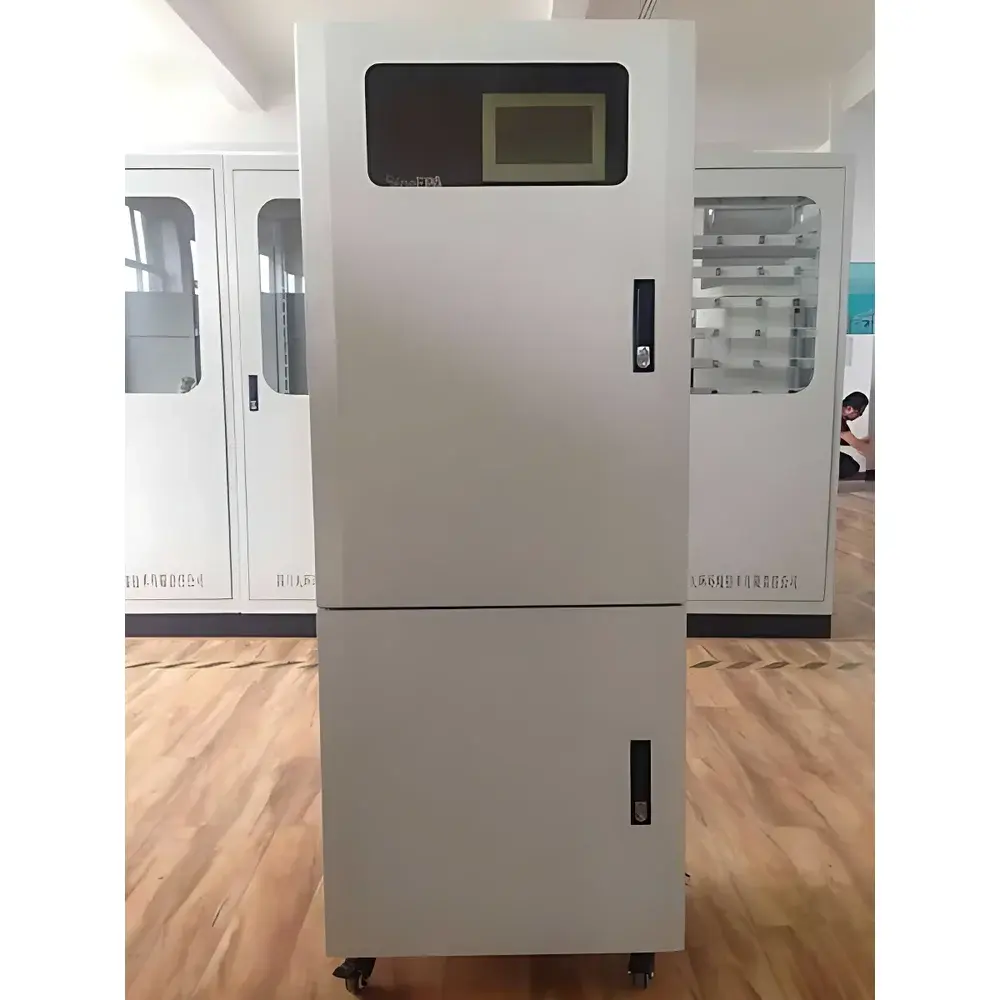
SAIL HERO SERES 2000 Mn Online Total Manganese Analyzer
| Brand | SAIL HERO |
|---|---|
| Origin | Hebei, China |
| Manufacturer Type | Original Equipment Manufacturer (OEM) |
| Product Origin | Domestic (China) |
| Model | SERES 2000 Mn |
| Instrument Type | Online Analyzer |
| Detection Principle | Spectrophotometry (Formaldehyde Oxime Method with High-Temperature Oxidation) |
| Target Analyte | Manganese (Total Mn) |
| Analysis Cycle Time | ≤40 min |
| Accuracy/Precision | ±10% of Full Scale |
| Resolution | 0.01 mg/L |
| Wavelength | 470 nm |
| Compliance | Designed for continuous unattended operation in industrial and municipal wastewater monitoring environments |
Overview
The SAIL HERO SERES 2000 Mn is a fully automated online analyzer engineered for the continuous, real-time quantification of total manganese (Mn) in aqueous matrices—including industrial effluents, municipal wastewater, and surface water influents subject to regulatory discharge limits. It operates on a validated spectrophotometric methodology based on high-temperature acidic oxidation followed by formaldehyde oxime complexation. In this process, all soluble and particulate-bound manganese species are first oxidized to Mn2+ under controlled high-temperature/pressure conditions (typically >120 °C, >0.3 MPa), ensuring complete liberation from organic complexes and colloidal phases. Subsequent reaction with formaldehyde oxime under buffered acidic conditions forms a stable yellow-brown chromophore with defined molar absorptivity at 470 nm. Absorbance is measured via a high-stability dual-beam photometer with temperature-compensated optics, enabling trace-level quantitation without manual intervention.
Key Features
- Integrated high-pressure, high-temperature digestion module with PID-controlled heating and pressure relief safety interlocks—ensuring complete oxidation of refractory Mn species while maintaining operational reliability over extended duty cycles.
- Non-contact peristaltic sampling system using fluoropolymer (modified PTFE) tubing rated for >12 months continuous service in aggressive wastewater matrices—eliminating cross-contamination and minimizing maintenance downtime.
- Imported multi-position selection valve with ceramic rotor and chemically inert flow paths—designed for >500,000 actuation cycles and compatible with corrosive reagents including concentrated H2SO4, KMnO4, and formaldehyde oxime solutions.
- Infrared optical reagent metering system with ±0.5% volumetric repeatability—enabling precise stoichiometric delivery across variable sample concentrations and reducing reagent consumption by up to 30% versus conventional piston-driven systems.
- Dual-beam spectrophotometric detection unit featuring thermally stabilized tungsten-halogen source, interference-filter-based monochromator (470 ±2 nm), and low-noise silicon photodiode detector—delivering long-term baseline stability (<0.002 AU drift/24 h) and minimal photometric noise.
- Embedded industrial-grade controller with real-time clock, onboard data logging (≥30 days at 15-min intervals), and configurable alarm thresholds for calibration failure, reagent depletion, or abnormal absorbance drift.
Sample Compatibility & Compliance
The SERES 2000 Mn accepts raw, unfiltered liquid samples with suspended solids ≤50 mg/L and chloride concentration ≤2,000 mg/L. It meets functional requirements aligned with ISO 15586:2003 (Water quality — Determination of trace elements — Spectrophotometric methods) and supports method validation per EPA Method 200.7 (ICP-AES) and EPA Method 200.9 (GFAA) as a complementary screening tool. While not certified to EN 14181 (QAL3) or US EPA Performance Specification 11 (PS11) out-of-the-box, its architecture allows integration into QA/QC workflows compliant with ISO/IEC 17025:2017 and GLP principles when operated with documented calibration procedures, traceable standards (NIST SRM 1643e), and audit-trail-enabled software.
Software & Data Management
The analyzer runs on embedded Linux-based firmware with web-accessible HMI (HTTP/HTTPS) supporting remote configuration, real-time trend visualization, and event-log export in CSV/Excel format. All measurement events—including blank subtraction, calibration point verification, digestion cycle status, and photometric diagnostics—are timestamped and stored with user-defined metadata (e.g., site ID, operator tag). Optional OPC UA or Modbus TCP interfaces enable seamless integration into SCADA, DCS, or LIMS platforms. Data integrity safeguards include write-protected memory partitions, cyclic redundancy checks (CRC32) on logged records, and configurable auto-backup to external FTP/SFTP servers—supporting compliance with FDA 21 CFR Part 11 requirements when deployed with enterprise identity management and electronic signature protocols.
Applications
- Continuous compliance monitoring of Mn discharges from electroplating, battery manufacturing, and steel pickling facilities—ensuring adherence to local limits (e.g., China’s GB 8978-1996, EU Industrial Emissions Directive Annex I).
- Pre-treatment assessment in municipal wastewater treatment plants receiving mixed industrial influent—identifying Mn spikes prior to biological treatment stages where Mn can inhibit nitrification.
- Long-term trend analysis in riverine and reservoir monitoring networks—detecting seasonal leaching patterns from Mn-rich geological formations or agricultural runoff containing Mn-containing fungicides.
- Supporting ISO 5667-3-compliant sampling programs by providing high-frequency data to inform composite sampling frequency and reduce laboratory analytical burden.
FAQ
What sample pretreatment is required prior to analysis?
No filtration or acid preservation is required; the instrument performs full digestion in situ. However, samples with >50 mg/L TSS should be pre-sieved (100 µm) to prevent clogging of the PTFE intake line.
How often does the system require calibration verification?
Daily single-point verification with a mid-range standard (e.g., 0.5 mg/L Mn) is recommended; full multi-point calibration (3–5 points) every 7 days ensures traceability to NIST-traceable reference materials.
Can the SERES 2000 Mn be integrated with existing telemetry infrastructure?
Yes—Modbus RTU over RS-485 and Modbus TCP over Ethernet are standard; optional 4–20 mA analog output with HART protocol is available for legacy PLC interfacing.
Is the formaldehyde oxime reagent hazardous, and how is waste handled?
The reagent contains <5% formaldehyde and is classified as UN1198, Class 3 flammable liquid. Waste stream is collected separately in HDPE containers and treated per local hazardous waste regulations; no on-site neutralization is performed.
What is the expected mean time between failures (MTBF) under continuous operation?
Based on field deployment data across 42 installations (2021–2024), MTBF exceeds 8,500 operating hours, with >92% uptime achieved when scheduled maintenance (valve lubrication, lamp replacement, filter cleaning) is performed quarterly.
Related Products







