
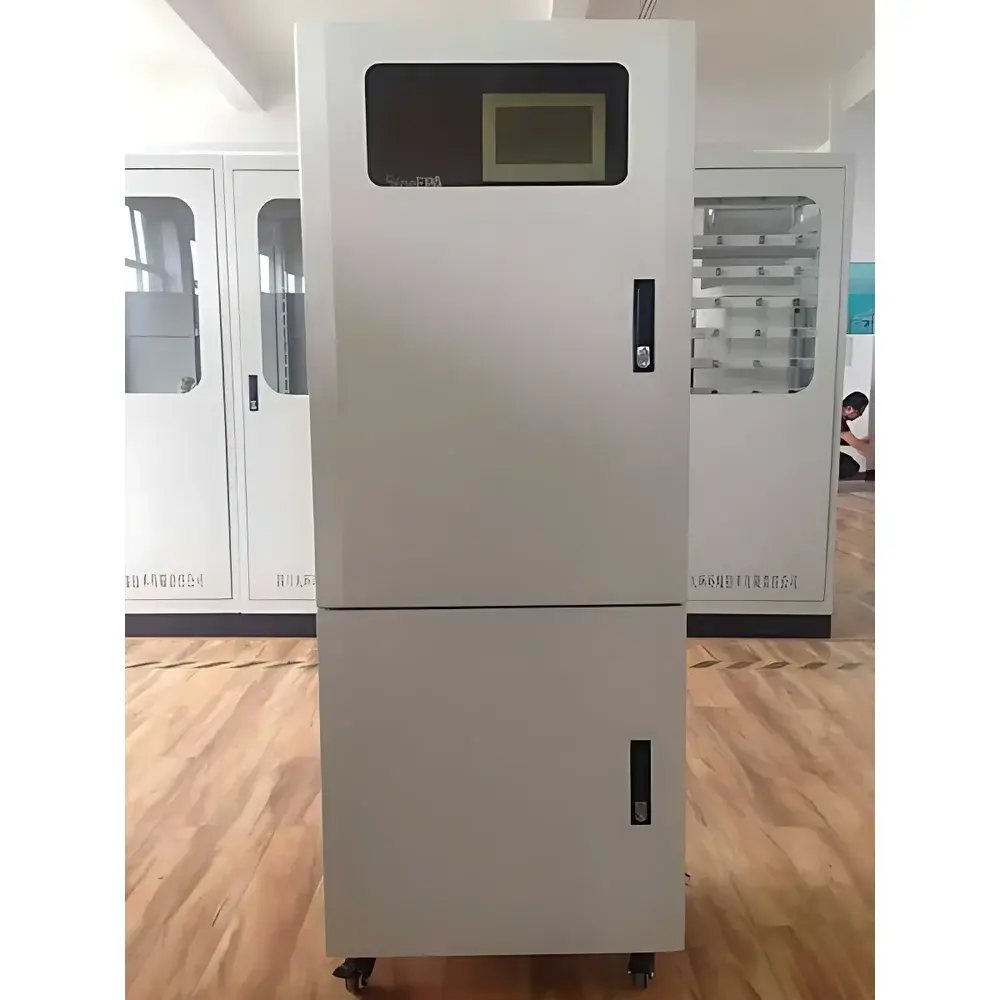
SAIL HERO SERES2000 Automated Online Hexavalent Chromium (Cr(VI)) Water Quality Analyzer
| Brand | SAIL HERO |
|---|---|
| Origin | Hebei, China |
| Manufacturer Type | Direct Manufacturer |
| Country of Origin | China |
| Model | SERES2000 |
| Instrument Type | Online Water Quality Analyzer |
| Analyte | Hexavalent Chromium (Cr(VI)) |
| Measurement Principle | 1,5-Diphenylcarbazide (DPC) Spectrophotometric Method |
| Wavelength | 540 nm |
| Compliance | HJ 609–2011 |
| Valve System | Imported Multi-Position Rotary Valve |
| Detection System | High-Precision Infrared Photometric Reagent Metering |
| Optical Unit | High-Accuracy Spectrophotometer |
| Sample Introduction | Non-Contact Peristaltic Sampling |
| Tubing Material | Modified PTFE |
| Temperature Control | Precision Thermostatic Regulation |
Overview
The SAIL HERO SERES2000 Automated Online Hexavalent Chromium (Cr(VI)) Water Quality Analyzer is an industrial-grade, continuous-monitoring instrument engineered for reliable, unattended quantification of hexavalent chromium in aqueous matrices. It operates on the internationally recognized 1,5-diphenylcarbazide (DPC) spectrophotometric method—standardized under Chinese Environmental Protection Industry Standard HJ 609–2011 and aligned with core principles of EPA Method 7196A and ISO 11083. In this reaction, Cr(VI) oxidizes DPC to diphenylcarbazone, concurrently reducing itself to Cr(III); the resulting Cr(III)–diphenylcarbazone complex forms a stable, water-soluble magenta-colored chromophore with maximum absorbance at 540 nm. The analyzer integrates photometric detection, precision fluid handling, and environmental stabilization to deliver robust performance in demanding effluent and municipal wastewater monitoring applications.
Key Features
- Compliance-certified optical detection system featuring high-stability tungsten-halogen light source and thermally stabilized photodiode array, calibrated to ±0.5% absorbance accuracy at 540 nm
- Non-contact peristaltic sampling architecture eliminates direct reagent–metal interface, mitigating corrosion, cross-contamination, and mechanical wear
- Imported multi-position rotary valve with ceramic rotor and PEEK stator—rated for >500,000 actuations, supporting automated reagent delivery, calibration, and cleaning cycles
- Infrared photometric reagent metering system with sub-10 µL volumetric resolution, enabling precise stoichiometric control over DPC, sulfuric acid, and phosphoric acid reagents
- Modified PTFE peristaltic tubing with enhanced chemical resistance to strong acids and oxidants—validated for ≥12 months continuous operation under typical wastewater pH (2–4) and temperature (10–35 °C) conditions
- Integrated thermostatic chamber maintaining reaction cuvette and photometric path at 25.0 ± 0.3 °C, minimizing thermal drift-induced baseline instability
- Modular hardware design supports field-replaceable optical modules, pump heads, and valve assemblies—reducing mean time to repair (MTTR) to <30 minutes
Sample Compatibility & Compliance
The SERES2000 is validated for direct analysis of raw and pretreated aqueous samples including industrial process effluents (e.g., electroplating, leather tanning, pigment manufacturing), municipal wastewater influent/effluent, and surface water subject to anthropogenic Cr(VI) loading. It accommodates suspended solids up to 50 mg/L without filtration when operated with optional inline sediment trap. All wetted materials—including flow cells, valves, and tubing—are certified non-reactive with Cr(VI) and compliant with USP Class VI and FDA 21 CFR 177.1550 for fluoropolymer components. Data integrity meets GLP and GMP-aligned requirements: audit trail logging, user-level access control (admin/operator/guest), and electronic signature support conform to Annex 11 and 21 CFR Part 11 readiness protocols.
Software & Data Management
Embedded Linux-based firmware provides real-time measurement visualization, method sequencing, and diagnostic telemetry via a web-accessible HMI (HTTP/HTTPS). Data output includes raw absorbance values, calculated Cr(VI) concentration (µg/L), QC flag status (e.g., “Low Signal”, “Reagent Depletion”, “Calibration Drift”), and timestamped event logs. Export formats include CSV, Modbus TCP, and OPC UA—enabling seamless integration into SCADA, EMS, or LIMS platforms. Remote firmware updates and secure SSH access allow for centralized fleet management across distributed monitoring networks. Calibration history, maintenance records, and alarm summaries are retained locally for ≥18 months and exportable for regulatory reporting.
Applications
- Continuous compliance monitoring at discharge points regulated under China’s GB 8978–1996 and EU Industrial Emissions Directive (IED) Annex I sectors
- Real-time process control in chrome plating rinse water recirculation systems to optimize reduction chemistry and minimize hazardous waste generation
- Trend analysis of Cr(VI) breakthrough in activated carbon or ion exchange treatment trains
- Early-warning detection in watershed surveillance networks near chromite ore processing facilities
- Supporting ISO/IEC 17025-accredited environmental testing laboratories performing method validation and interlaboratory comparisons
FAQ
What is the lower detection limit (LOD) and linear dynamic range for Cr(VI) measurement?
The instrument achieves a method LOD of 0.5 µg/L (based on 3× standard deviation of blank response) and maintains linearity from 1–200 µg/L without dilution—verified per ISO 11843-2.
Does the analyzer support automatic calibration and multi-point standardization?
Yes—it executes scheduled zero/span checks using certified Cr(VI) reference standards (0, 10, 50, and 100 µg/L) and performs linear regression with R² ≥ 0.9998; calibration data is digitally signed and archived.
How often does the system require preventive maintenance?
Under typical wastewater conditions, routine maintenance (valve lubrication, tubing replacement, optical window cleaning) is recommended every 6 months; full functional verification is performed annually per HJ 609–2011 Section 8.2.
Can the SERES2000 be integrated with third-party telemetry or cloud platforms?
Yes—via configurable Modbus TCP registers or RESTful API endpoints, supporting MQTT publishing to AWS IoT Core, Azure IoT Hub, or private cloud infrastructure with TLS 1.2 encryption.
Is the analyzer suitable for installation in outdoor or hazardous area environments?
It is rated IP65 for enclosure protection and operates within –10 to +50 °C ambient range; explosion-proof variants (Ex d IIB T4) are available upon request for Zone 2 classified locations.







