
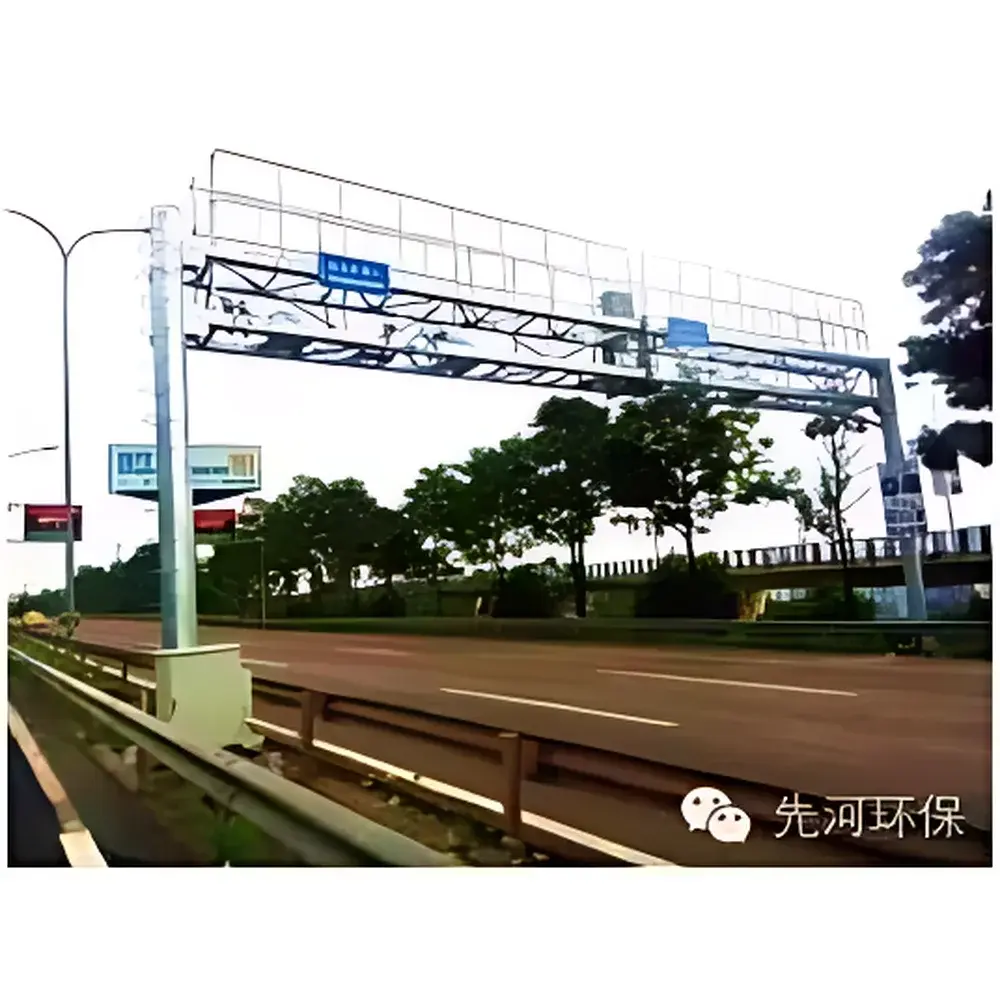
SAIL HERO Vehicle Emission Remote Sensing System (VERSS)
| Brand | SAIL HERO |
|---|---|
| Origin | Hebei, China |
| Manufacturer Type | Original Equipment Manufacturer (OEM) |
| Country of Origin | China |
| Model | VERSS Series |
| Pricing | Available upon Request |
Overview
The SAIL HERO Vehicle Emission Remote Sensing System (VERSS) is a field-deployable, non-contact optical monitoring platform engineered for real-time, in-motion measurement of exhaust emissions from passing motor vehicles. Operating on the principles of dual-beam differential optical absorption spectroscopy (DOAS) in the ultraviolet (UV) and near-infrared (NIR) spectral ranges, the system simultaneously quantifies gaseous pollutants—including CO, CO₂, NO, NO₂, HC (as propane-equivalent), and NH₃—as well as particulate matter (PM) via light extinction and scattering analysis. Designed to comply with national and provincial regulatory frameworks for mobile source emission control (e.g., China’s HJ 845–2017 and HJ 1019–2019 standards), the VERSS supports enforcement-grade data acquisition under ambient traffic conditions without vehicle stoppage or driver interaction. Its integrated optical architecture eliminates the need for separate diesel- and gasoline-specific units, enabling unified compliance assessment across spark-ignition (SI), compression-ignition (CI), and compressed natural gas (CNG) vehicles.
Key Features
- Dual-spectrum optical path integration: Co-aligned UV (200–400 nm) and NIR (1100–2500 nm) beams enable simultaneous detection of regulated gaseous species and PM-related attenuation coefficients with sub-second temporal resolution.
- Onboard calibration autonomy: Two replaceable button-cell standard gas cartridges (certified NIST-traceable NO and CO mixtures) support scheduled automatic zero/span verification at user-defined intervals (e.g., every 2, 4, or 8 hours), minimizing manual intervention and external calibration gas consumption by >70% compared to conventional systems.
- Modular mechanical configuration: Supports both overhead (vertical downward) and horizontal (road-level) installation geometries—adaptable to roadside gantries, tunnel portals, or temporary enforcement zones—without recalibration or optical realignment.
- Embedded ANPR engine: High-resolution industrial camera coupled with deep learning–based optical character recognition (OCR) delivers ≥95% license plate recognition (LPR) accuracy under variable lighting, weather, and motion blur conditions; captures plate number, color classification (e.g., blue/yellow/green), vehicle class (e.g., passenger car, heavy-duty truck), and axle count.
- Real-time multi-source data fusion: Native API integration with municipal environmental databases, vehicle registration repositories, and emission inspection history platforms enables instant cross-referencing to flag yellow-label vehicles,超标 (non-compliant) vehicles, unregistered units, and visible smoke-emitting (black smoke) vehicles—all within <500 ms latency.
Sample Compatibility & Compliance
The VERSS is validated for operation across Class I–IV road vehicles per GB 18352.6–2016 (China VI) and applicable EU-type approval categories (M1, M2, N1, N2). It accommodates speed ranges from 10 km/h to 120 km/h and accommodates vehicle heights up to 4.5 m. All emission concentration outputs are reported in standardized units (ppm for gases; mg/m³ for PM equivalents) and traceable to national metrological standards. The system meets electromagnetic compatibility (EMC) requirements per GB/T 17626 series and environmental protection certification per CNCA-C10-01:2023. Data integrity conforms to GLP-aligned audit trail protocols, including immutable timestamping, operator ID logging, and change history retention for ≥18 months.
Software & Data Management
The VERSS Control Suite is a Linux-based, web-accessible application supporting TLS 1.2–encrypted remote access via desktop or mobile browsers. It provides role-based user permissions (admin, operator, auditor), configurable alert thresholds, automated PDF report generation (daily/weekly/monthly), and export in CSV, JSON, and XML formats compliant with national environmental data exchange specifications (HJ 75–2017 Annex D). Raw spectra and processed results are stored locally on redundant SSD arrays (RAID 1) and optionally mirrored to secure cloud infrastructure. Audit logs record all configuration changes, calibration events, and data exports in accordance with ISO/IEC 17025:2017 Clause 7.10 requirements.
Applications
- Regulatory roadside enforcement: Real-time identification of high-emitting vehicles for targeted inspection and penalty issuance.
- Urban air quality management: Spatial-temporal mapping of fleet-average emission factors to inform low-emission zone (LEZ) policy design.
- Fleet compliance screening: Pre-screening of municipal bus, taxi, and logistics fleets prior to periodic inspection.
- Technology evaluation: Field validation of after-treatment device performance (e.g., SCR, DPF) under real-world driving cycles.
- Academic research: Long-term trend analysis of on-road emission inventories correlated with traffic volume, meteorology, and fuel composition.
FAQ
Does the system require vehicle stoppage or driver cooperation?
No. VERSS performs fully passive, in-motion measurements during normal traffic flow.
How often must the internal calibration gas cartridges be replaced?
Typically every 6–12 months depending on local ambient temperature and calibration frequency settings.
Can the system distinguish between tailpipe emissions and background interference?
Yes—via synchronized dual-beam referencing and real-time background subtraction algorithms based on pre-measurement ambient spectral baselines.
Is raw spectral data accessible for third-party reprocessing?
Yes. Full-resolution UV/NIR absorbance spectra (0.5 nm resolution) and time-stamped metadata are available via SFTP or RESTful API.
What cybersecurity certifications does the software platform hold?
The Control Suite complies with GB/T 22239–2019 (China’s Multi-Level Protection Scheme Level 3) and supports FIPS 140-2 validated cryptographic modules for data-at-rest and data-in-transit encryption.







