
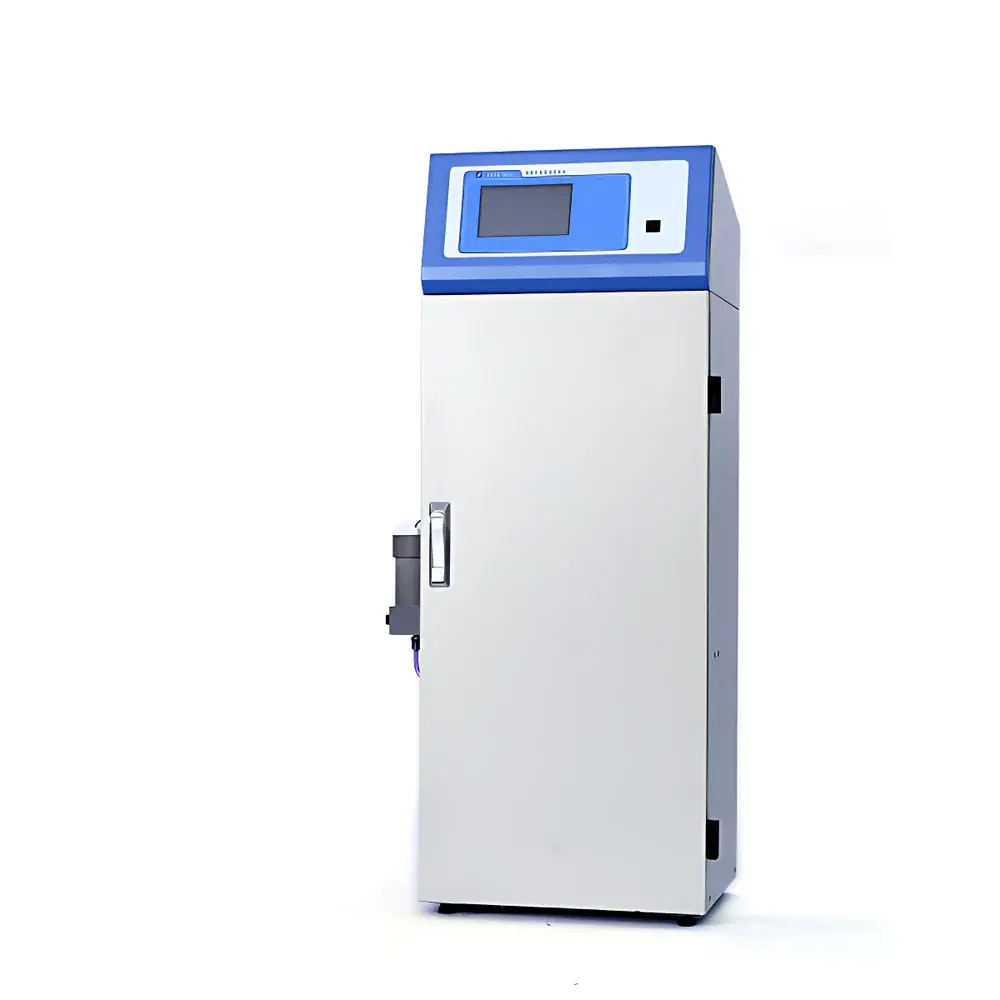
SAIL HERO XHAN-90B Online Ammonia Nitrogen Analyzer
| Brand | SAIL HERO |
|---|---|
| Origin | Hebei, China |
| Manufacturer Type | Original Equipment Manufacturer (OEM) |
| Product Category | Domestic |
| Model | XHAN-90B |
| Instrument Type | Online Analyzer |
| Measurement Principle | Ammonia Gas-Sensing Electrode Method |
| Measurement Range | 0–1000 mg/L NH₃–N (adjustable in multiple sub-ranges) |
| Detection Limit | 0.05 mg/L NH₃–N |
| Response Time | < 3 minutes (t₉₀) |
| Sample Requirements | Particulate concentration ≤ 10 mg/L, particle size < 0.1 mm (filtration not required) |
| Calibration | Automated two-point calibration (zero/span) |
| Data Storage | ≥ 90 days of high-resolution time-stamped records (1-min to 1-h intervals configurable) |
| Communication Interfaces | 4–20 mA analog output, RS485 serial interface, MODBUS RTU protocol support |
| Remote Access | TCP/IP-enabled for web-based monitoring and configuration |
| Maintenance Features | Automatic electrode cleaning cycle, reagent level monitoring, fault diagnostics with event logging |
| Compliance | Designed to meet ISO 15681-2:2022 (Water quality — Determination of phosphorus and nitrogen compounds — Part 2: Ammonium — Electrode method), supports GLP/GMP data integrity requirements including audit trail and user access control |
Overview
The SAIL HERO XHAN-90B Online Ammonia Nitrogen Analyzer is an industrial-grade, continuous-monitoring instrument engineered for reliable, real-time quantification of ammonium-nitrogen (NH₃–N) in aqueous matrices using the potentiometric ammonia gas-sensing electrode principle. Unlike colorimetric or distillation-based methods, this analyzer operates on selective membrane diffusion: free ammonia (NH₃) volatilizes from the sample into a thin alkaline buffer layer, crosses a hydrophobic gas-permeable membrane, and dissolves in an internal electrolyte solution where it alters the pH-dependent potential of a pH-sensitive glass electrode. This electrochemical signal is linearly correlated to NH₃–N concentration over the full 0–1000 mg/L range, with trace-level sensitivity down to 0.05 mg/L. Its design targets unattended operation in municipal wastewater treatment plants, industrial effluent discharge points (e.g., pharmaceutical, brewing, fertilizer, textile dyeing), and surface water quality surveillance networks—environments demanding robustness against variable pH, conductivity, and low-level suspended solids.
Key Features
- Gas-sensing electrode architecture eliminates need for chemical reagents beyond standardized calibration solutions—reducing operational cost and hazardous waste generation.
- No filtration required for samples with turbidity ≤ 10 mg/L and particulates < 0.1 mm—minimizing clogging risk and maintenance frequency.
- Automated two-point calibration routine (zero and span) executed at user-defined intervals; calibration history and drift metrics are logged with timestamps.
- Integrated ultrasonic or mechanical electrode cleaning module activates on schedule or upon signal stability detection—preserving long-term electrode response fidelity.
- Onboard non-volatile memory retains ≥ 90 days of second-level measurement data, including raw mV readings, temperature-compensated concentration values, calibration events, and system diagnostics.
- Comprehensive alarm framework: reagent depletion, sensor timeout, signal deviation > ±15% from baseline, temperature out-of-range, and communication loss—all trigger relay outputs and Syslog-compatible notifications.
- Modular hardware design allows field replacement of electrode cartridges, peristaltic pump tubing, and pH reference modules without recalibration.
Sample Compatibility & Compliance
The XHAN-90B accommodates influent and effluent streams across diverse water matrices: activated sludge return lines, tertiary treatment outfalls, river intake points, and industrial process drains. It maintains accuracy under pH 6.5–9.5 and conductivity 200–2000 µS/cm without external conditioning. Interference from common ions (e.g., Na⁺, K⁺, Ca²⁺, Cl⁻) is negligible below 5000 mg/L; elevated sulfide (> 0.5 mg/L) or high organic load may require optional UV pretreatment. The analyzer conforms to ISO 15681-2:2022 for method validation and supports regulatory data integrity standards—including electronic signature capability, role-based user permissions, and tamper-evident audit trails aligned with FDA 21 CFR Part 11 Annex 11 expectations for environmental monitoring systems.
Software & Data Management
Embedded firmware provides local web interface (HTTP/HTTPS) for configuration, real-time trend visualization, and diagnostic review. Data export supports CSV and XML formats via USB or Ethernet. Optional SAIL HERO Cloud Connect enables secure TLS-encrypted telemetry to SCADA platforms or LIMS using MQTT or OPC UA protocols. All measurements include embedded metadata: sensor ID, temperature, sample flow status, calibration validity flag, and QC check results. Firmware updates are delivered via signed OTA packages with SHA-256 verification.
Applications
- Continuous compliance monitoring of NH₃–N discharge limits per EU Urban Wastewater Treatment Directive (91/271/EEC) and US EPA NPDES permit conditions.
- Process optimization in nitrification/denitrification basins—correlating real-time NH₃–N with DO, ORP, and nitrate profiles.
- Early-warning detection of upstream contamination events in drinking water source protection zones.
- Batch release testing support in pharmaceutical manufacturing where ammonium residuals must remain below ICH Q5C thresholds.
- Research-grade longitudinal studies of nitrogen cycling in constructed wetlands and aquaculture recirculation systems.
FAQ
What sample pretreatment is required prior to analysis?
No filtration or centrifugation is needed if suspended solids are ≤ 10 mg/L and particle diameter remains under 0.1 mm. For higher turbidity, a 5-µm inline filter is recommended.
How often must the ammonia electrode be replaced?
Typical service life is 6–12 months depending on sample matrix aggressiveness; performance degradation is tracked via daily zero-check stability and span recovery rate.
Does the analyzer support integration with existing PLC or DCS systems?
Yes—via standard 4–20 mA analog output, MODBUS RTU over RS485, or optional Profibus DP and HART 7 modules.
Is remote firmware update capability available?
Firmware upgrades can be performed securely over HTTPS or via USB stick with cryptographic signature validation.
Can measurement data be exported in formats compatible with EPA STORET or WQX?
CSV exports include all required fields (station ID, parameter code, result value, unit, detection limit, QA/QC flags); mapping templates for WQX submission are provided in the installation toolkit.
Related Products







