
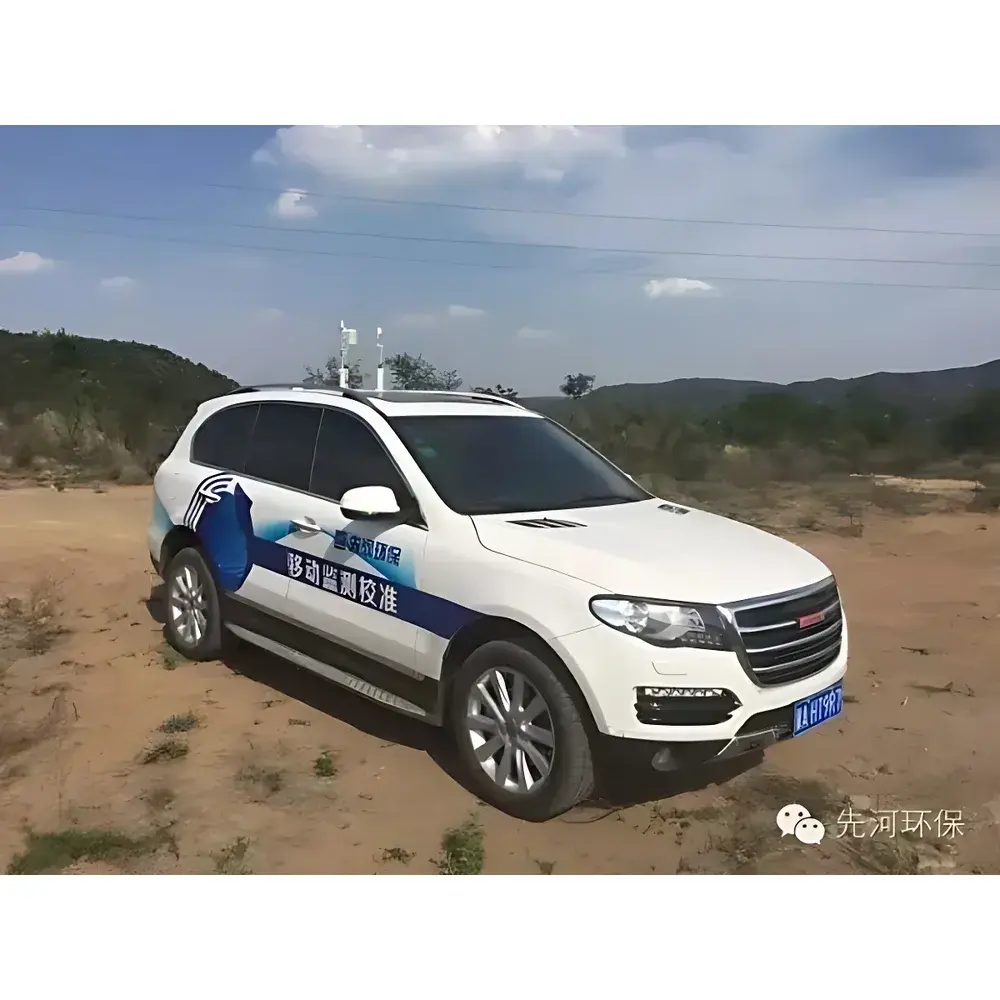
SAIL HERO XHAQMS4000 Mobile Ambient Air Calibration and Monitoring Vehicle
| Brand | SAIL HERO |
|---|---|
| Origin | Hebei, China |
| Manufacturer Type | Direct Manufacturer |
| Country of Origin | China |
| Model | XHAQMS4000 |
| Pricing | Upon Request |
Overview
The SAIL HERO XHAQMS4000 is a fully integrated mobile ambient air calibration and monitoring vehicle engineered for high-mobility environmental quality assurance in dynamic field operations. Designed around standardized analytical principles—including UV fluorescence (for SO₂), chemiluminescence (for NO/NO₂), beta attenuation (for PM₂.₅/PM₁₀), and non-dispersive infrared (for CO)—the system complies with Chinese national ambient air quality standards (HJ 653–2013, HJ 654–2013) and aligns with internationally recognized measurement methodologies referenced in ISO 7935, ISO 12039, and EN 14625. Unlike static reference stations, the XHAQMS4000 functions as a traceable, on-the-move calibration hub—capable of performing co-located, real-time comparison between regulatory-grade analyzers and dense-network low-cost sensors (e.g., micro-stations), thereby quantifying sensor bias, drift, and spatial representativeness under actual ambient conditions.
Key Features
- Multi-functional integration: Combines reference-grade calibration, continuous ambient monitoring, GIS-enabled mobile mapping, and command-center coordination within a single Class 3 chassis-based platform.
- Rapid deployment architecture: Equipped with automatic leveling, rooftop analyzer mounting rails, and climate-controlled instrument cabin (maintaining 20–25 °C ±2 °C and <60% RH), enabling operational readiness within 15 minutes of vehicle stop.
- Traceable calibration capability: Supports span/zero verification, multi-point linear calibration, and dynamic dilution using certified gas standards (NIST-traceable cylinders), with full audit trail logging per ISO/IEC 17025 requirements.
- Real-time georeferenced data fusion: Integrates GPS-RTK positioning (accuracy ≤10 cm), onboard meteorological sensors (wind speed/direction, temperature, humidity, pressure), and synchronized pollutant concentration streams to generate time-resolved pollution heatmaps.
- Secure remote operation: Implements TLS 1.2–encrypted MQTT and HTTP(S) protocols for bidirectional telemetry; supports remote firmware updates, parameter reconfiguration, and diagnostic access via role-based web console compliant with IEC 62443-3-3 Level 1.
Sample Compatibility & Compliance
The XHAQMS4000 is validated for gaseous and particulate ambient air matrices across urban, industrial, roadway, tunnel, and peri-urban environments. It meets the sampling interface specifications defined in EPA Method TO-15 (VOCs), EN 14625 (NOₓ), and HJ 93–2013 (PM). All onboard analyzers undergo annual third-party verification against national metrological standards (CNAS-accredited laboratories). The vehicle’s electrical architecture conforms to GB/T 21275–2007 (vehicle-mounted equipment EMC) and GB 7258–2017 (motor vehicle safety standards). Data acquisition software maintains full ALCOA+ (Attributable, Legible, Contemporaneous, Original, Accurate, Complete, Consistent, Enduring, Available) compliance for GLP/GMP-aligned environmental reporting.
Software & Data Management
The embedded AirTrack™ v4.2 software suite provides unified control of all subsystems—including analyzer sequencing, calibration event scheduling, GPS trajectory interpolation, and automated QA/QC flagging (e.g., outlier detection via Hampel identifier, zero/span failure alerts). Raw and processed data are stored locally in SQLite3 databases with SHA-256 checksum integrity verification and exported in netCDF-4 or CSV formats compliant with ISO 19115 metadata conventions. Audit logs record every user action, configuration change, and calibration event with digital signature and timestamp—meeting FDA 21 CFR Part 11 electronic record requirements when deployed under regulated environmental programs.
Applications
- Regulatory enforcement: Supporting environmental inspection teams during mobile source emissions investigations and non-compliance verification at industrial perimeters.
- Emergency response: Deploying within 2 hours of incident notification to characterize plume dispersion (e.g., chemical spills, fire smoke) with sub-kilometer spatial resolution.
- Network validation: Performing rolling intercomparison campaigns across municipal micro-station networks to correct systematic offsets and improve model input fidelity.
- Transport corridor assessment: Conducting longitudinal transects along highways, rail lines, and tunnels to quantify exposure gradients and inform ventilation design.
- Baseline characterization: Establishing pre-development air quality benchmarks for EIA (Environmental Impact Assessment) and post-construction verification per GB/T 14885–2015.
FAQ
Does the XHAQMS4000 meet international calibration traceability requirements?
Yes—it utilizes NIST- or BIPM-traceable gas standards and follows procedures aligned with ISO/IEC 17025 for measurement uncertainty estimation.
Can it operate autonomously without on-site personnel?
It supports unattended 72-hour monitoring cycles with automated calibration checks, but initial site setup and QA validation require trained operators.
Is the system compatible with existing municipal air quality data platforms?
Yes—via configurable API endpoints supporting AQICN, OpenAQ, and custom XML/JSON schemas with OAuth 2.0 authentication.
What is the maximum continuous operating duration on battery backup?
With auxiliary power unit (APU) engaged, runtime exceeds 8 hours; with shore power or vehicle engine idle, operation is indefinite.
How is cybersecurity managed for remote data transmission?
All communications use certificate-pinned TLS encryption; device authentication employs X.509 certificates, and firmware updates require dual-signature verification.







