
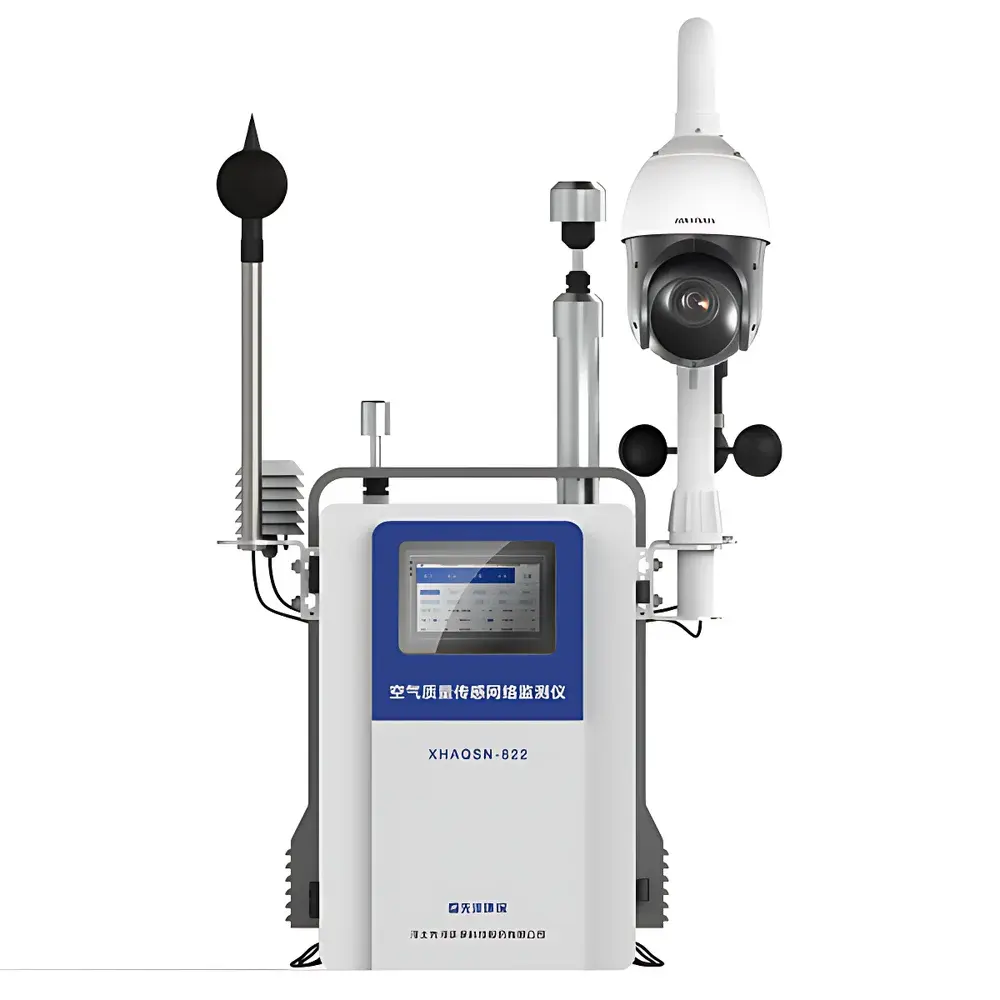
SAIL HERO XHAQSN-822 Air Quality Sensing Network Monitor
| Brand | SAIL HERO |
|---|---|
| Origin | Hebei, China |
| Manufacturer Type | Original Equipment Manufacturer (OEM) |
| Country of Origin | China |
| Model | XHAQSN-822 |
| Pricing | Available upon Request |
| Measured Pollutants | PM2.5, PM10, TSP, CO, O₃, SO₂, NO₂, NO, TVOC |
| Optional Modules | Meteorological Sensors (Temperature, Relative Humidity, Atmospheric Pressure, Wind Speed, Wind Direction), Noise Monitoring, Video Surveillance, Negative Air Ions |
| Sensor Technologies | Laser Scattering (PM), Quad-Electrode Electrochemical (Gases), Photoionization Detection (TVOC) |
| Certifications | CAPI Environmental Product Certification (China) |
Overview
The SAIL HERO XHAQSN-822 Air Quality Sensing Network Monitor is an integrated, field-deployable environmental monitoring platform engineered for continuous, real-time measurement of airborne particulate and gaseous pollutants in ambient urban, industrial, and construction environments. It operates on three complementary sensing principles: laser scattering photometry for mass concentration quantification of PM2.5, PM10, and total suspended particles (TSP); quad-electrode electrochemical detection for selective, stable measurement of carbon monoxide (CO), ozone (O₃), sulfur dioxide (SO₂), nitrogen dioxide (NO₂), and nitric oxide (NO); and photoionization detection (PID) for broad-spectrum volatile organic compound (VOC) monitoring—reported as total VOC (TVOC). Designed for unattended operation across variable climatic conditions, the system incorporates active environmental compensation strategies—including dynamic heating of the particle inlet manifold and embedded temperature-controlled gas chambers—to minimize humidity- and temperature-induced signal drift. Its architecture supports modular expansion and networked deployment via cellular or Ethernet backhaul, enabling scalable air quality sensor networks compliant with national ambient air quality monitoring frameworks.
Key Features
- Laser scattering particulate sensor with auto-cleaning optical path design—reduces optical attenuation from dust accumulation and ensures long-term signal fidelity.
- Dynamic heating of the aerosol sampling tube coupled with proprietary humidity compensation algorithms—mitigates hygroscopic growth artifacts in PM readings under high-RH conditions.
- Automated zero-point calibration routine for particulate sensors—corrects baseline drift without manual intervention or external reference instruments.
- Imported quad-electrode electrochemical gas sensors—enhanced selectivity and reduced cross-sensitivity to interfering gases (e.g., NO₂ interference on NO measurement).
- Temperature-stabilized gas reaction chambers—maintains sensor operating temperature within ±0.5 °C tolerance to ensure electrochemical response consistency across diurnal thermal cycles.
- Modular hardware architecture—supports seamless integration of meteorological sensors (temperature, relative humidity, barometric pressure, wind speed/direction), acoustic noise dosimeters, IP-based video surveillance units, and negative air ion counters.
Sample Compatibility & Compliance
The XHAQSN-822 is validated for ambient air sampling at standard temperature and pressure (STP), with inlet flow rates optimized for representative atmospheric volume capture (≥16.7 L/min). It meets the technical requirements outlined in HJ 653–2013 (Chinese Standard for Ambient Air Quality Monitoring Instruments) and has received formal Environmental Product Certification from the China Association of Environmental Protection Industry (CAPI). While not certified to ISO/IEC 17025 or EPA EQOA protocols out-of-the-box, its sensor-level traceability, documented calibration procedures, and audit-ready data logging support alignment with GLP-compliant field operations. All firmware and data transmission protocols adhere to IEC 61000-4 electromagnetic compatibility standards and RoHS Directive 2011/65/EU material restrictions.
Software & Data Management
Data acquisition is managed by embedded Linux-based firmware supporting dual-mode storage: local microSD logging (CSV/JSON) with configurable intervals (1–60 min), and secure cloud upload via TLS 1.2-encrypted MQTT or HTTP(S) endpoints. The companion web-based platform provides time-series visualization, spatial mapping (GIS-integrated), automated alerting (SMS/email on threshold exceedance), and exportable reports conforming to Chinese Ministry of Ecology and Environment (MEE) reporting templates. Audit trails record all configuration changes, calibration events, and firmware updates—supporting regulatory readiness for internal QA audits and third-party verification. Optional API access enables integration into municipal environmental information systems (EIS) or enterprise IoT platforms.
Applications
- Urban ambient air quality monitoring networks—deployed at traffic intersections, residential zones, and near sensitive receptors (schools, hospitals).
- Construction site compliance monitoring—real-time PM10/PM2.5 tracking against local regulatory thresholds (e.g., Hebei Provincial DB13/1982–2014).
- Industrial fence-line monitoring—continuous detection of fugitive emissions (SO₂, NOₓ, VOCs) for EHS incident prevention and community exposure assessment.
- Smart city infrastructure—fusion of air quality, meteorological, noise, and visual data for multi-parameter environmental dashboards and predictive modeling.
- Research-grade field studies—long-term deployment in epidemiological cohort investigations requiring synchronized pollutant and co-variable (e.g., temperature, wind) datasets.
FAQ
What is the recommended maintenance interval for the XHAQSN-822?
Routine inspection and optical path cleaning are advised every 3 months; electrochemical sensor replacement is typically required every 18–24 months depending on exposure concentration and duty cycle.
Does the system support remote calibration verification?
Yes—zero and span checks can be initiated remotely via the web interface; however, span verification requires on-site introduction of certified calibration gases per HJ 75–2017 guidelines.
Can meteorological and noise modules be added post-purchase?
Yes—modular design allows field upgrade via hardware insertion and firmware activation using authorized configuration keys.
Is raw sensor output accessible for custom algorithm development?
Yes—raw analog/digital sensor outputs and pre-compensated values are available via RS-485 Modbus RTU and optional UART debug interface.
How does the system handle power outages?
Integrated UPS buffer (≥15 min runtime) ensures uninterrupted data logging and graceful shutdown; event-triggered recovery resumes sampling and transmission upon power restoration.







