
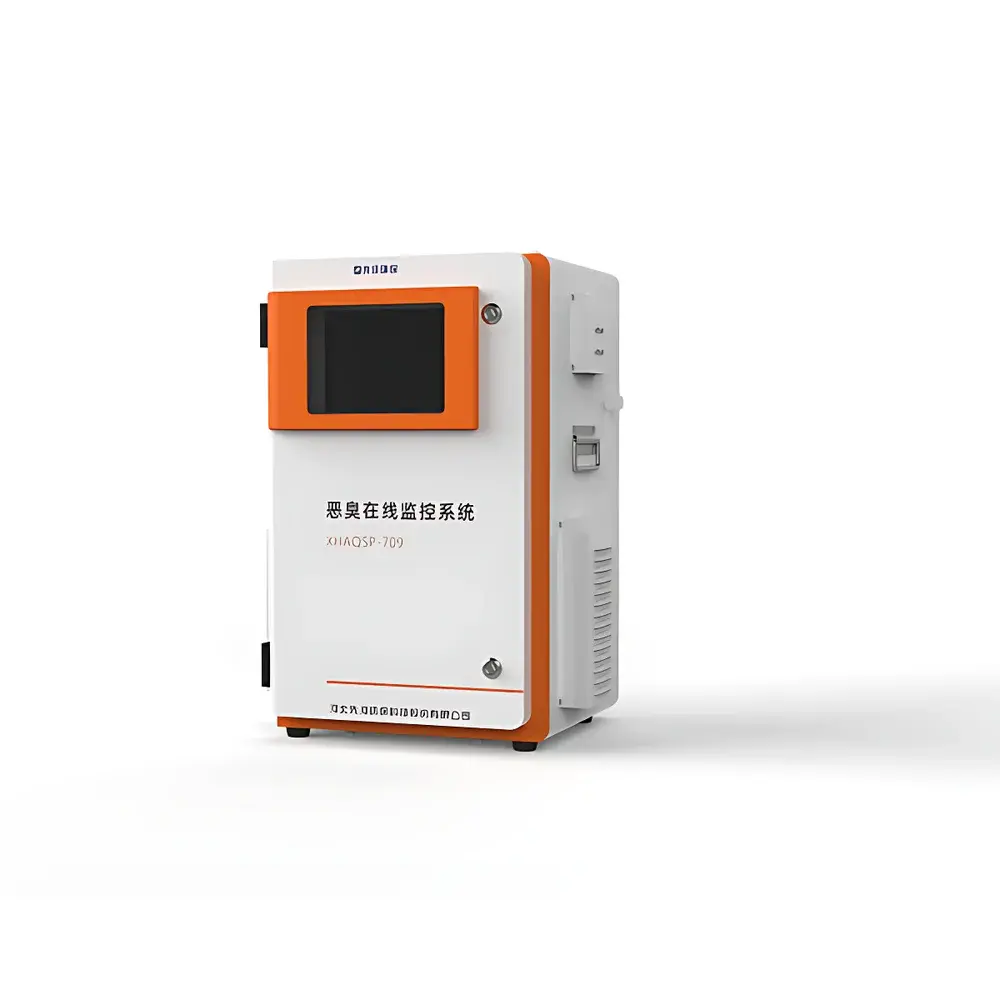
SAIL HERO XHAQSP-709A Online Odor Monitoring System
| Brand | SAIL HERO |
|---|---|
| Origin | Hebei, China |
| Manufacturer Type | Original Equipment Manufacturer (OEM) |
| Product Category | Domestic |
| Model | XHAQSP-709A |
| Instrument Type | Online Continuous Emission Monitoring System (CEMS) |
| Detection Principle | Hybrid Sensor Array (Electrochemical, Metal Oxide Semiconductor – MOS, and Photoionization Detector – PID) |
| Target Analytes | NH₃, H₂S, Trimethylamine, Methanethiol, Dimethyl Sulfide, Dimethyl Disulfide, Carbon Disulfide, Styrene, Odor Intensity (OUₘ), Optional: TVOC, Cl₂, HCl |
| Compliance | GB 14554–1993 “Emission Standard of Odorous Pollutants” |
| Data Storage | ≥3 years (local SD + cloud backup) |
| Operating Temperature Range | –20 °C to +50 °C (sensor-controlled) |
| Sampling Method | Constant-flow sampling with integrated thermoelectric cooling condenser and multi-stage particulate filtration |
| Calibration | Automated zero/span calibration using standard gas cylinders |
Overview
The SAIL HERO XHAQSP-709A Online Odor Monitoring System is a continuous, real-time environmental monitoring platform engineered for regulatory-grade measurement of odor-active compounds in industrial emission streams and ambient boundary zones. It operates on a hybrid detection architecture integrating electrochemical (EC), metal oxide semiconductor (MOS), and photoionization detector (PID) sensor technologies—each selected for its selectivity, dynamic range, and long-term stability toward specific volatile organic and inorganic odorants. Unlike single-sensor systems, the XHAQSP-709A employs a multi-channel sensor array calibrated against reference gases traceable to NIM (National Institute of Metrology, China) standards. Its core function is to quantify individual odorants—including ammonia (NH₃), hydrogen sulfide (H₂S), trimethylamine, methanethiol, dimethyl sulfide, dimethyl disulfide, carbon disulfide, and styrene—and compute composite odor intensity (OUm) per GB 14554–1993 methodology. The system applies proprietary cross-interference compensation algorithms and neural network-based pattern recognition to resolve overlapping responses in complex gas matrices—enabling robust odor intensity estimation even under variable humidity, temperature, and co-pollutant conditions.
Key Features
- Hybrid sensor array architecture combining EC, MOS, and PID detection modalities for broad-spectrum odorant coverage and improved analytical specificity.
- Integrated thermoelectric cooling condenser and multi-stage mechanical filtration for active dew point suppression and particulate removal—critical for stable operation in high-humidity or dusty fixed-source environments.
- Active sensor temperature control (–20 °C to +50 °C) ensuring consistent sensitivity and minimizing drift across seasonal ambient fluctuations.
- Constant-flow sampling pump with mass flow controller (MFC) feedback, maintaining ±1% volumetric accuracy over extended deployment periods.
- Automated zero/span calibration sequence triggered by programmable schedule or remote command; supports certified calibration gases (e.g., 10 ppm H₂S in N₂, 50 ppm NH₃ in air).
- 7-inch industrial-grade capacitive touchscreen HMI with local data visualization, alarm configuration, and event log review; no external PC required for routine operation.
- Dual communication interface: RS485 Modbus RTU (wired) and LTE Cat-1 (wireless), enabling secure data transmission to central SCADA or cloud-based EMS platforms.
Sample Compatibility & Compliance
The XHAQSP-709A is validated for use in stack gas monitoring (dilution-probe or direct-insertion configurations), fence-line ambient monitoring, and wastewater treatment plant headspace applications. It meets the technical requirements of GB 14554–1993 for odor concentration determination and supports optional extension to ISO 16000-29 (indoor air—determination of odor concentration by dynamic olfactometry) via configurable output protocols. While not certified to EU EN 13725 or US EPA Method TO-15, its sensor response profiles and calibration traceability align with GLP-aligned field validation practices. All firmware and data handling modules are designed to support audit-ready logging per ISO/IEC 17025:2017 clause 7.7 (result reporting) and accommodate future integration with FDA 21 CFR Part 11-compliant data management systems via API.
Software & Data Management
The embedded firmware includes a dual-layer data architecture: raw sensor voltage outputs and compensated concentration values are timestamped at 1-second intervals and stored locally on industrial-grade microSD (≥32 GB). Data export supports CSV, JSON, and Modbus TCP formats. Remote access is enabled via HTTPS-secured web interface or MQTT protocol for ingestion into third-party platforms (e.g., Siemens Desigo, Schneider EcoStruxure, or custom Python-based dashboards). Audit trails record all calibration events, parameter changes, and maintenance alerts with user ID and UTC timestamps. Firmware updates are delivered OTA (over-the-air) with SHA-256 signature verification to ensure integrity.
Applications
- Continuous compliance monitoring at municipal wastewater treatment plants (WWTPs), rendering facilities, and composting sites.
- Fence-line odor surveillance for petrochemical refineries, pharmaceutical manufacturing units, and food processing plants subject to local odor ordinances.
- Source apportionment studies where temporal correlation between individual odorants and OUm trends informs abatement strategy optimization.
- Long-term trend analysis for environmental impact assessments (EIAs) and corporate sustainability reporting (GRI 305, CDP Climate Change Questionnaire).
- Integration into smart city environmental IoT networks for neighborhood-level odor hotspot identification and public notification systems.
FAQ
What calibration gases are required for routine maintenance?
Certified standard gases traceable to national metrology institutes are required: e.g., 10 ppm H₂S in nitrogen, 50 ppm NH₃ in synthetic air, and 100 ppm isobutylene (for PID response normalization). Calibration frequency is recommended every 7–14 days depending on exposure severity.
Does the system support remote diagnostics and firmware updates?
Yes—diagnostic logs, sensor health metrics (e.g., baseline drift, response time), and firmware version status are accessible via secure HTTPS or MQTT. OTA updates include cryptographic signature validation.
How does the system handle high relative humidity (>90% RH)?
The integrated Peltier-cooled condenser maintains sample gas dew point below 5 °C prior to sensor exposure, while hydrophobic membrane filters prevent liquid water ingress. Humidity compensation algorithms adjust PID and MOS outputs in real time.
Can the XHAQSP-709A be integrated with existing plant DCS or SCADA?
Yes—Modbus RTU (RS485) and Modbus TCP (Ethernet) protocols are natively supported; custom OPC UA or IEC 61850 gateways can be deployed upon request.
Is the data storage compliant with long-term archival requirements?
Local microSD storage retains ≥3 years of 1-minute averaged data (≈1.6 million records). Exported datasets include ISO 8601 timestamps, sensor-specific uncertainty flags, and calibration certificate references—meeting minimum retention expectations under GB/T 32200–2015 (Environmental Monitoring Data Management Specification).







