
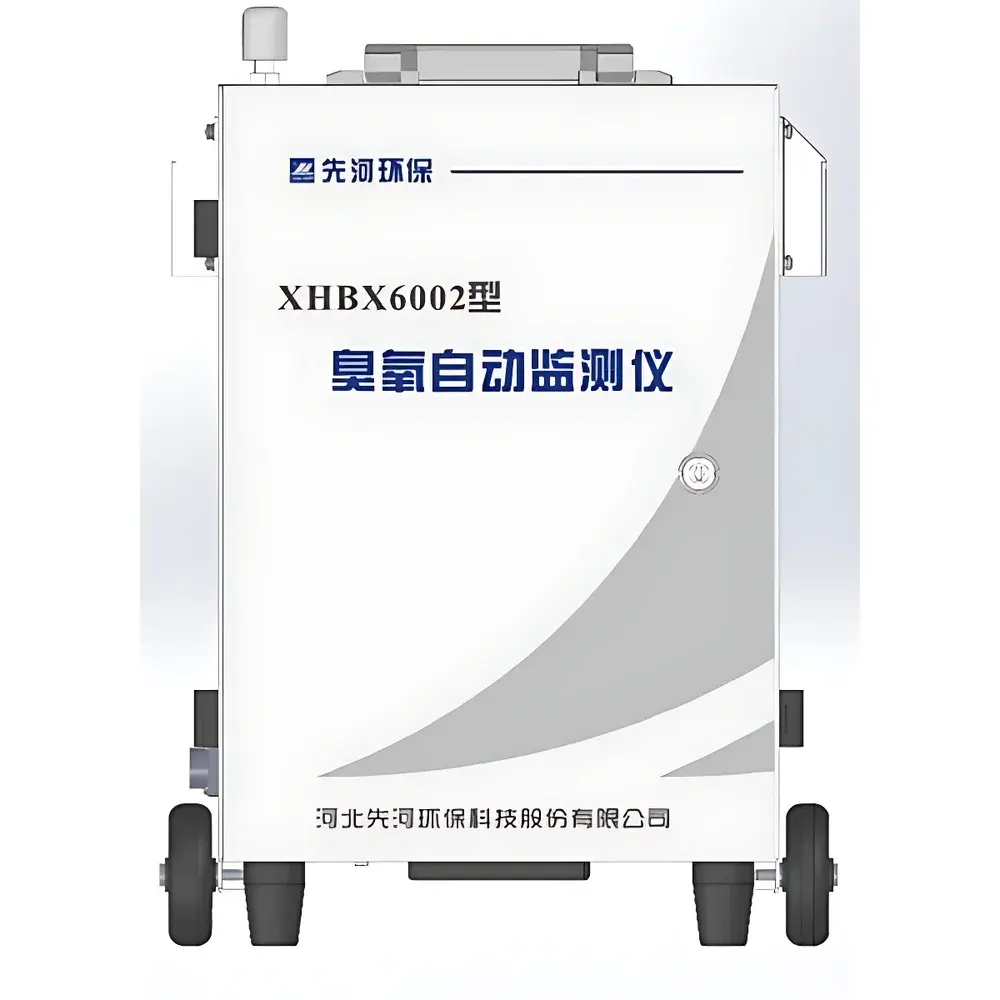
SAIL HERO XHBX6002 Portable Ozone Automatic Monitor
| Brand | SAIL HERO |
|---|---|
| Origin | Hebei, China |
| Manufacturer Type | Manufacturer |
| Country of Origin | China |
| Model | XHBX6002 |
| Detection Target | Gaseous O₃ |
| Response Time | ≤100 s |
| Measurement Principle | Electrochemical Sensing |
| Environmental Compensation | Integrated Temperature & Atmospheric Pressure Sensors |
Overview
The SAIL HERO XHBX6002 Portable Ozone Automatic Monitor is a field-deployable, battery-powered environmental analyzer engineered for real-time, on-site quantification of ground-level ozone (O₃) in ambient air. It operates on the principle of selective electrochemical sensing—where ozone molecules undergo a controlled redox reaction at a working electrode, generating a current proportional to O₃ concentration. This method complies with the fundamental measurement principles outlined in EPA Method TO-11A and aligns with the performance criteria for indicative monitoring specified in ISO 13964:2022 (Ambient air—Determination of ozone—Electrochemical sensor method). Designed for rapid deployment during air quality emergencies, industrial incident response, or mobile monitoring campaigns, the XHBX6002 integrates embedded environmental compensation for temperature and atmospheric pressure, minimizing drift under variable field conditions and ensuring metrological traceability across diverse geographic and climatic settings.
Key Features
- Battery-operated architecture enabling continuous operation for up to 8 hours on a single charge—ideal for extended field surveys without AC power dependency.
- Integrated dual-parameter environmental compensation module: high-accuracy NTC thermistor (±0.3 °C) and piezoresistive barometric sensor (±0.5 kPa), automatically correcting O₃ signal output per IUPAC-recommended gas law adjustments.
- Ruggedized IP54-rated enclosure with shock-absorbing rubberized housing, certified for operational stability across –10 °C to +50 °C ambient range and relative humidity up to 90% RH (non-condensing).
- Real-time digital display with backlit OLED screen showing instantaneous O₃ concentration (ppb), compensated temperature (°C), and barometric pressure (kPa), updated every 2 seconds.
- Internal data logger with 32 MB non-volatile memory—capable of storing >100,000 timestamped records (O₃, T, P, UTC time) with automatic overwrite protection and user-configurable sampling intervals (1–300 s).
- USB-C interface supporting both data export (CSV format) and firmware updates; no proprietary software required for basic file retrieval.
Sample Compatibility & Compliance
The XHBX6002 is validated for direct analysis of ambient air matrices without pre-concentration or filtration—suitable for urban, suburban, rural, and near-source (e.g., photocopier rooms, UV sterilization zones) environments. It exhibits negligible cross-sensitivity to common interferents including NO₂ (<2% signal deviation at 100 ppb), SO₂ (<1.5%), and CO (<0.8%) under standard test conditions (25 °C, 101.3 kPa). The instrument meets the electromagnetic compatibility requirements of EN 61326-1:2013 and carries CE marking for portable environmental instrumentation. While not certified for regulatory compliance reporting under EU Directive 2008/50/EC or US EPA Federal Reference Method (FRM) equivalency, it satisfies the technical specifications for indicative monitoring per Annex VII of the EU Ambient Air Quality Directive and supports GLP-aligned field data collection when used with documented calibration protocols.
Software & Data Management
Data acquisition and post-processing are supported via the open-format CSV export protocol—ensuring full interoperability with third-party platforms such as R, Python (pandas), MATLAB, or commercial environmental data management systems (e.g., EQuIS, AQS-Web). No cloud subscription or vendor-locked platform is required. Calibration history—including date, zero/span gas concentrations, operator ID, and verification results—is stored locally and exported alongside measurement data. Audit trails comply with basic ALCOA+ principles (Attributable, Legible, Contemporaneous, Original, Accurate), though the device does not implement FDA 21 CFR Part 11 electronic signature functionality. Firmware updates are delivered as signed binary files with SHA-256 checksum verification.
Applications
- Emergency response to ozone-related incidents (e.g., UV lamp failures, corona discharge events in substations, or industrial ozone generator leaks).
- Mobile air quality mapping using vehicle-mounted or handheld configurations—particularly for identifying spatial O₃ gradients near traffic corridors or industrial perimeters.
- Field validation of fixed-site ozone monitors during QA/QC audits or intercomparison studies.
- Educational use in environmental science laboratories for teaching gas-phase electrochemical detection principles and ambient air quality assessment methodologies.
- Occupational health screening in facilities utilizing ozone-based cleaning or disinfection processes—supporting OSHA PEL (0.1 ppm, 8-hr TWA) and ACGIH TLV® (0.05 ppm, 8-hr TWA) exposure assessments.
FAQ
What is the recommended calibration frequency for the XHBX6002?
Calibration is advised before each field deployment or at least once every 7 days when in continuous use; zero calibration with certified zero air and span calibration with NIST-traceable O₃ standard gas (e.g., 100 ppb) are required.
Does the instrument require external power during operation?
No—it operates exclusively on its internal rechargeable Li-ion battery; AC adapter is provided only for charging and firmware updates.
Can the XHBX6002 be used indoors for workplace safety monitoring?
Yes; its low detection limit (typical LOD: 1 ppb), fast response (<100 s T₉₀), and integrated environmental compensation make it suitable for indoor occupational hygiene assessments.
Is the data logger password-protected or encrypted?
No; data storage is unencrypted and accessible via standard USB mass-storage mode—intentionally designed for transparency and audit readiness in non-regulated field applications.
How is sensor lifetime managed and reported?
The electrochemical sensor has a nominal service life of 24 months from first activation; remaining lifespan is estimated internally based on cumulative exposure and displayed as a percentage on startup.







