
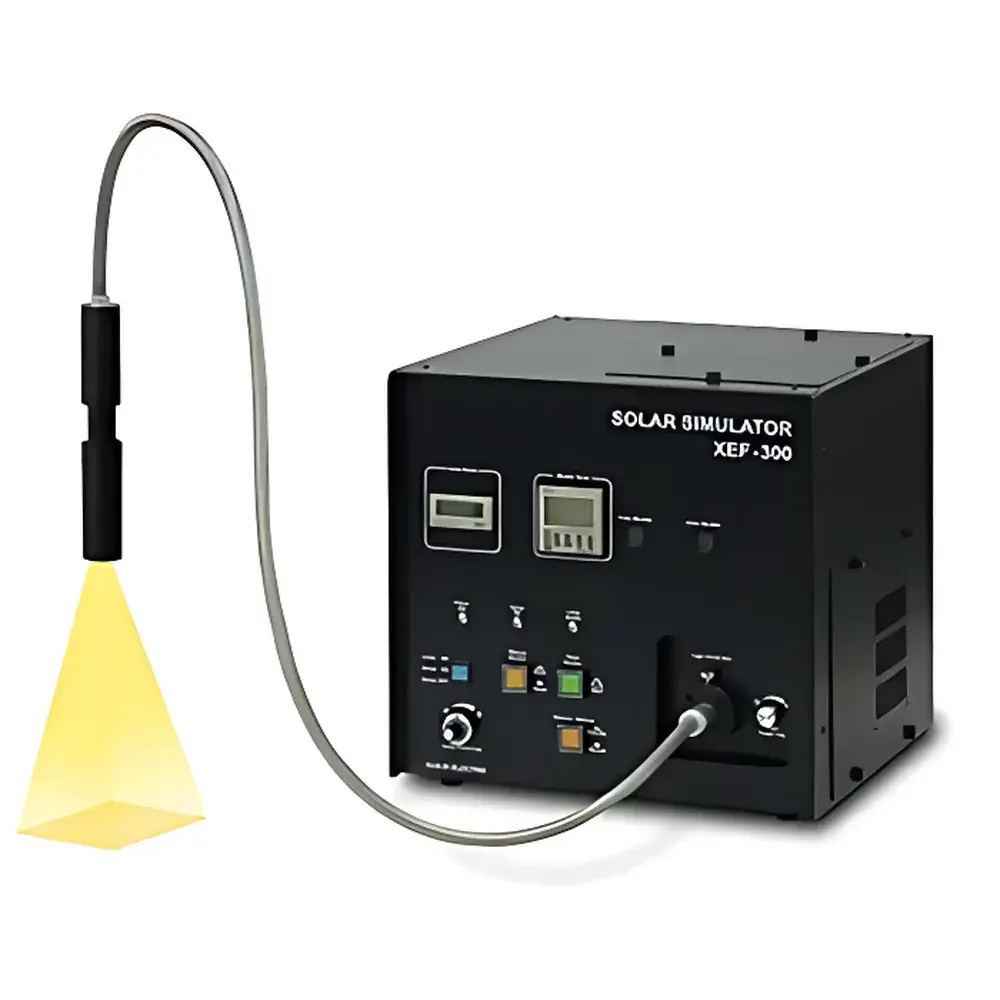
SAN-EI XEF-300 Fiber-Optic Steady-State Solar Simulator
| Brand | SAN-EI |
|---|---|
| Origin | Japan |
| Model | XEF-300 |
| Illumination Mode | Steady-State |
| Spectral Class | AAA (ASTM/IEC/JIS 3A) |
| Spectral Match (AM1.5G) | < ±12.5% (A+ Class) |
| Spatial Non-Uniformity | < 2% (A Class) |
| Temporal Instability | < 1% (A+ Class) |
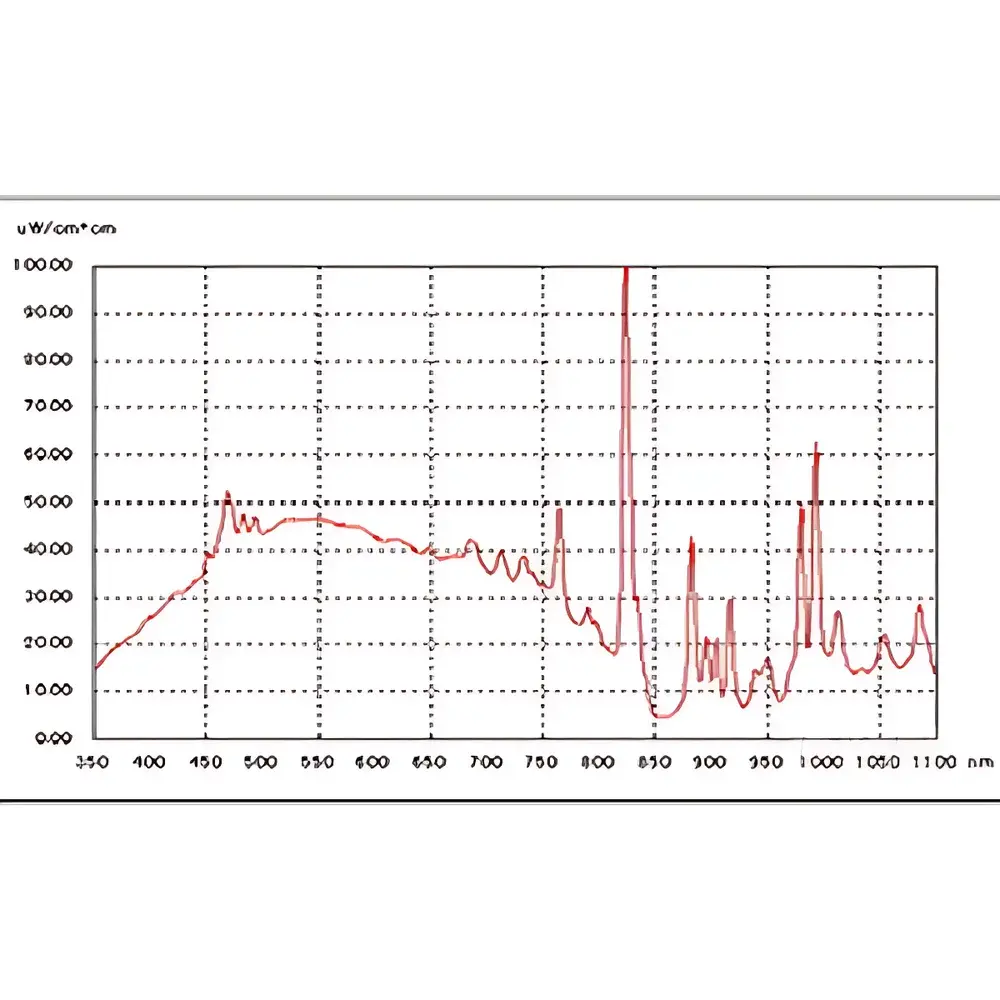
| Spectral Range | 300–1200 nm |
| Effective Irradiation Area | 2" × 2" (customizable up to 500 mm × 500 mm) |
| Light Source | 150–300 W Short-Arc Xenon Lamp |
| Optical Delivery | Fiber-Coupled Output |
| Beam Direction | Adjustable |
| Compliance | ASTM E927-23, IEC 60904-9 Ed. 3, JIS C 8912 |
Overview
The SAN-EI XEF-300 is a fiber-optic coupled, steady-state solar simulator engineered for high-fidelity photovoltaic and photoelectrochemical characterization under controlled illumination conditions. Unlike traditional direct-illumination simulators, the XEF-300 integrates a stabilized short-arc xenon lamp with a high-efficiency optical fiber delivery system—enabling spatial decoupling of the light source from the sample stage. This architecture eliminates thermal radiation interference, minimizes convective heating at the sample plane, and supports seamless integration into inert-atmosphere gloveboxes, vacuum chambers, or multi-instrument test benches. The system delivers Class AAA performance per ASTM E927-23, IEC 60904-9 Ed. 3, and JIS C 8912 standards, with spectral match deviation < ±12.5% against AM1.5G reference (A+ grade), spatial non-uniformity < 2% (A grade), and temporal instability < 1% over 1 hour (A+ grade). Its calibrated spectral output spans 300–1200 nm, covering the full photoresponse range of silicon, perovskite, organic, and tandem photovoltaic devices, as well as photosynthetic and photobiological specimens.
Key Features
- Fiber-coupled illumination path isolates heat-generating lamp housing from measurement zone—critical for temperature-sensitive OPV, perovskite, and biological samples.
- Adjustable beam exit orientation and lamp position enable flexible optical alignment with custom fixtures, spectrometers, or in situ reaction cells.
- Digitally programmable irradiance control (0–1.5 suns, traceable to NIST-calibrated reference cells) ensures repeatable light intensity across experiments.
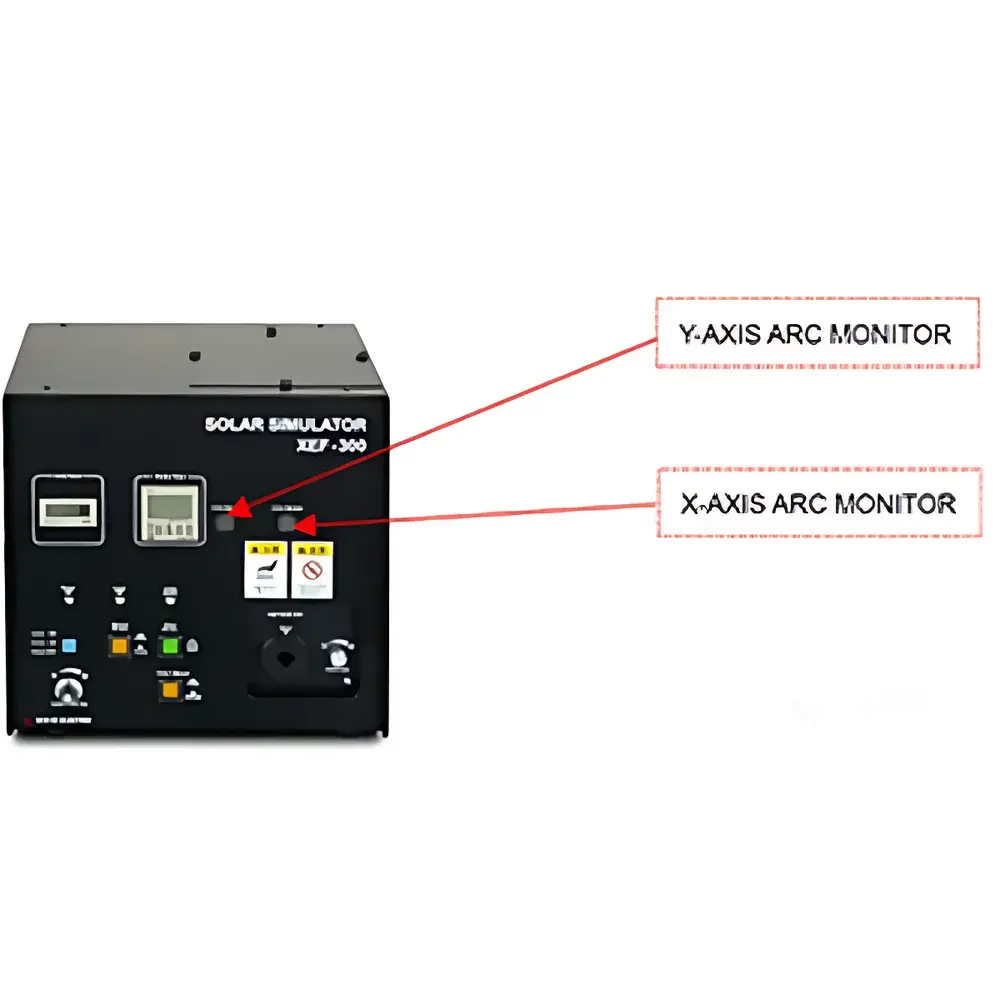
- Integrated lamp-hour counter and real-time arc stability monitoring support predictive maintenance and GLP-compliant instrument lifecycle tracking.
- Modular design accommodates optional collimation optics, spectral filters (e.g., UV-cut, IR-cut), and beam homogenizers for specialized applications including spectral responsivity mapping.
- Compliance-ready architecture includes hardware interlocks, emergency shutoff, and RS-232/Ethernet interfaces for synchronized triggering with source-measure units (SMUs) or data acquisition systems.
Sample Compatibility & Compliance
The XEF-300 is validated for use with rigid and flexible substrates—including glass/ITO, FTO, PET/AgNW, and silicon wafers—as well as liquid-phase photoelectrodes and microbial cultures in quartz cuvettes or custom flow cells. Its low-thermal-load illumination enables stable testing of thermally labile perovskite thin films without observable phase segregation during prolonged exposure. All optical calibration certificates are issued per ISO/IEC 17025-accredited procedures and include full spectral irradiance data (300–1200 nm, 1 nm resolution), spatial uniformity maps, and temporal stability logs. The system meets requirements for regulatory submissions under IEC 61215 (PV module qualification), USP (analytical instrument qualification), and FDA 21 CFR Part 11 when paired with compliant data acquisition software featuring electronic signatures and audit trails.
Software & Data Management
The XEF-300 operates with SAN-EI’s proprietary PVLab Control Suite (v4.2+), a Windows-based application supporting full IEC 60904-10-compliant IV/PV curve acquisition, bias-assisted transient measurements, MPPT tracking, and efficiency degradation analysis (light-soaking, ISOS-L-1/L-2 protocols). Raw irradiance data, SMU synchronization timestamps, and environmental sensor inputs (T, RH) are logged in HDF5 format with embedded metadata (instrument ID, calibration date, operator ID). Export options include CSV, MATLAB .mat, and PQDIF-compliant files for third-party analysis in Origin, Python (SciPy/Pandas), or MATLAB. Optional integration with Keysight B2900A/B2910B or Keithley 2450/2636B SMUs enables automated dark/light IV sweeps with forward/reverse scan directionality, series resistance extraction via single-diode modeling, and dynamic load-line analysis.
Applications
- Quantitative power conversion efficiency (PCE) evaluation of perovskite, organic, dye-sensitized, and multi-junction solar cells per ISO 18550 and IEC 60904-1.
- Spectral responsivity and external quantum efficiency (EQE/IPCE) mapping using monochromator-coupled configurations.
- Stability assessment under continuous illumination (ISOS-L-1), thermal stress (ISOS-T-1), and ambient air exposure (ISOS-O-1).
- Photoelectrochemical water splitting studies requiring precise photon flux control and minimal IR-induced heating.
- Photobiological assays involving cyanobacteria, algae, or plant tissue under standardized solar spectra (AM0 for space applications, AM1.5G for terrestrial).
- Calibration of reference photodiodes and secondary standard cells traceable to NREL or PTB primary standards.
FAQ
What standards does the XEF-300 comply with for solar simulation classification?
It meets AAA (3A) classification per ASTM E927-23, IEC 60904-9 Ed. 3, and JIS C 8912, verified by third-party certification reports included with shipment.
Can the XEF-300 be used inside a nitrogen-filled glovebox?
Yes—the fiber-optic delivery allows full separation of the lamp housing (outside glovebox) and output port (inside glovebox), with optional quartz viewport coupling and purge-compatible mounting flanges.
Is spectral recalibration required after lamp replacement?
Yes—each new xenon lamp requires full spectral recalibration using a NIST-traceable spectroradiometer; SAN-EI provides on-site or return-to-factory recalibration services with ISO/IEC 17025 documentation.
Does the system support automated long-term stability testing?
Yes—via timed irradiance logging, integrated temperature sensors, and programmable duty cycles (e.g., 100 h light-soak with hourly IV sampling), all exportable with timestamped metadata for GLP audit readiness.
What is the maximum customizable irradiation area?
Standard configurations support up to 500 mm × 500 mm; larger areas are feasible with custom homogenizer optics and extended fiber bundles—contact engineering support for feasibility assessment.





