
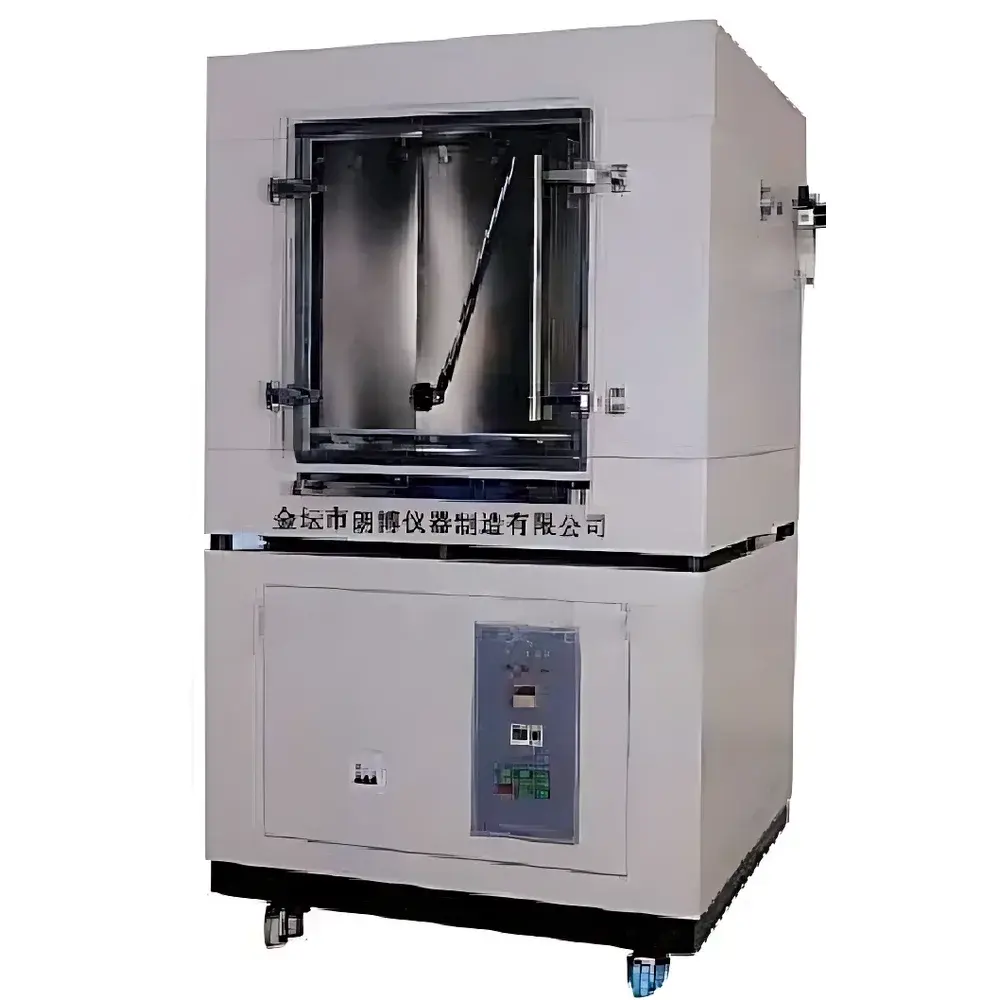
Sand and Dust Test Chamber SC-1000 / SC-1500
| Origin | Jiangsu, China |
|---|---|
| Manufacturer Type | Authorized Distributor |
| Origin Category | Domestic (PRC) |
| Model | SC-1000, SC-1500 |
| Internal Working Dimensions | 1000 × 1000 × 1000 mm (SC-1000) |
| Mesh Wire Diameter | 50 µm |
| Nominal Mesh Spacing | 75 µm |
| Operating Ambient Temperature Range | 15–35 °C |
| Relative Humidity Range | 45–75 %RH |
| Talc Powder Concentration | 2–4 kg/m³ |
| Vibration Impact Duration | 0–99 h 59 min |
| Chamber Construction | Stainless steel inner chamber, electrostatically powder-coated steel outer enclosure, tempered glass observation door |
| Controller | Imported programmable logic controller (PLC) with selectable continuous or cyclic dust-blowing modes |
| Safety Protections | Leakage current protection, phase-loss protection |
Overview
The Sand and Dust Test Chamber SC-1000 and SC-1500 are engineered for standardized environmental simulation of particulate ingress under controlled airborne dust conditions. Designed in accordance with IEC 60529 (IP5X and IP6X), MIL-STD-810H Method 510.7, and GB/T 2423.37–2006 (equivalent to ISO 20623:2012), these chambers replicate real-world exposure to non-abrasive, dry, fine particulate matter—primarily talc powder—to evaluate the dust-tightness and operational integrity of enclosures, electronic housings, automotive components, aerospace subsystems, and outdoor industrial equipment. The test principle relies on gravitational sedimentation combined with controlled mechanical vibration (impact shaker) and forced-air suspension to maintain a uniform, reproducible dust cloud within the working volume. Unlike thermal or humidity chambers, sand and dust testing focuses exclusively on mechanical sealing performance and ingress resistance—not material degradation—making precise control over particle size distribution, concentration, and exposure duration critical for regulatory compliance and design validation.
Key Features
- Two standard configurations: SC-1000 (1 m³ internal volume) and SC-1500 (3.375 m³ internal volume), both featuring identical metrological specifications and control architecture.
- Stainless steel inner chamber (AISI 304) ensures corrosion resistance, long-term dimensional stability, and ease of powder residue removal between test cycles.
- Calibrated stainless steel wire mesh (50 µm wire diameter, 75 µm nominal spacing) installed at the air inlet serves as a physical sieve to limit maximum particle size, ensuring consistency with IEC-defined “fine dust” classification.
- Programmable PLC-based controller enables precise definition of dust suspension mode: continuous blowing, intermittent cycling, or timed vibration-only phases—each independently adjustable for duration, interval, and intensity.
- Integrated impact shaker system delivers calibrated mechanical vibration across the full test specimen support platform, simulating transport-induced agitation that promotes dust penetration through marginal seals.
- Dual-safety architecture includes automatic cut-off for leakage current detection and three-phase power monitoring to prevent operation under unbalanced or missing-phase conditions.
Sample Compatibility & Compliance
The SC-1000/SC-1500 accommodates specimens up to 900 × 900 × 900 mm (SC-1000) or 1400 × 1400 × 1400 mm (SC-1500), allowing full-system evaluation of control cabinets, junction boxes, LED streetlight housings, UAV chassis, and military-grade connectors. All operational parameters—including ambient temperature (15–35 °C), relative humidity (45–75 %RH), and talc concentration (2–4 kg/m³)—are maintained within tolerances defined by IEC 60529 Annex B and ISO 20623 Clause 6. The chamber does not generate heat or moisture; it operates strictly as an ambient-conditioned particulate exposure environment. As such, it is compatible with GLP-compliant test laboratories when paired with validated SOPs, operator training records, and audit-ready calibration logs for vibration amplitude, airflow velocity, and powder mass delivery rate.
Software & Data Management
While the base configuration utilizes a standalone imported PLC with LCD interface, optional Ethernet-enabled controllers support Modbus TCP or OPC UA integration for centralized lab management systems. Real-time logging captures timestamped data for vibration start/stop events, total elapsed blow time, cycle count, and fault codes (e.g., phase loss, overtemperature alarm). All logged data are exportable as CSV files for traceability. For regulated environments, optional 21 CFR Part 11-compliant firmware packages provide user-level access control, electronic signatures, and immutable audit trails—meeting FDA, ISO 13485, and IATF 16949 documentation requirements.
Applications
- IP rating verification (IP5X: protection against limited dust ingress; IP6X: complete dust-tightness) per IEC 60529.
- Design validation of gasketed enclosures for outdoor telecom infrastructure and renewable energy inverters.
- Reliability screening of automotive ECU housings subjected to desert road conditions.
- Qualification testing of portable medical devices intended for field deployment in arid climates.
- Supplier qualification audits requiring third-party witnessed dust ingress testing under accredited laboratory conditions.
FAQ
What standards does the SC-1000/SC-1500 comply with?
IEC 60529 (IP5X/IP6X), MIL-STD-810H Method 510.7, GB/T 2423.37–2006, and ISO 20623:2012.
Can the chamber be used with materials other than talc powder?
Only talc powder meeting ISO 12103-1 A2 (Fine Test Dust) specifications is recommended; substitution with silica sand or other abrasives voids compliance with IEC and MIL standards and risks chamber contamination or sensor damage.
Is temperature or humidity control integrated into the chamber?
No—the chamber maintains ambient laboratory conditions only (15–35 °C, 45–75 %RH) and does not include active heating, cooling, or humidification subsystems.
How is dust concentration verified during operation?
Concentration is pre-set volumetrically using calibrated powder dispensers; verification requires external gravimetric sampling per ISO 10112 or optical particle counter validation prior to test execution.
Does the system include calibration certification?
Factory calibration certificates for vibration amplitude, airflow uniformity, and timer accuracy are provided; annual recalibration by an ISO/IEC 17025-accredited provider is recommended for auditable test reports.



