
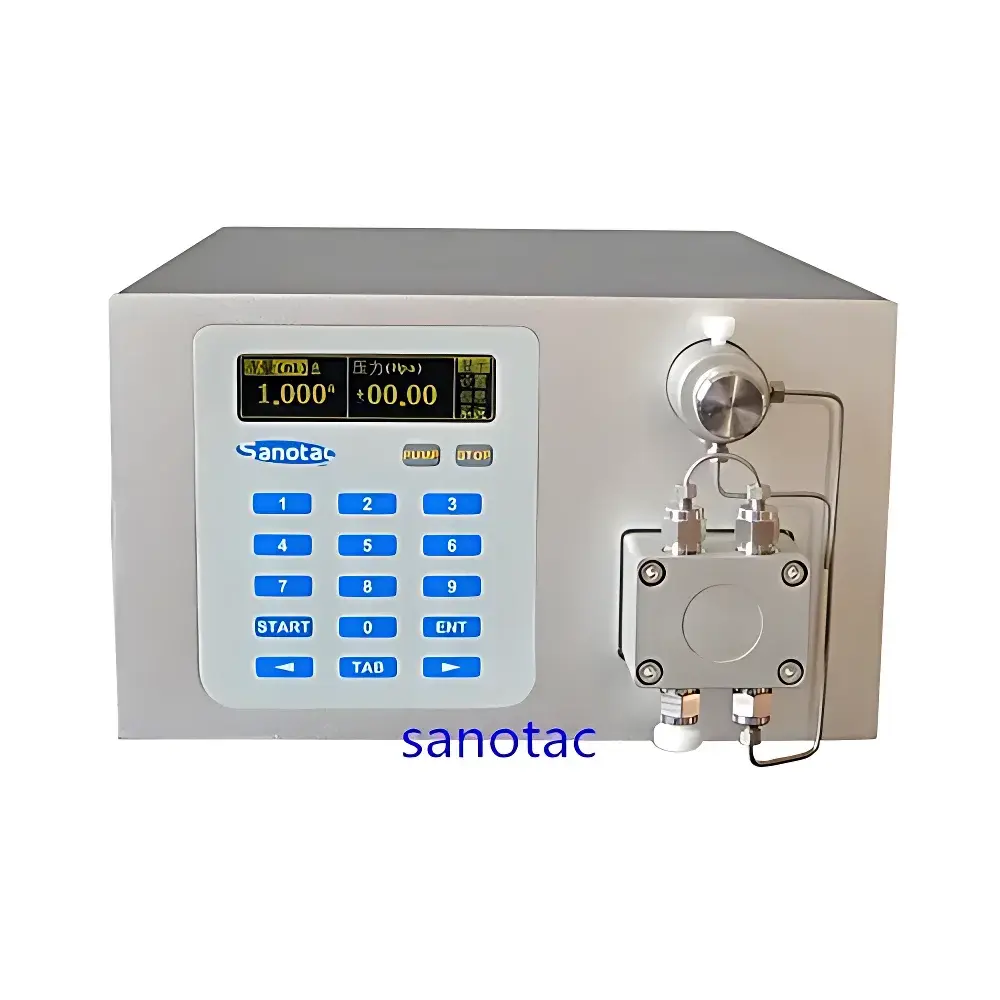
Sanotac CH0010 Analytical High-Pressure Syringe Pump for Catalytic Reaction Evaluation Systems
| Brand | Sanotac |
|---|---|
| Origin | Shanghai, China |
| Manufacturer Type | Direct Manufacturer |
| Product Origin | Domestic (China) |
| Model | CH0010 |
| Price Range | USD 1,400 – 2,800 |
| Flow Rate Range | 0.001–9.999 mL/min |
| Flow Increment | 0.001 mL/min |
| Flow Accuracy | ±0.1% |
| Flow Precision (RSD) | ≤0.1% |
| Maximum Pressure | 42 MPa |
| Pressure Pulsation | ≤0.1 MPa |
| Pump Head Volume | 10 mL |
| Drive Mechanism | Dual-piston serial configuration with floating piston design |
| Wetted Materials | 316L stainless steel, ruby, PTFE, ceramic |
| Tubing Connection | 1/16" standard fittings |
| Display | 256×64 dot matrix backlit LCD |
| Control Interface | Front-panel keypad + RS232/USB computer remote control (open protocol) |
| Power Supply | 85–264 VAC, 50 Hz |
| Dimensions (W×D×H) | 370×240×152 mm |
| Compliance | Designed for GLP-compliant catalytic testing environments |
Overview
The Sanotac CH0010 Analytical High-Pressure Syringe Pump is an engineered fluid delivery module specifically developed for catalytic reaction evaluation systems in research laboratories and pilot-scale process development facilities. It operates on a dual-piston serial displacement principle with floating piston architecture, enabling precise, pulse-dampened liquid metering under sustained high-pressure conditions up to 42 MPa. Unlike peristaltic or diaphragm-based constant-flow devices, the CH0010 employs positive displacement via precision-machined 316L stainless steel pump heads, ruby check valves, and ceramic plungers—ensuring long-term volumetric fidelity across wide dynamic flow ranges (0.001–9.999 mL/min). Its design prioritizes metrological traceability, mechanical robustness, and seamless integration into automated reactor control loops—making it suitable not only for conventional fixed-bed or slurry-phase catalytic testing but also for supercritical fluid-assisted reactions, hydrothermal synthesis, and electrocatalysis feedstock delivery where flow stability directly impacts kinetic data reproducibility.
Key Features
- Dual-piston serial drive with real-time solvent compressibility compensation, minimizing baseline drift during gradient elution or multi-component reagent injection
- Floating piston mechanism reduces radial loading on high-pressure seals, extending seal service life by ≥3× compared to rigid-plunger configurations
- Multi-point flow calibration algorithm embedded in microprocessor firmware corrects nonlinearity across full flow range, achieving ±0.1% absolute accuracy and ≤0.1% RSD repeatability
- Low-pressure pulsation (<0.1 MPa) achieved through cam-profile optimization and active electronic pulse suppression—critical for pressure-sensitive catalyst beds and membrane reactors
- Open-protocol RS232/USB interface supports bidirectional communication with third-party chromatography data systems (CDS), LIMS, or custom Python/Matlab-based reactor orchestration software
- Preloaded with ten user-defined method programs supporting time-resolved flow ramping, multi-step gradient profiles (isocratic, linear, step), and pressure-triggered pause/resume logic
Sample Compatibility & Compliance
The CH0010 accommodates aggressive process fluids commonly encountered in heterogeneous catalysis studies—including aqueous ammonia solutions, organic solvents (THF, DMF, dioxane), supercritical CO₂, hydrogen sulfide-containing streams, and viscous ionic liquids—thanks to its chemically inert wetted path (316L SS, ruby, PTFE, and ceramic). All materials comply with FDA 21 CFR §177.2470 (PTFE) and ASTM F2136 (ceramic component biocompatibility standards). The pump’s mechanical design meets ISO 11277 Annex B for laboratory fluid metering systems, and its firmware implements audit-trail-capable parameter logging aligned with GLP Annex 11 and FDA 21 CFR Part 11 requirements when operated under validated workstation control.
Software & Data Management
The pump operates autonomously via its onboard 256×64 backlit LCD interface or integrates into centralized lab automation via open ASCII command protocol. No proprietary drivers are required—standard terminal emulators or Python pySerial libraries can configure flow profiles, monitor real-time pressure/flow telemetry, and trigger external events (e.g., valve actuation upon reaching target residence time). Data export supports CSV-formatted timestamped logs with millisecond resolution, compatible with MATLAB, OriginLab, and JMP for kinetic modeling. Firmware updates are performed via USB mass storage mode without external programming hardware.
Applications
- Continuous-flow catalytic screening: steady-state delivery of reactants to fixed-bed, trickle-bed, or monolithic reactors
- Supercritical fluid processing: controlled co-injection of scCO₂ and organometallic precursors in nanoparticle synthesis
- Electrocatalytic fuel cell testing: precise stoichiometric feeding of methanol/water mixtures to PEM anodes
- Hydrodesulfurization (HDS) and hydrocracking model studies: high-pressure H₂ + diesel surrogate delivery into microreactors
- Time-resolved operando spectroscopy: synchronized reagent pulses with XAS or DRIFTS acquisition windows
- Automated catalyst deactivation profiling: programmed flow decay sequences mimicking industrial fouling kinetics
FAQ
Is the CH0010 compatible with corrosive media such as concentrated HCl or HF?
Yes—when configured with optional PCTFE or Hastelloy C-276 pump heads and PEEK tubing, the CH0010 maintains structural integrity and metrological performance in highly acidic environments per ASTM G31 immersion testing protocols.
Can it be used in explosion-hazard areas (ATEX Zone 1)?
No—the standard CH0010 lacks intrinsic safety certification; however, Sanotac offers ATEX-certified variants (CH0010-EX) with purged enclosures and Class I, Division 1 motor protection.
Does the pump support real-time flow feedback from external Coriolis meters?
Yes—via analog 4–20 mA input, the CH0010 can close a cascade control loop using external mass flow sensor signals to dynamically adjust piston stroke velocity.
What maintenance intervals are recommended for high-pressure operation (>30 MPa)?
Plunger seals require replacement every 6 months under continuous 40 MPa operation; ruby check valves are rated for ≥10⁶ cycles at full pressure and should be inspected quarterly.
Is firmware source code available for customization?
While the compiled firmware is proprietary, Sanotac provides full command-set documentation, register mapping, and example scripts for LabVIEW, Python, and MATLAB—enabling full functional extension without reverse engineering.
Related Products



