
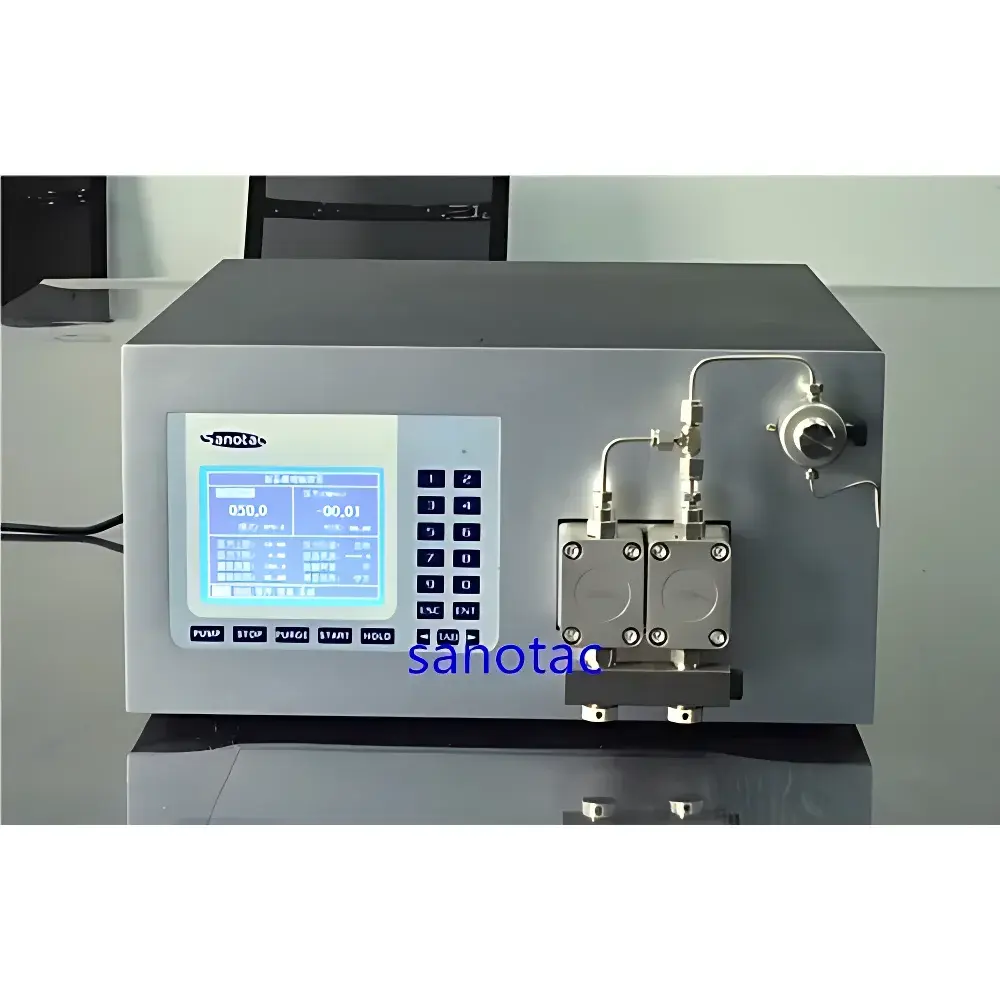
Sanotac GD Series High-Pressure Constant Flow Pump for Fixed-Bed Reactor Systems
| Brand | Sanotac |
|---|---|
| Origin | Shanghai, China |
| Manufacturer Type | Direct Manufacturer |
| Product Origin | Domestic (China) |
| Model | SANOTAC GD |
| Flow Rate | 10 mL/min |
| Maximum Pressure | 42 MPa |
| Construction Materials | 316L Stainless Steel / Hastelloy / PTFE |
| Control Interface | RS-232, RS-485, RS-422, USB |
| Communication Protocols | Sanotac Proprietary, Modbus RTU/ASCII |
| Flow Accuracy | ±0.1% |
| Flow Precision (RSD) | ≤0.1% |
| Pressure Pulsation | ≤0.1 MPa |
| Display | 256×64-dot backlit LCD |
| Dimensions | 370 × 240 × 152 mm |
| Power Supply | 85–264 VAC, 50 Hz |
Overview
The Sanotac GD Series High-Pressure Constant Flow Pump is an engineered solution designed specifically for integration into fixed-bed catalytic reactor systems used in laboratory-scale process development, catalyst screening, and continuous-flow chemical synthesis. Operating on a dual-piston parallel drive architecture with floating plunger design, the pump delivers precise, pulse-dampened solvent or reagent delivery under sustained high-pressure conditions—up to 42 MPa (6,090 psi). Its core measurement principle relies on volumetric displacement calibrated via real-time solvent compressibility compensation and multi-point flow curve correction, ensuring stable mass transfer rates essential for kinetic studies, residence time distribution analysis, and long-duration stability testing. Unlike peristaltic or diaphragm pumps, the GD Series employs positive displacement with mechanical feedback control, making it suitable for non-compressible and low-volatility fluids—including corrosive organometallics, supercritical CO₂ mixtures, and high-viscosity feedstocks—common in heterogeneous catalysis and hydrogenation workflows.
Key Features
- Dual-piston parallel head design with active plunger position sensing and solvent compression compensation for ±0.1% flow accuracy and ≤0.1% RSD repeatability
- Configurable pressure limits (upper/lower thresholds) with automatic shutdown and alarm logging compliant with IEC 61508 functional safety principles
- Low-pressure pulsation (≤0.1 MPa) achieved via cam-profile motion optimization and electronic pulse suppression circuitry
- Real-time dual-unit flow control: selectable volumetric (mL/min) or gravimetric (g/min) delivery mode synchronized with external mass loss sensors
- Post-plunger wash function to prevent salt crystallization and abrasive deposit accumulation on seals and ceramic plungers
- Modular communication interface supporting RS-232 (standard), RS-485/422 (optional), and USB; fully compatible with Modbus RTU/ASCII and Sanotac’s native protocol
- Scalable control architecture: supports 1:1 local operation or 1:32 distributed control via industrial fieldbus, enabling seamless integration into SCADA, DCS, or PLC-based automation environments
- Onboard data logging with timestamped pressure and flow curves exportable to Excel (.csv) format for GLP-compliant audit trails
Sample Compatibility & Compliance
The GD Series accommodates a wide range of chemically aggressive media through configurable wetted-path materials—including 316L stainless steel, Hastelloy C-276, and PTFE-lined fluidic paths—meeting ASTM A240 and ISO 15156-3 requirements for sour service compatibility. Its mechanical design conforms to CE Machinery Directive 2006/42/EC and electromagnetic compatibility standards EN 61326-1. For regulated environments, the pump’s firmware supports configurable audit trail parameters (user ID, timestamp, parameter change log), aligning with FDA 21 CFR Part 11 data integrity expectations when used with validated SanoFlu Fluid Control Management Software. It is routinely deployed in ISO/IEC 17025-accredited laboratories performing catalyst activity testing per ASTM D3226 and reaction calorimetry per ISO 11358.
Software & Data Management
The SanoFlu Fluid Control Management System provides a unified interface for configuring, monitoring, and archiving pump operations. Users can define gradient programs, set dynamic pressure protection profiles, and assign unique method IDs linked to experimental metadata. The software supports bidirectional communication with load cells or analytical balances (e.g., Mettler Toledo XPR series) to implement closed-loop gravimetric feeding—critical for stoichiometric precision in exothermic hydrogenations or nitration reactions. All operational logs—including flow deviations exceeding ±0.5%, pressure excursions, and maintenance alerts—are stored with SHA-256 hashed integrity verification. Exported datasets include ISO 8601 timestamps, device serial numbers, and calibration certificate traceability references, satisfying ALCOA+ (Attributable, Legible, Contemporaneous, Original, Accurate, Complete, Consistent, Enduring, Available) documentation criteria.
Applications
- Fixed-bed reactor feed control in Fischer–Tropsch synthesis, hydrodesulfurization (HDS), and ammonia oxidation studies
- Continuous-flow hydrogenation and asymmetric epoxidation requiring sub-milliliter-per-minute dosing precision
- Supercritical fluid processing (scCO₂, scCHF₃) where thermal expansion and compressibility effects demand real-time flow compensation
- Automated catalyst deactivation profiling with extended-run (>168 h) stability validation under constant pressure differentials
- Integration into PAT (Process Analytical Technology) frameworks for real-time feed-forward control based on inline IR or UV-Vis sensor feedback
FAQ
What pressure ranges are supported, and how is overpressure protection implemented?
The GD Series operates up to 42 MPa with programmable upper/lower pressure thresholds. Hardware-based pressure transducers trigger immediate motor stoppage and relay output activation upon threshold breach, independent of software polling cycles.
Can the pump be calibrated in-house, and what documentation is provided?
Yes—users access a dedicated calibration parameter zone to input system-specific correction factors. Each unit ships with a NIST-traceable factory calibration certificate covering flow rate (at 5, 10, and 20 mL/min) and pressure (at 10, 25, and 42 MPa) points.
Is the SanoFlu software validated for GMP environments?
While the base software is not pre-validated, its architecture includes configurable electronic signatures, role-based access control, and immutable audit logs—enabling site-specific IQ/OQ/PQ validation per Annex 11 and GAMP 5 guidelines.
How does the post-plunger wash function interface with system solvents?
It utilizes a dedicated auxiliary port connected to a secondary solvent reservoir, activated automatically after each run cycle or manually via software command, with programmable dwell time and volume.
What certifications apply to hazardous area installations?
Standard units are rated for Class I, Division 2 (NEC) / Zone 2 (IECEx) environments; explosion-proof variants with ATEX-certified enclosures are available upon request.



