
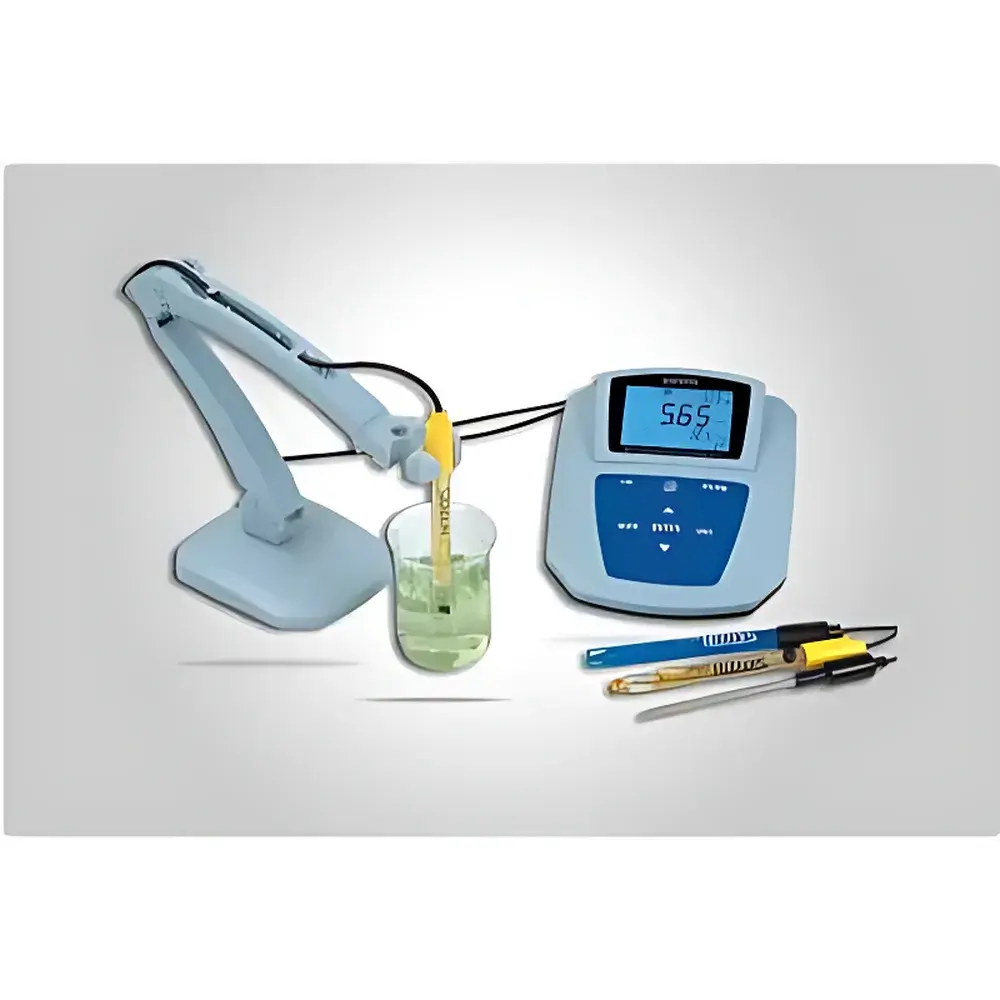
SANXIN MP522 Precision pH / Conductivity Meter
| Brand | SANXIN |
|---|---|
| Origin | Shanghai, China |
| Manufacturer Type | OEM Manufacturer |
| Model | MP522 |
| Instrument Type | Laboratory Water Quality Analyzer |
| Measured Parameters | pH, mV, ORP, Conductivity, Resistivity, TDS, Salinity |
| pH Range | −2.000 to 19.999 |
| pH Accuracy | ±0.002 |
| Temperature Compensation (pH) | 0–100 °C |
| mV Range | ±1999.9 mV |
| mV Accuracy | ±0.03% FS |
| Conductivity Range | 0–2000 mS/cm (6 ranges, K=1 and K=10 electrodes supported) |
| Conductivity Accuracy | ±0.5% FS |
| Temperature Range | −10 to 110 °C |
| Temp. Accuracy | ±0.4 °C |
| Resistivity | 0–100 MΩ·cm |
| TDS | 0–100 g/L |
| Salinity | 0–100 ppt |
| Data Storage | 900 sets |
| Interface | RS232 |
| Power | DC 9 V / 300 mA |
| Dimensions | 160 × 190 × 70 mm |
| Weight | 880 g |
| IP Rating | IP54 |
| GLP Compliance | Yes |
Overview
The SANXIN MP522 Precision pH / Conductivity Meter is a dual-parameter benchtop analyzer engineered for high-accuracy, trace-level water quality assessment in regulated laboratory environments. It operates on potentiometric principles for pH and ORP measurement, and employs four-electrode AC conductivity detection with automatic frequency and voltage adjustment—enabling stable, low-drift measurements across six decades of conductivity (0.00 μS/cm to 2000 mS/cm). Designed specifically for applications ranging from ultrapure water monitoring in semiconductor and pharmaceutical utilities to municipal wastewater characterization, the MP522 integrates advanced temperature compensation algorithms—including non-linear compensation for high-purity water—and supports both linear and segmented calibration protocols per ISO/IEC 17025 and ASTM D1125 guidelines.
Key Features
- True dual-parameter operation: simultaneous, independent pH and conductivity measurement with shared temperature reference (ATC)
- Automatic range switching and intelligent electrode recognition: identifies up to 13 pH buffer standards (NIST, DIN, JIS, GB) and 8 conductivity standards (USP, ASTM, GB, custom)
- Dedicated high-purity water modes: configurable pH measurement modes for ammonia-amended and non-ammoniated ultrapure water, with built-in non-linear temperature compensation (0–50 °C)
- One-point conductivity calibration capability: extends effective range of K=1 sensors to 100 mS/cm via adaptive frequency modulation—eliminating need for multi-point calibrations in routine QC workflows
- Comprehensive electrochemical measurement suite: includes mV, ORP (vs. SHE), resistivity, TDS (with selectable conversion factor), and salinity (ppt)
- GLP-compliant data handling: timestamped storage of 900 measurement records with electrode ID, calibration history, and environmental conditions
- Robust mechanical design: IP54-rated enclosure with silicone-sealed ports, integrated electrode holder (602 universal stand), and DC-powered operation for EMI-free benchtop use
Sample Compatibility & Compliance
The MP522 accommodates a broad spectrum of aqueous matrices including deionized water, boiler feedwater, reverse osmosis permeate, process cooling water, and wastewater effluents. Its 2503-C glass pH electrode ensures stability in low-ionic-strength and colloidal samples, while the optional DJS-0.1 (K=0.1) and 2310-C (K=10) conductivity cells extend operational coverage to ultrapure (2000 mS/cm) applications. The instrument conforms to GLP requirements per FDA 21 CFR Part 11 (when used with validated RS232 logging software), supports audit-trail-capable data export, and meets IEC 61000-4 electromagnetic compatibility standards. All calibration and measurement procedures align with ISO 7888 (conductivity), ISO 3696 (water purity), and USP for purified water testing.
Software & Data Management
Equipped with an RS232 serial interface, the MP522 enables direct communication with Windows-based laboratory information systems (LIMS) or dedicated data acquisition software (included). Raw datasets include measurement time, temperature, electrode serial numbers, calibration status flags, and operator-defined sample IDs. The firmware implements automatic data stabilization detection (with visual “ready” indicator), programmable auto-hold, and timed interval measurement—critical for unattended batch analysis. Exported CSV files contain metadata fields required for regulatory submission, including traceable calibration dates, standard lot numbers, and uncertainty annotations per ISO/IEC Guide 98-3 (GUM).
Applications
- Pharmaceutical water system validation (PW, WFI, pure steam condensate) per EU GMP Annex 1 and USP
- Power plant cycle chemistry monitoring: condensate polishing, feedwater pH control, and turbine bypass sampling
- Microelectronics fab ultrapure water (UPW) qualification per SEMI F63 and ASTM D5127
- Environmental lab compliance testing for surface water, groundwater, and treated effluent under EPA Method 120.1 and ISO 10523
- Academic and industrial research requiring trace pH accuracy in low-conductivity solvents and colloidal suspensions
FAQ
Does the MP522 support FDA 21 CFR Part 11 compliance?
Yes—when paired with the included RS232 software and configured with user authentication, electronic signatures, and audit-trail logging, the system meets core Part 11 requirements for electronic records and signatures in regulated environments.
Can the MP522 measure pH in high-purity water without ammonia addition?
Yes—the instrument includes a dedicated “ultrapure water” pH mode that applies non-linear temperature compensation and adjusts for liquid junction potential drift inherent in low-conductivity samples.
What conductivity cell constants are supported?
Standard configuration includes K=1 (2401-M); optional cells include K=0.1 (DJS-0.1) for sub-μS/cm measurements and K=10 (2310-C) for high-salinity brines up to 2000 mS/cm.
Is temperature measurement performed independently or via ATC electrode?
Both options are available: integrated ATC in composite electrodes or discrete MP500 thermistor probe for higher accuracy (±0.2 °C) in critical applications.
How is calibration traceability maintained?
Each calibration event stores buffer lot numbers, expiration dates, measured values, and deviation metrics; all data are exportable with full metadata for internal QA review or external audit.
Related Products







