
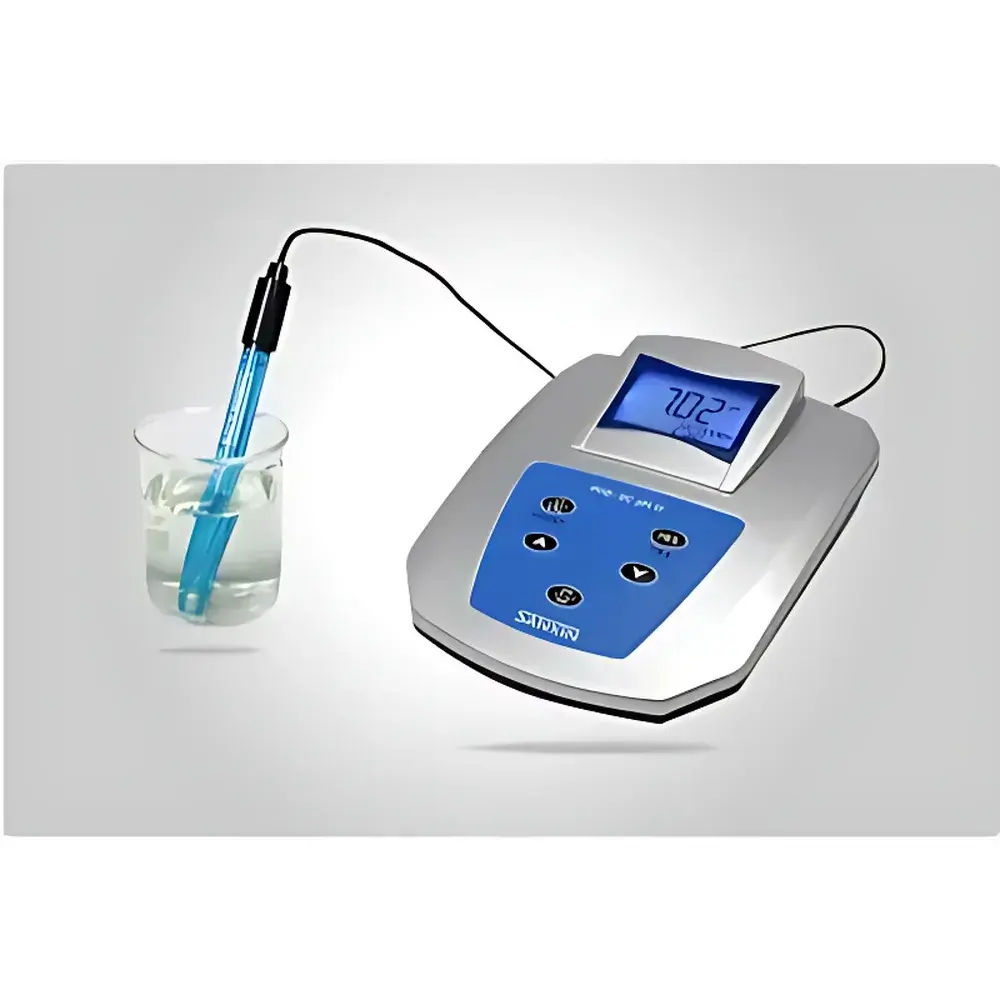
Sanxin PHS-2C Benchtop pH Meter
| Brand | Sanxin |
|---|---|
| Model | PHS-2C |
| Type | Benchtop Electrochemical pH Meter |
| Origin | Shanghai, China |
| Manufacturer | Sanxin Peray Instrument Co., Ltd. |
| Measurement Range (pH) | 0.00–14.00 pH |
| Resolution | 0.1 / 0.01 pH |
| Accuracy (meter) | ±0.01 pH ±1 digit |
| Accuracy (with electrode) | ±0.02 pH ±1 digit |
| mV Range | ±1500 mV |
| mV Resolution | 1 mV |
| mV Accuracy | ±0.15% FS ±1 digit |
| Input Impedance | ≥1 × 10¹² Ω |
| Stability | ≤±0.01 pH ±1 digit / 3 h |
| Temperature Compensation | Manual (0–100 °C) |
| Display | Backlit LCD (blue), simultaneous pH and temperature readout |
| Calibration | Dual-slope, 3-point automatic calibration |
| Electrode Slope Display | Yes, post-calibration % slope shown |
| Buffer Sets | Built-in NIST and DIN pH buffer tables (pH 4.00, 6.86, 9.18) |
| Temperature Unit | Selectable °C / °F |
| Power Supply | DC 9 V adapter |
| Dimensions (W × D × H) | 160 × 190 × 70 mm |
| Weight | 750 g |
| Operating Environment | 5–35 °C, ≤85% RH |
| Included Electrode | 201-C plastic-body composite pH electrode |
| Optional Accessory | PHT temperature compensation electrode |
| Standard Buffers Supplied | 50 mL each of pH 4.00, 6.86, and 9.18 |
Overview
The Sanxin PHS-2C is a precision benchtop pH meter engineered for routine electrochemical measurement in academic teaching laboratories, quality control environments, and industrial process support applications. It operates on the fundamental principle of potentiometric measurement: detecting the potential difference between a pH-sensitive glass electrode and a stable reference electrode immersed in an aqueous sample. This voltage—expressed in millivolts—is converted to pH units using the Nernst equation, with built-in temperature compensation ensuring thermodynamic accuracy across variable thermal conditions. Designed for reliability under standard laboratory conditions (5–35 °C, ≤85% RH), the PHS-2C delivers consistent performance without requiring environmental enclosures or specialized infrastructure. Its compact footprint (160 × 190 × 70 mm) and lightweight construction (750 g) facilitate integration into shared lab benches or mobile testing stations. The instrument complies with general requirements for electrochemical instrumentation per IEC 61010-1 (safety) and supports traceable calibration practices aligned with ISO/IEC 17025 documentation frameworks when used with certified reference materials.
Key Features
- Backlit blue LCD display enabling simultaneous real-time readout of pH value and temperature—critical for rapid interpretation during titration or batch monitoring.
- Dual-slope, three-point automatic calibration routine that evaluates both zero offset and electrode sensitivity (slope), yielding higher metrological fidelity than single-point methods.
- Post-calibration display of electrode slope percentage (%), providing immediate diagnostic feedback on electrode health and hydration status—essential for preventive maintenance scheduling.
- Configurable temperature compensation: manual entry across 0–100 °C or fully automatic mode when paired with the optional PHT temperature electrode (not included).
- Built-in dual buffer tables—NIST-traceable and DIN-compliant—allow users to select appropriate calibration standards based on regional regulatory expectations or internal SOPs.
- Selectable temperature units (°C or °F) and user-defined buffer set selection enhance operational flexibility across international educational and industrial settings.
- High-input-impedance circuitry (≥1 × 10¹² Ω) minimizes loading error when measuring low-conductivity samples such as deionized water or organic-aqueous mixtures.
Sample Compatibility & Compliance
The PHS-2C is validated for use with aqueous solutions having conductivity ≥50 µS/cm. It accommodates standard laboratory samples including buffer solutions, culture media, wastewater effluents, food extracts, and pharmaceutical preparations. The supplied 201-C plastic-body composite electrode features a robust Ag/AgCl reference system and low-resistance junction suitable for general-purpose measurements but is not rated for high-pressure, high-temperature, or strongly non-aqueous solvents. For GLP/GMP-regulated workflows, the instrument supports audit-ready calibration logs when paired with external data recording systems; while it does not natively implement FDA 21 CFR Part 11 electronic signature functionality, its stable analog output and deterministic calibration behavior permit integration into validated data acquisition platforms compliant with Annex 11 and ISO 13485 requirements.
Software & Data Management
The PHS-2C operates as a standalone hardware platform with no embedded microprocessor-based data logging or USB connectivity. All measurement data must be manually recorded or captured via external devices (e.g., digital cameras, serial-to-USB adapters with terminal emulation). However, its stable analog signal path and repeatable calibration response make it compatible with third-party DAQ systems supporting RS-232 or analog voltage output interfaces (when adapted). Calibration parameters—including slope, offset, and buffer assignment—are retained in non-volatile memory after power cycling, ensuring continuity across shifts and reducing setup time in multi-user labs. Firmware updates are not supported; functional integrity is maintained through mechanical and electrical design longevity rather than software revision cycles.
Applications
- Undergraduate and graduate chemistry/biology teaching labs: Demonstrating acid-base equilibria, titration curves, and electrode theory.
- QC testing in food & beverage production: Monitoring pH stability of dairy products, sauces, and preserved goods per AOAC and Codex Alimentarius guidelines.
- Environmental field screening support: Pre-checking wastewater influent/effluent prior to advanced ion chromatography or ICP-MS analysis.
- Pharmaceutical excipient verification: Confirming pH compliance of saline solutions, gel bases, and ophthalmic preparations against USP specifications.
- Industrial coolant and boiler water monitoring: Tracking alkalinity drift in closed-loop systems where corrosion risk correlates strongly with pH deviation.
FAQ
What is the recommended calibration frequency for routine use?
For daily operation in stable environments, perform a two-point calibration (pH 7.00 and one bracketing point, e.g., pH 4.00 or 9.18) at the start of each shift. Re-calibrate if ambient temperature changes by >5 °C or after measuring aggressive samples (e.g., strong acids/bases, protein-rich fluids).
Can the PHS-2C measure pH in non-aqueous solvents?
No. The 201-C electrode is designed exclusively for aqueous or predominantly aqueous solutions. Measurements in ethanol, acetone, or oil-based matrices will yield inaccurate and unstable readings due to junction potential distortion and reference electrolyte leaching.
Is automatic temperature compensation (ATC) enabled by default?
No. ATC requires the separately purchased PHT temperature electrode. Without it, only manual temperature entry is available. The instrument does not infer temperature from solution resistance or other proxies.
How is electrode slope interpreted for quality assurance?
A healthy pH electrode exhibits a slope of 95–105% of theoretical (59.16 mV/pH at 25 °C). Slopes below 90% indicate aging, coating, or dehydration; slopes above 105% suggest incorrect buffer assignment or temperature misentry.
Does the PHS-2C meet ISO 5725 or ASTM E70 requirements?
While not certified to these standards, its stated accuracy (±0.02 pH ±1 digit with electrode) and stability (≤±0.01 pH/3 h) fall within the repeatability and intermediate precision thresholds specified in ASTM E70 for Class II pH meters used in non-critical applications.



