
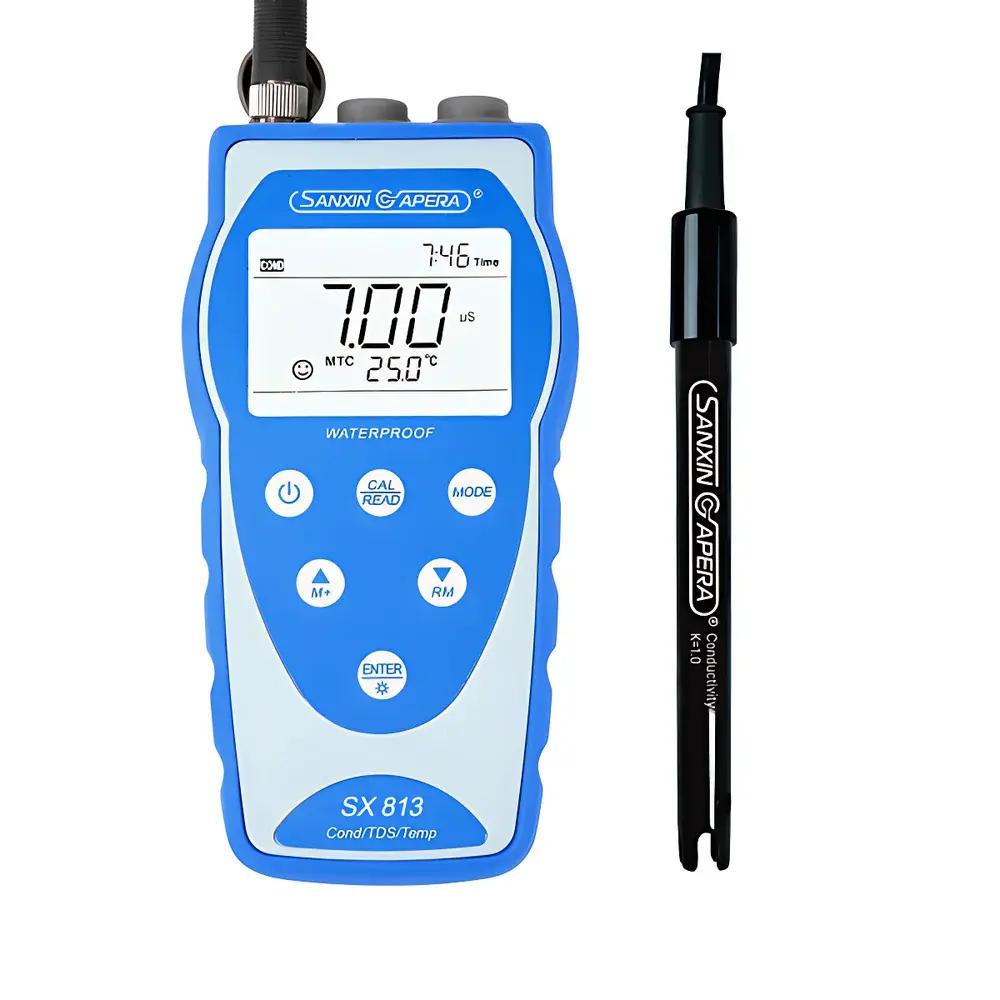


SANXIN SX813 Portable Conductivity Meter
| Brand | SANXIN |
|---|---|
| Origin | Shanghai, China |
| Manufacturer | SANXIN Precision Instruments Co., Ltd. |
| Model | SX813 |
| Detection Parameter | Single-parameter (Conductivity/TDS/Salinity/Resistivity) |
| Portability | Portable |
| Intended Use | Laboratory & Field Applications |
| Conductivity Range | 0–200 mS/cm (5 auto-ranging segments) |
| TDS Range | 0–100 g/L |
| Resistivity Range | 0–100 MΩ·cm |
| Salinity Range | 0–100 ppt |
| Temperature Range | 0–80 °C (automatic compensation) |
| Accuracy | ±1.0% FS ±1 digit |
| Minimum Resolution | 0.01 µS/cm |
| Temperature Accuracy | ±0.5 °C ±1 digit |
| Data Storage | 500 sets with timestamp, unit, temperature, and measurement value |
| IP Rating | IP57 |
| Power Supply | 3×AA batteries (1.5 V) or DC 5 V via USB |
| Dimensions (instrument) | 88 × 170 × 33 mm |
| Weight (instrument) | 313 g |
| Weight (carrying case) | 1.6 kg |
Overview
The SANXIN SX813 Portable Conductivity Meter is a field-deployable, multi-parameter electrochemical analyzer engineered for high-reproducibility measurements of conductivity, total dissolved solids (TDS), salinity, and resistivity in aqueous solutions. Based on four-electrode AC conductivity measurement principles—employing a constant-frequency sinusoidal excitation signal to minimize polarization errors—the SX813 delivers stable, drift-resistant readings across five auto-switching conductivity ranges (0.00–19.99 µS/cm to 20.0–199.9 mS/cm). Its integrated temperature sensor (±0.5 °C accuracy) enables automatic temperature compensation (ATC) per ASTM D1125 and ISO 7888 standards, with configurable compensation algorithms—including non-linear compensation specifically optimized for ultrapure water (<10 µS/cm)—critical for power plant boiler feedwater, semiconductor rinse monitoring, and pharmaceutical purified water (PW/WFI) validation per USP .
Key Features
- IP57-rated enclosure with dual-material rubberized housing for dust resistance and submersion up to 1 m for 30 minutes—validated per IEC 60529.
- Intelligent auto-calibration with guided prompts and real-time electrode diagnostics; supports up to four-point calibration using pre-recognized standard solutions (USA or CH series).
- Auto-ranging conductivity measurement with dynamic resolution switching: 0.01 µS/cm (low-range), 0.1 µS/cm, 1 µS/cm, 0.01 mS/cm, and 0.1 mS/cm—ensuring optimal signal-to-noise ratio across all segments.
- Dual power mode: battery-operated (3×AA, >200 h typical life) or USB-powered (5 V DC), enabling uninterrupted operation during extended field surveys or benchtop use.
- Integrated fold-out stand transforms the instrument into a stable desktop configuration; ergonomic design with tactile feedback keys for gloved-hand operation.
- Real-time clock (RTC) synchronized data logging with 500-entry memory, including measurement ID, date/time stamp, parameter, unit, temperature, and electrode status flags.
Sample Compatibility & Compliance
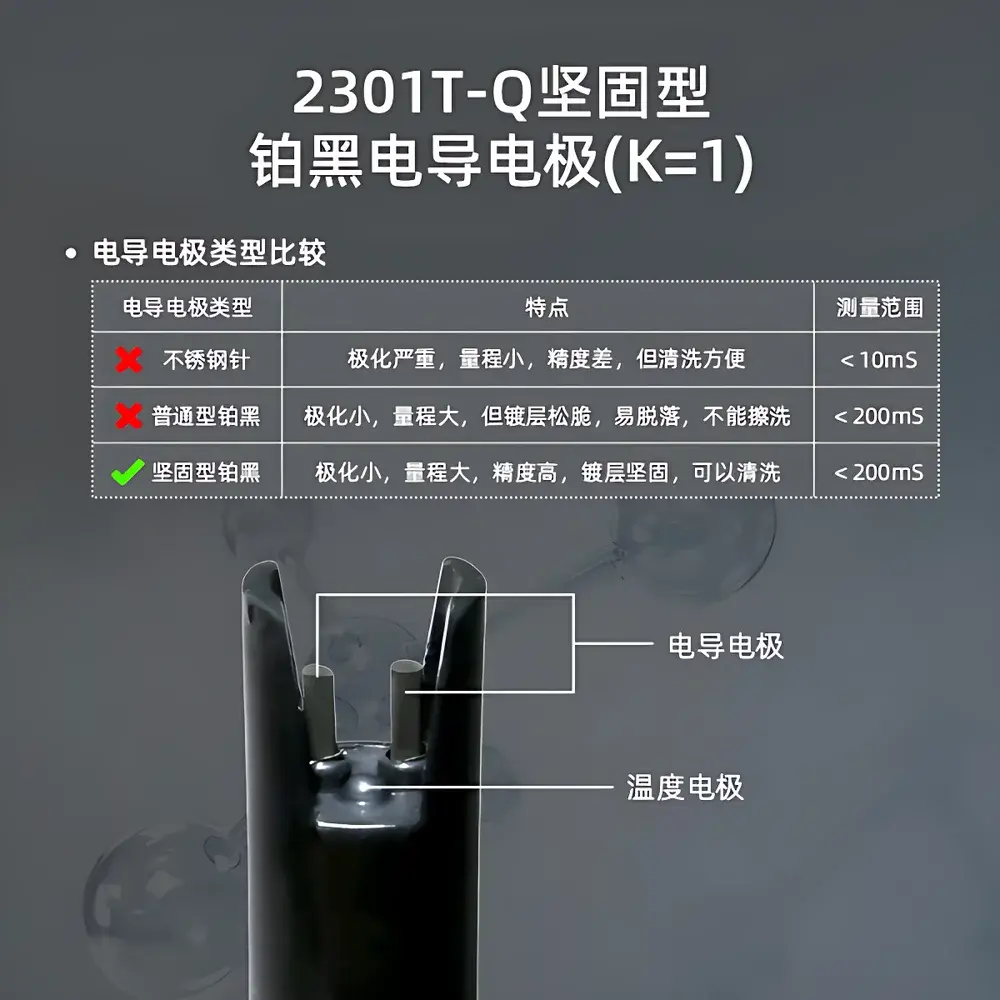
The SX813 accommodates a broad spectrum of aqueous samples—from natural surface waters and industrial effluents to high-purity process streams and saline brines—via interchangeable conductivity cells with selectable cell constants (0.1, 1.0, or 10 cm⁻¹). Its compliance framework aligns with key regulatory expectations: GLP-compliant data management (audit trail enabled via PC-Link software), traceable calibration records, and support for FDA 21 CFR Part 11–compatible electronic signatures when used with validated software configurations. All factory calibrations are traceable to NIM (National Institute of Metrology, China) certified reference materials. The instrument meets CE marking requirements under the EMC Directive 2014/30/EU and RoHS 2011/65/EU.
Software & Data Management
PC-Link communication software (included on optical disc) provides secure bidirectional data transfer via USB interface. It supports export to CSV and Excel-compatible formats, customizable report templates, and time-synchronized batch analysis. Data integrity safeguards include automatic checksum verification, write-protection for archived logs, and tamper-evident file metadata (creation/modification timestamps, operator ID fields). Firmware updates are delivered through signed binary packages with SHA-256 hash validation. For regulated environments, optional validation documentation packages (IQ/OQ protocols) are available upon request to support GMP/GLP laboratory audits.
Applications
- Power generation: Monitoring condensate, demineralizer effluent, and steam cycle purity per ASTM D4582 and IAPWS guidelines.
- Pharmaceutical manufacturing: Routine verification of purified water (PW) and water for injection (WFI) conductivity against USP limits at 25 °C.
- Environmental field testing: On-site assessment of river, lake, and groundwater conductivity and salinity gradients.
- Food & beverage QC: Rapid screening of brine concentration, cleaning-in-place (CIP) solution strength, and osmotic pressure estimation.
- Academic research labs: Teaching electrochemical fundamentals, calibration methodology, and temperature compensation models.
FAQ
Does the SX813 support manual temperature compensation?
Yes—users may select either automatic (ATC) or manual temperature input (0–100 °C) depending on application requirements.
Can custom calibration solutions be defined and stored?
Yes—the instrument allows entry and storage of up to three user-defined conductivity standards with adjustable TDS conversion factors (0.4–1.0).
Is the USB interface compatible with Windows 10/11 and macOS?
PC-Link software is validated for Windows 7–11 (64-bit); macOS compatibility requires virtualization or third-party serial-to-USB drivers.
What is the maximum allowable sample temperature during measurement?
The probe and instrument electronics are rated for continuous operation up to 80 °C; brief exposure to 100 °C is permissible but not recommended for long-term stability.
How is data security ensured during USB transfer?
All transmitted data packets include CRC-16 error detection; no encryption is applied at the firmware level, so network-level TLS or local host firewall policies should govern external transfers in regulated settings.





