
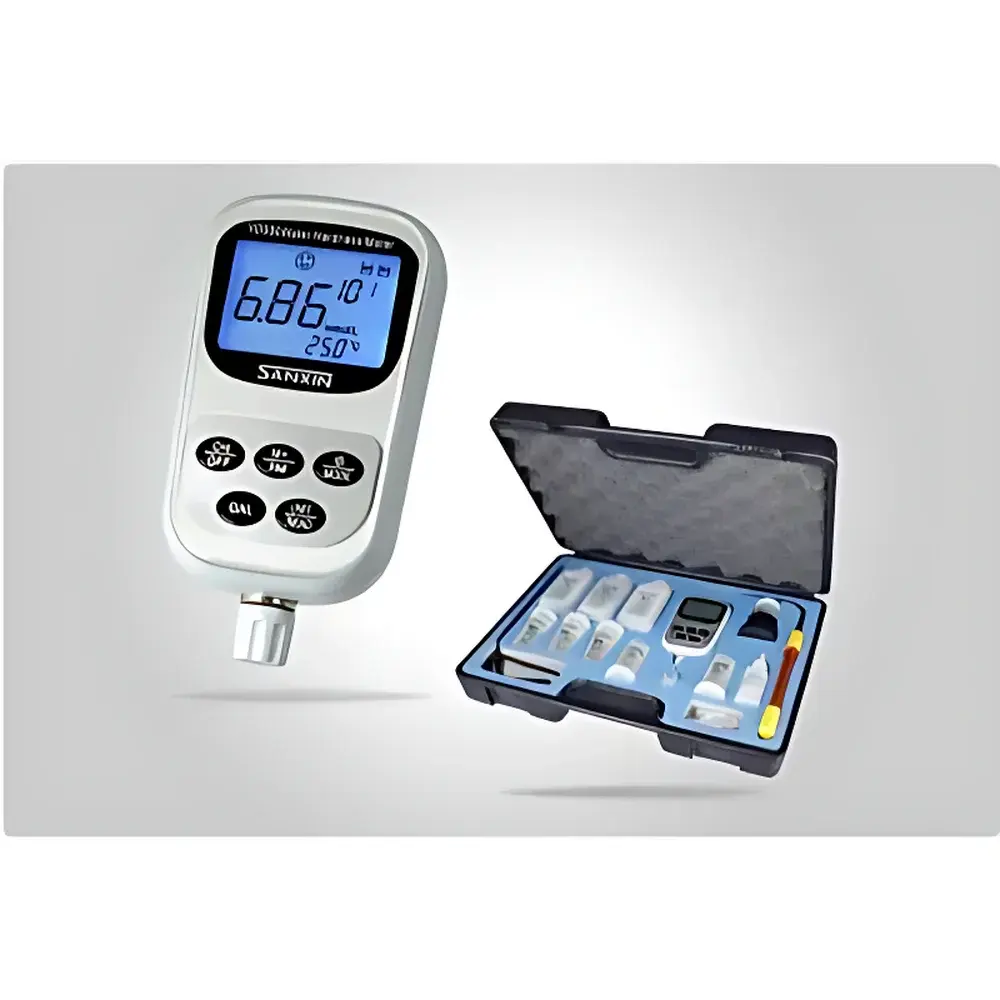
Sanxin YD300 Portable Water Hardness Analyzer
| Brand | Sanxin |
|---|---|
| Origin | Shanghai, China |
| Manufacturer Type | Manufacturer |
| Product Category | Domestic |
| Model | YD300 |
| Instrument Type | Portable / Handheld Water Quality Analyzer |
| Measurement Principle | Electrode-based Potentiometric Titration (Calcium/Magnesium Ion-Selective Detection) |
| Water Hardness Range | 1.50×10⁻² – 1.00×10² mmol/L (as CaCO₃) |
| Temperature Range | 0.0 – 60.0 °C |
| Resolution | 0.01 / 0.1 (hardness units), 0.1 °C |
| Accuracy | ±5% FS (hardness), ±0.5 °C (temperature) |
| Automatic Temperature Compensation | 5 – 50 °C |
| Hardness Units Supported | mmol/L, mg/L (CaCO₃), mg/L (CaO), mmol/L (Boiler), mg/L (Ca), °fH (French), °dH (German), °eH (English) |
| Calibration Solutions | B1, B2, B3 |
| Display | Backlit LCD (blue) |
| Enclosure Rating | IP67 |
| Power | Battery-operated (low-voltage indication) |
| Auto-power-off & Data Hold Functions | Yes |
| Storage | Internal data logging capability |
Overview
The Sanxin YD300 Portable Water Hardness Analyzer is a field-deployable, electrode-based analytical instrument engineered for rapid, on-site quantification of total water hardness—defined as the combined molar concentration of calcium (Ca²⁺) and magnesium (Mg²⁺) ions in aqueous samples. Unlike classical EDTA titrimetric methods, the YD300 employs a selective potentiometric sensing principle using a proprietary ion-selective electrode (ISE) system calibrated for multi-ion response in natural and treated waters. This electrochemical approach eliminates subjectivity in endpoint detection, maintains high reproducibility in turbid or colored samples, and conforms to foundational principles outlined in ISO 6059:2022 (Water quality — Determination of hardness — Titrimetric method) and ASTM D1126-21 (Standard Test Method for Hardness in Water), while offering operational advantages in decentralized monitoring environments.
Key Features
- Intelligent microprocessor-controlled electronics with auto-calibration routines and real-time temperature compensation (5–50 °C)
- Multi-unit conversion engine supporting eight internationally recognized hardness expressions: mmol/L, mg/L as CaCO₃, mg/L as CaO, mmol/L (Boiler), mg/L as Ca, °fH (French degree), °dH (German degree), and °eH (English degree)
- Dual-resolution display mode (0.01 or 0.1 unit increments) optimized for both low-range groundwater and high-range industrial boiler feedwater analysis
- IP67-rated enclosure ensuring dust-tight integrity and submersion resistance up to 1 m for 30 minutes—validated per IEC 60529
- Backlit blue LCD screen with high-contrast characters for legibility under variable ambient lighting conditions
- Built-in data hold function, automatic measurement stabilization lock, and low-battery indicator
- Integrated auto-shutdown after 10 minutes of inactivity to extend battery service life
- Comprehensive calibration suite including three standardized buffer solutions (B1, B2, B3) traceable to NIST-maintained reference materials
Sample Compatibility & Compliance
The YD300 is validated for use across diverse water matrices including drinking water, surface water, groundwater, wastewater effluents, cooling tower water, and boiler feedwater. Its electrode architecture minimizes interference from common anions (e.g., Cl⁻, SO₄²⁻, NO₃⁻) and organic humic substances—critical for field applications where sample pretreatment is impractical. While not intended for seawater or highly saline brines (>10,000 µS/cm), it meets functional performance criteria specified in EPA Method 130.1 (Hardness by EDTA Titration) for comparative validation. The device supports GLP-aligned workflows through manual record-keeping of calibration dates, operator IDs, and sample IDs—though it does not provide electronic audit trails required under FDA 21 CFR Part 11. For regulated QC/QA laboratories, periodic verification against certified reference materials (CRMs) such as NIST SRM 1643e is recommended.
Software & Data Management
The YD300 operates as a standalone, embedded-system instrument with no external software dependency. All calibration coefficients, unit preferences, and temperature settings are retained in non-volatile memory. Measurement results are displayed in real time and may be manually recorded; internal storage capacity supports timestamped logging of up to 100 readings. No USB, Bluetooth, or cloud connectivity is included—consistent with its design philosophy as a ruggedized, maintenance-minimal field tool. Users requiring digital data export must transcribe values directly into LIMS or spreadsheet platforms. Firmware updates are not supported in-field; hardware revision control is maintained via model-specific serial number registration with Sanxin’s technical support team.
Applications
- Routine hardness screening during municipal drinking water distribution system audits
- Pre-commissioning verification of softener resin performance in commercial HVAC systems
- Field assessment of scaling potential in geothermal and industrial process water circuits
- Educational laboratory instruction on water chemistry fundamentals and ISE theory
- Environmental site assessments where rapid hardness profiling informs downstream metal speciation modeling
- Validation of reverse osmosis membrane integrity via post-treatment hardness leakage detection
FAQ
What measurement principle does the YD300 employ?
It uses a potentiometric ion-selective electrode (ISE) system calibrated for combined Ca²⁺/Mg²⁺ activity, providing direct electromotive force (EMF)-based quantification without chemical reagents.
Is the instrument suitable for wastewater with suspended solids?
Yes—the electrode design and signal processing algorithm maintain stability in moderately turbid samples (<50 NTU); however, heavy particulate load requires filtration prior to measurement to prevent sensor fouling.
Does the YD300 comply with ISO or ASTM standards?
It aligns with the measurement intent and reporting conventions of ISO 6059 and ASTM D1126, though it is not certified as a primary standard method; validation against titrimetric reference methods is advised for regulatory submissions.
Can temperature units be switched between °C and °F?
Yes—user-selectable via the configuration menu; default factory setting is °C.
What is the expected service life of the hardness electrode?
Under typical field use (≤5 measurements/day), the integrated sensor module delivers ≥18 months of stable performance; replacement electrodes are available as Sanxin part #YD300-ISE-REPL.







