
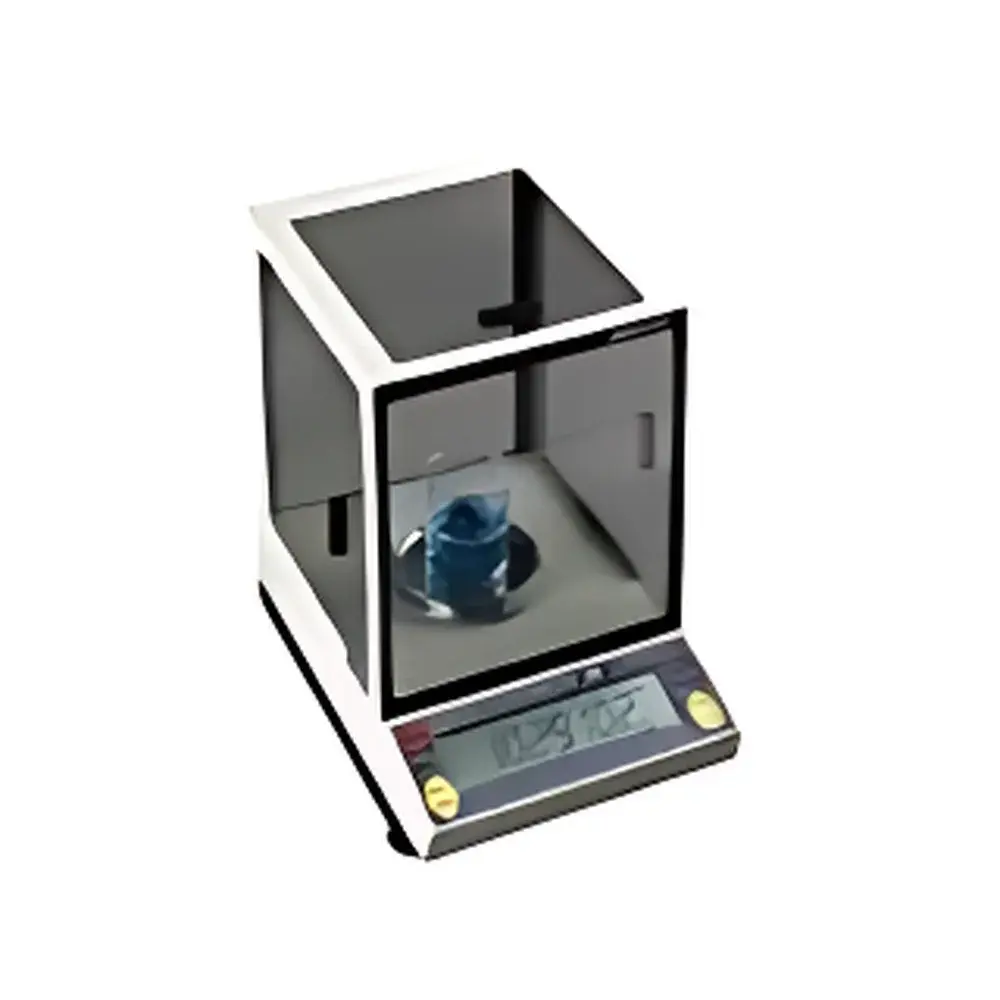
Scientech newopto Precision Electronic Analytical Balance
| Brand | Scientech |
|---|---|
| Origin | USA |
| Model | newopto |
| Readability | 0.01 mg to 0.1 g (model-dependent) |
| Warranty | 2 years |
| Compliance | NTEP-certified variants available (e.g., ZSP-NJ, ZSP-NP), ISO/IEC 17025-compatible operation |
| Regulatory Support | FDA 21 CFR Part 11–ready software options (via optional DataMaster Suite), GLP/GMP audit trail capable |
Overview
The Scientech newopto Precision Electronic Analytical Balance is an engineered metrological instrument designed for high-accuracy mass determination in regulated and research-intensive laboratory environments. Based on electromagnetic force compensation (EMFC) technology, it delivers stable, drift-compensated measurements by dynamically balancing the gravitational load of a sample against a precisely controlled electromagnetic field. This principle ensures linearity, repeatability, and long-term stability without mechanical wear—critical for applications demanding traceable accuracy per ISO/IEC 17025 and USP . The balance series encompasses multiple readability tiers—from 0.01 mg (microgram) to 0.1 g—enabling selection aligned with specific uncertainty budgets, sample volume constraints, and regulatory classification (e.g., NTEP legal-for-trade certification for jewelry or pharmacy compounding). All models are manufactured in the United States and reflect over four decades of refinement in EMFC transducer design, thermal management, and environmental compensation algorithms.
Key Features
- Electromagnetic force compensation (EMFC) sensor architecture with active temperature stabilization and internal mass calibration routine
- Multi-tier readability options: 0.01 mg (Series 12000 SM, Zeta ZSA), 0.1 mg (SA, ZSA), 1 mg (SP, ZSP), 0.01 g (SL, ZSL), and 0.1 g (SG, SHC)—each optimized for distinct uncertainty profiles
- NTEP-certified configurations available: ZSP150-NJ (jewelry trade), ZSP400-NJ (precious metals), and ZSP400-NP (pharmaceutical compounding and pill counting), compliant with Handbook 44 requirements
- Integrated draft shield compatibility across all analytical-grade models (SM, SA, ZSA, SP, ZSP), supporting ISO 9001 and GMP ambient condition control
- Modular OEM sensor platforms (Type 202, Type 299, Zeta-type) for integration into automated dispensing systems, density analyzers, and custom QC workstations
- Two-year limited warranty covering sensor electronics, calibration integrity, and structural housing—valid globally with Scientech-authorized service centers
Sample Compatibility & Compliance
The newopto balance platform accommodates diverse sample forms—including powders, granules, liquids in tared vessels, hygroscopic solids under inert gas purging, and delicate biological specimens—when used with appropriate pans, anti-static accessories, and draft enclosures. Its weighing chamber geometry and internal damping minimize air-current-induced noise, particularly critical for low-mass measurements (<10 mg). All analytical models meet or exceed ASTM E898–22 (Standard Practice for Calibration of Laboratory Balances) and support traceable calibration using Class E1 or E2 reference weights. NTEP-certified variants undergo periodic verification at NIST-accredited test labs and include permanent firmware-locked metrological parameters to prevent unauthorized configuration changes—a requirement for legal-for-trade enforcement jurisdictions.
Software & Data Management
When paired with Scientech’s optional DataMaster Suite (v3.2+), the newopto balance supports full 21 CFR Part 11 compliance: electronic signatures, role-based user access control, immutable audit trails, and automatic data export to CSV, XML, or LIMS-compatible formats. Real-time metadata capture includes timestamp, operator ID, environmental conditions (optional external sensor input), calibration status, and uncertainty estimation per GUM (JCGM 100:2008). The suite enables method-driven workflows—for example, density calculation via dual-weighing (air + submerged), percent recovery assays, or dynamic averaging for unstable samples—with configurable pass/fail thresholds aligned with internal SOPs or pharmacopeial monographs (e.g., USP ).
Applications
- Pharmaceutical quality control: Active pharmaceutical ingredient (API) assay, blend uniformity testing, and capsule weight variation per USP
- Materials science: Density determination of ceramics and composites using Archimedean immersion; powder flow characterization via tapped density protocols
- Jewelry & precious metals: Legal-for-trade weighing per NTEP Handbook 44, including karat gold and platinum group metal valuation
- Academic research: Gravimetric preparation of standard solutions, stoichiometric reaction monitoring, and micro-scale catalyst loading
- Biotechnology: Cell culture media component dosing, lyophilized product reconstitution accuracy verification, and enzyme activity quantification via substrate mass tracking
- Environmental testing: Filter mass gain analysis for PM2.5/PM10 particulate matter gravimetry (EPA Method IO-4.2 compliant setup)
FAQ
What is the difference between NTEP-certified and non-certified models?
NTEP-certified balances (e.g., ZSP150-NJ, ZSP400-NP) undergo third-party evaluation to verify conformance with NIST Handbook 44 requirements for commercial transactions. They feature sealed firmware, tamper-evident hardware, and permanent metrological identification—mandatory for retail jewelry sales or pharmacy compounding subject to state weights-and-measures inspection.
Can the balance be integrated into an automated lab system?
Yes. OEM sensor variants (Type 202, Type 299, Zeta-type) provide analog voltage output (±5 V) or digital RS-232/USB interfaces with ASCII command protocol, enabling seamless integration with PLCs, SCADA systems, or robotic liquid handlers.
Is internal calibration performed automatically or manually?
All analytical models support both scheduled automatic internal calibration (via motor-driven calibration mass) and manual initiation. Calibration frequency may be configured per ISO/IEC 17025 internal quality procedures or risk-based assessment.
How does the balance compensate for environmental drift?
It employs dual-sensor thermal monitoring (housing and coil temperature), real-time zero-tracking algorithms, and adaptive filtering to suppress low-frequency noise from building vibration or HVAC airflow—without requiring external vibration isolation tables in most laboratory settings.
Are service manuals and firmware updates publicly accessible?
Service documentation and firmware revisions are provided exclusively to Scientech-authorized service partners under NDA. End users receive calibrated performance reports and traceable certificate templates upon request.



