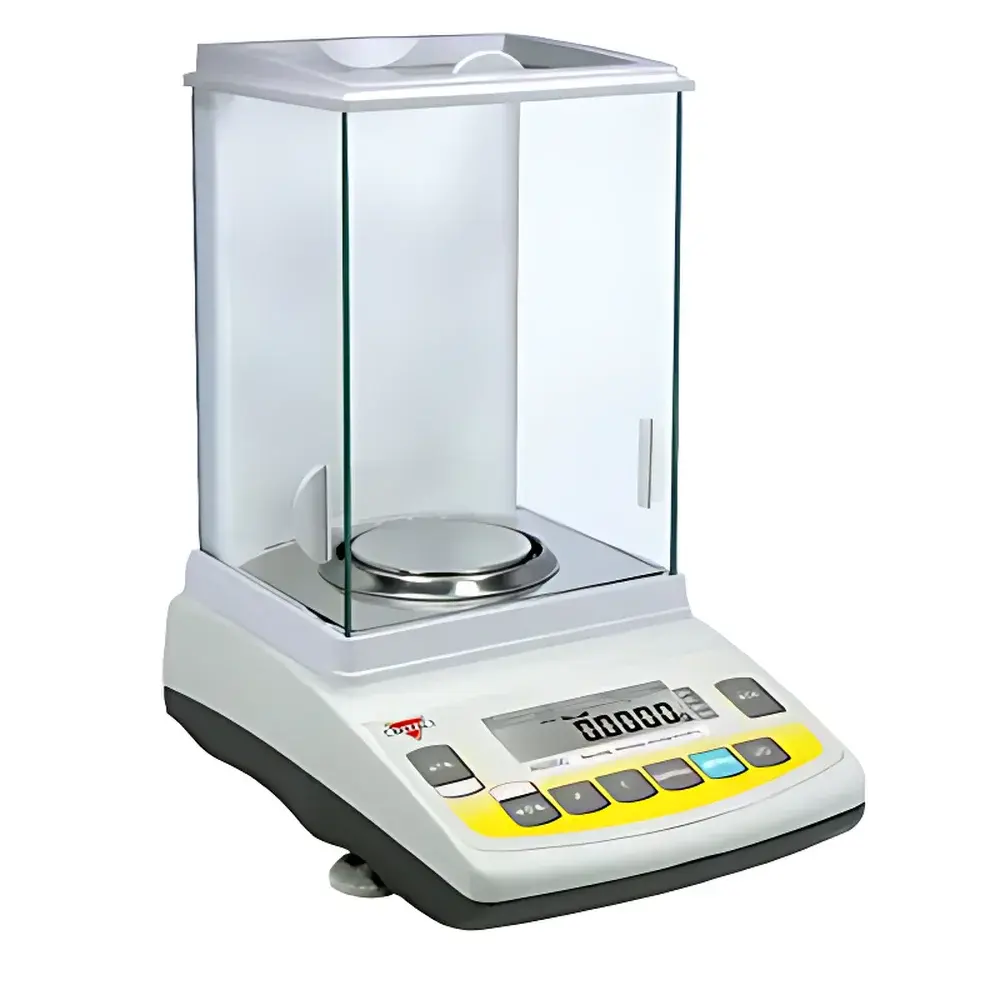
Scientific Industries Torbal AGCN Series Automatic Internal Calibration Analytical Balance
| Brand | Scientific Industries |
|---|---|
| Origin | USA |
| Model | AGCN100, AGCN200 |
| Capacity | 100 g / 200 g |
| Readability | 0.0001 g |
| Repeatability | < ±0.2 mg |
| Calibration | Fully automatic internal calibration |
| Linearity | ±0.0002 g |
| Stabilization Time | ~3 s |
| Pan Diameter | 90 mm |
| Dimensions (W×D×H) | 216 × 345 × 347 mm |
| Net Weight | 10 kg |
| Operating Temperature | +15 °C to +30 °C |
| Interface | Bidirectional RS232 |
| Accuracy Class | I |
| Weighing Modes | Weighing, Piece Counting, Percentage Weighing, Density Determination, Totalization |
| Units | g, ct, lb |
Overview
The Scientific Industries Torbal AGCN Series Analytical Balance is an ISO/IEC 17025-aligned precision weighing instrument engineered for laboratories requiring traceable mass measurement with minimal operator intervention. Built upon the fundamental principle of electromagnetic force compensation (EMFC), the AGCN series delivers high-resolution static mass determination in compliance with OIML R 76-1 and ASTM E898–22 standards for analytical balances. Its core architecture integrates a hermetically sealed weighing chamber—constructed from die-cast metal housing and tempered glass—to minimize air current interference and thermal drift, ensuring stable readings under routine ambient lab conditions (+15 °C to +30 °C). Unlike external calibration-dependent models, the AGCN’s embedded microprocessor-controlled internal calibration system activates automatically at predefined intervals or on demand, maintaining metrological integrity without manual weight handling—critical for GLP-compliant environments where audit trails and calibration history are routinely reviewed.
Key Features
- Automatic internal calibration with real-time drift compensation, eliminating reliance on certified external weights and reducing calibration-related downtime.
- Die-cast metal chassis and fully enclosed glass draft shield provide mechanical robustness and environmental isolation for consistent repeatability (< ±0.2 mg) across daily use cycles.
- Five integrated weighing modes: standard mass measurement, piece counting (with user-defined sample count), percentage weighing relative to reference mass, density calculation (requiring auxiliary sinker and liquid medium), and cumulative totalization.
- High-contrast LCD display with center-zero indicator, auto-zero function, and tare initialization—optimized for rapid visual verification and intuitive operation by QC technicians and research staff alike.
- Bidirectional RS232 interface enables seamless integration with LIMS, ELN, or statistical process control (SPC) software; supports ASCII protocol for automated data logging and report generation.
- Class I accuracy per OIML R 76-1, validated for applications governed by USP <41>, FDA 21 CFR Part 11 (when paired with compliant software), and ISO 9001 quality management systems.
Sample Compatibility & Compliance
The AGCN series accommodates standard laboratory samples up to 200 g—including powders, granules, small solid components, and pre-weighed vials—within its 90 mm diameter stainless-steel weighing pan. The sealed chamber design prevents contamination ingress and supports hygroscopic or volatile sample handling when combined with appropriate desiccant protocols. All units ship with factory calibration certificates traceable to NIST standards. The balance meets regulatory requirements for pharmaceutical assay preparation (USP <1251>), raw material verification (ISO 17034), and routine QC release testing. Internal calibration logs—including timestamps, deviation values, and pass/fail status—are retained in non-volatile memory and exportable via RS232 for GMP audit documentation.
Software & Data Management
While the AGCN operates as a standalone instrument, its RS232 port facilitates direct communication with third-party data acquisition platforms. Users may configure data output formats (e.g., comma-delimited, fixed-width) and trigger transmission upon stabilization or manual keypress. When integrated into regulated workflows, the balance supports 21 CFR Part 11-compliant electronic records when used with validated middleware that enforces user authentication, audit trail generation, and electronic signature capture. Firmware updates—distributed exclusively through Scientific Industries’ authorized support channels—maintain compatibility with evolving laboratory informatics standards.
Applications
- Pharmaceutical formulation: Accurate dispensing of active pharmaceutical ingredients (APIs) and excipients per batch records.
- Materials science: Precise mass input for stoichiometric calculations in synthesis and thin-film deposition protocols.
- Food & beverage QA: Verification of ingredient dosing consistency and net content labeling compliance (e.g., EU Directive 2008/95/EC).
- Academic research: Reproducible sample preparation for chromatography, spectroscopy, and calorimetry workflows.
- Environmental testing labs: Weighing of filter media pre- and post-extraction in gravimetric particulate matter analysis (EPA Method 201A).
FAQ
Does the AGCN require periodic external calibration?
No—its internal calibration mechanism uses a built-in reference mass and motor-driven actuator to verify and adjust sensor response automatically. External calibration is only required during initial installation verification or after physical relocation impacting leveling.
Can the balance be used in a fume hood?
Not recommended. The AGCN relies on stable thermal and airflow conditions. Fume hoods induce turbulence and temperature gradients that compromise repeatability and stabilization time.
Is density determination fully automated?
Density mode requires manual entry of liquid density and sinker mass; the balance computes sample density using Archimedes’ principle but does not automate fluid handling or immersion steps.
What happens if power is interrupted during calibration?
The unit retains last-known calibration parameters in non-volatile memory and initiates a full self-check sequence upon reboot, resuming normal operation only after successful validation.
How is leveling performed?
An integrated bubble level and dual adjustable feet enable mechanical leveling; the system confirms correct orientation via internal tilt sensors before enabling weighing functions.