
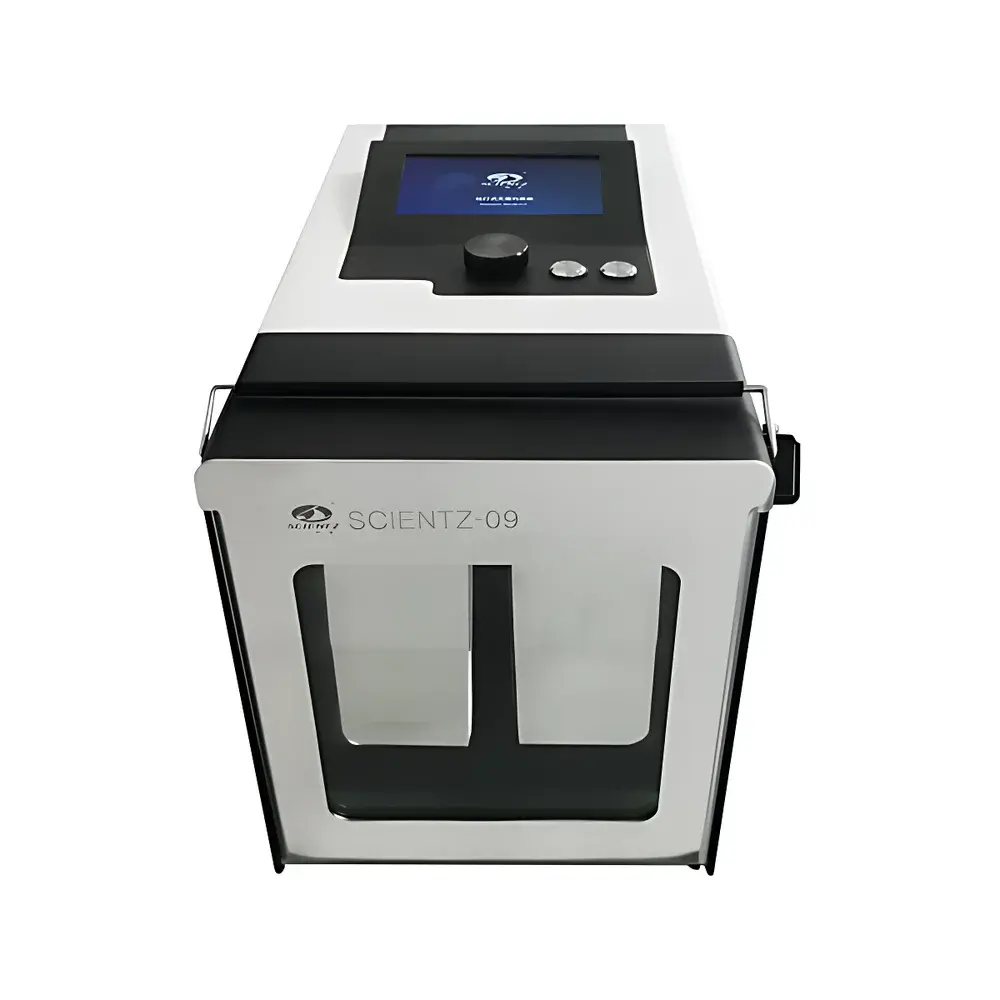
SCIENTZ-11 Sterile Stomacher-Type Homogenizer
| Brand | SCIENTZ |
|---|---|
| Origin | Zhejiang, China |
| Manufacturer | Ningbo SCIENTZ Biotechnology Co., Ltd. |
| Instrument Type | Stomacher-style (Paddle-beat) Homogenizer |
| Dimensions (W×D×H) | 420 × 245 × 340 mm |
| Sample Volume Range | 3–400 mL |
| Compliance | Designed for ISO 6887-1, ISO 7218, and USP <61> microbiological testing workflows |
Overview
The SCIENTZ-11 Sterile Stomacher-Type Homogenizer is a benchtop, paddle-beat homogenization system engineered for reproducible, contamination-free sample preparation in microbiological analysis. It operates on the principle of controlled mechanical shear generated by dual reciprocating paddles that apply rhythmic compressive force against a sterile, sealed sample bag—inducing turbulent mixing without introducing external microbial load or thermal degradation. Unlike rotor-stator or probe-based homogenizers, this stomacher design eliminates cross-contamination risk between samples and avoids aerosol generation, making it compliant with biosafety Level 2 (BSL-2) laboratory requirements. The device is specifically calibrated for quantitative recovery of viable microorganisms from complex matrices—including food composites, animal tissues, environmental swabs, and pharmaceutical raw materials—ensuring compliance with standardized enumeration protocols required by regulatory bodies such as AOAC, FDA Bacteriological Analytical Manual (BAM), and ISO/IEC 17025-accredited laboratories.
Key Features
- Stainless-steel housing with IP54-rated enclosure for resistance to chemical splashes and routine disinfection using ethanol, sodium hypochlorite, or hydrogen peroxide vapor.
- Programmable digital control panel supporting adjustable speed (0–300 rpm equivalent shear intensity), beat frequency (0–120 cycles/min), and duration (10 s–5 min in 10-s increments) to match sample viscosity and microbial resilience.
- Dual-paddle symmetric drive mechanism ensures uniform energy distribution across the sample bag surface, minimizing localized overheating and preserving cell viability during homogenization.
- Integrated safety interlock prevents operation unless the lid is fully closed and latched, satisfying IEC 61000-6-2 electromagnetic compatibility and mechanical safety standards.
- Low-noise motor assembly (<65 dB(A) at 1 m distance) enables continuous use in shared lab environments without acoustic interference to adjacent analytical instruments.
Sample Compatibility & Compliance
The SCIENTZ-11 accommodates standard ISO-compliant stomacher bags (e.g., 400 mL capacity, polyethylene-laminated with nylon barrier layer) and supports heterogeneous sample types including cooked meat homogenates, leafy vegetable rinsates, dairy powders suspended in peptone water, and minced tissue specimens preserved in transport media. Its performance has been validated per ISO 6887-1:2017 for enumeration of aerobic mesophilic bacteria and conforms to the mechanical homogenization parameters specified in USP Microbiological Examination of Nonsterile Products. All contact surfaces are autoclavable up to 121°C for 20 minutes, enabling full traceability under GLP and GMP audit frameworks where equipment qualification (IQ/OQ/PQ) documentation is mandated.
Software & Data Management
While the SCIENTZ-11 operates via embedded firmware without cloud connectivity, its control interface logs timestamped operational records—including cycle count, total runtime, and last-used parameter set—for local review via USB export (CSV format). These logs support 21 CFR Part 11-compliant data integrity practices when paired with laboratory information management systems (LIMS) that enforce user authentication, electronic signatures, and audit trail retention. Optional firmware upgrade kits enable future integration with SCIENTZ’s centralized instrument fleet monitoring platform for remote diagnostics and preventive maintenance scheduling.
Applications
- Routine pathogen isolation (e.g., Salmonella, Listeria monocytogenes, E. coli O157:H7) from retail food products prior to selective enrichment.
- Preparation of homogenized suspensions for membrane filtration assays in drinking water quality assessment (per ISO 9308-1).
- Standardized tissue dissociation for veterinary diagnostic labs performing bacterial culture from bovine udder washings or avian cloacal swabs.
- QC release testing of cosmetic preservative efficacy (challenge testing per ISO 11930) requiring consistent microbial dispersion across emulsion phases.
- Environmental monitoring of bioaerosol collection filters in cleanroom validation studies (ISO 14644-1 Class 5–8 environments).
FAQ
What sterilization methods are compatible with the SCIENTZ-11 unit?
Autoclaving is not applicable to the full unit; however, the removable paddle assembly and sample chamber liner may be autoclaved at 121°C for 20 minutes. Surface disinfection using 70% isopropyl alcohol or 0.5% sodium hypochlorite is recommended between runs.
Can the SCIENTZ-11 process frozen tissue samples?
No. Samples must be thawed to ≥4°C prior to homogenization to ensure consistent bag deformation and avoid paddle misalignment or seal failure.
Is the device suitable for RNA/DNA extraction workflows?
Yes—when used with RNase-free stomacher bags and chilled diluents, it delivers mechanical lysis compatible with downstream nucleic acid purification kits, provided total homogenization time remains ≤2 min to limit nuclease activation.
Does the SCIENTZ-11 meet CE or UL certification requirements?
The unit complies with CE marking directives (2014/30/EU EMC Directive and 2014/35/EU LVD) and carries CB Scheme certification per IEC 61010-1:2010 for laboratory electrical equipment safety.
How often does the paddle alignment require verification?
Alignment should be verified quarterly using the included gauge block, or after any impact event exceeding 1.5 g-force detected by the internal accelerometer log.



