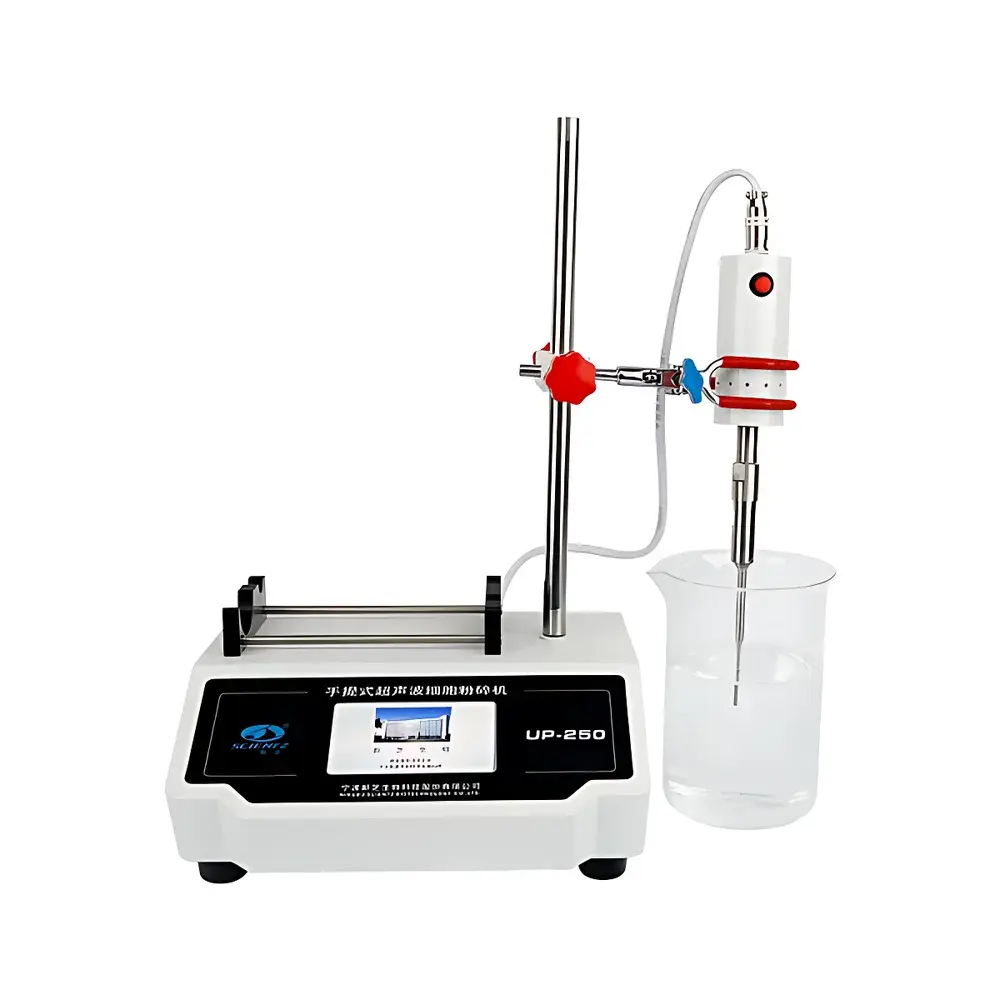
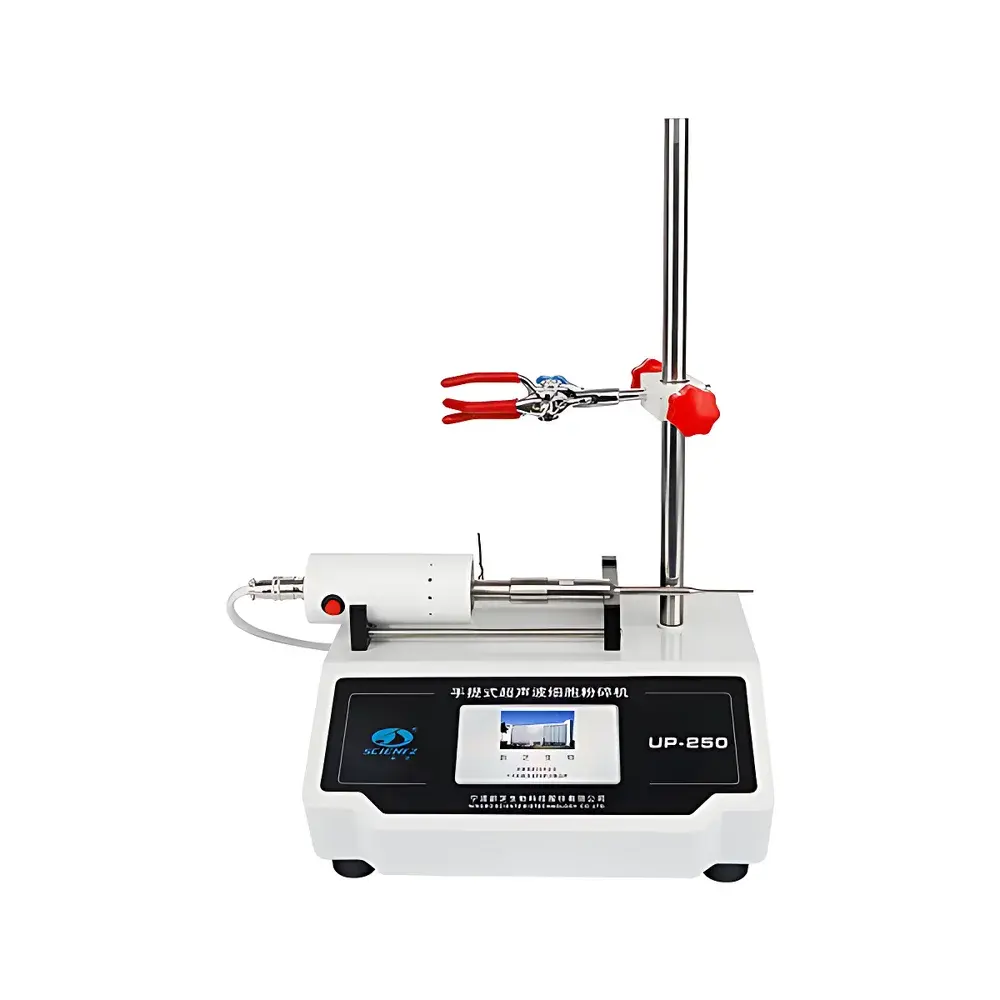
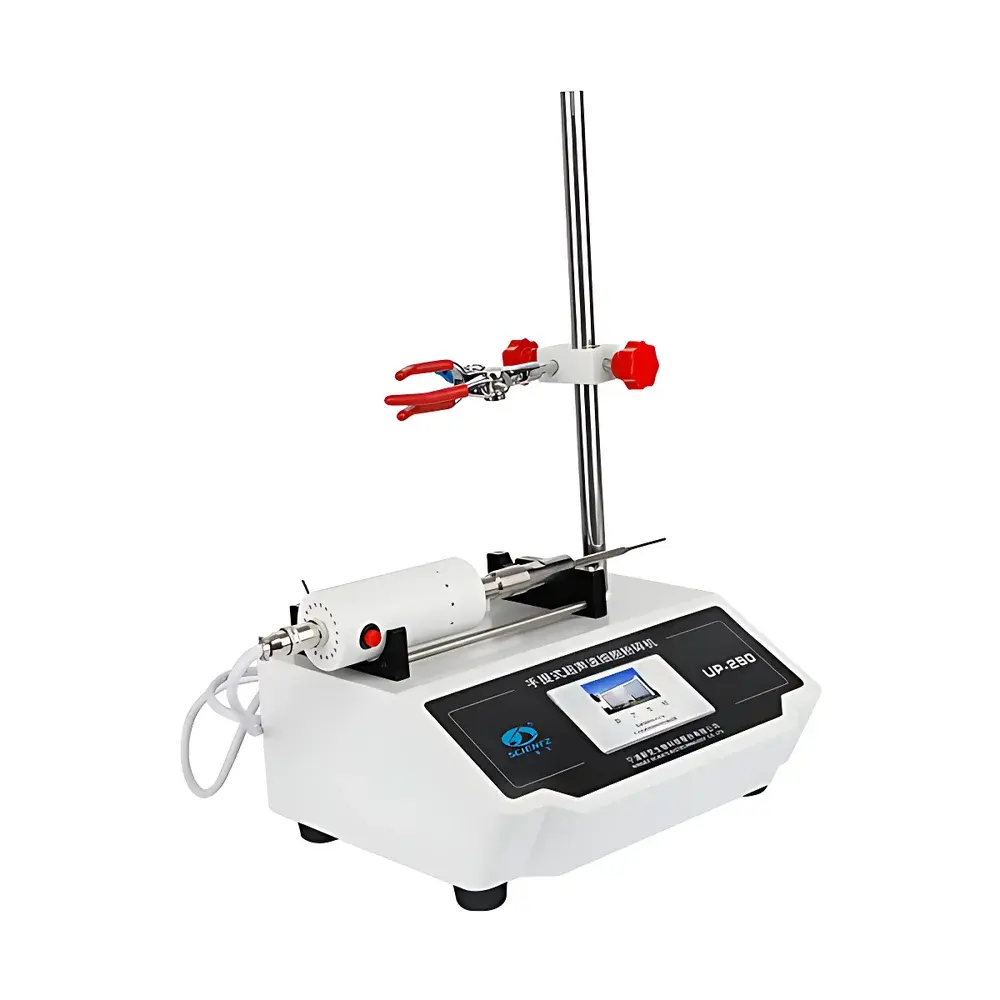
Scientz UP-250 Handheld Ultrasonic Cell Disruptor
| Brand | Scientz |
|---|---|
| Origin | Zhejiang, China |
| Manufacturer Type | Direct Manufacturer |
| Instrument Type | Ultrasonic Cell Disruptor |
| Model | UP-250 |
| Ultrasonic Power | 250 W |
| Operating Frequency | 19–25 kHz |
| Sample Volume Capacity | 100 µL – 10 mL |
| Battery Runtime (UP-250S variant) | Up to 4 h continuous operation |
| Temperature Monitoring | Integrated sensor with over-temperature alarm |
| Operation Modes | Manual (foot-switch compatible) and Automatic |
| Portability | Fully handheld, battery-powered (UP-250S), no external power required |
Overview
The Scientz UP-250 Handheld Ultrasonic Cell Disruptor is an engineered solution for rapid, reproducible, and scalable cell lysis and sample homogenization in life science laboratories, field-deployable diagnostics, and quality control environments. It operates on the physical principle of acoustic cavitation: high-intensity ultrasonic energy—delivered via a titanium alloy probe—is coupled into liquid media, generating transient microbubbles that undergo rapid expansion and violent collapse. This implosive process produces localized shear forces exceeding 10⁴ Pa, hydrodynamic microjets, and transient temperatures >5,000 K—sufficient to disrupt cellular membranes, shear chromatin, disintegrate aggregates, and facilitate molecular extraction without significant thermal denaturation when operated under controlled duty cycles. Unlike benchtop sonicators requiring fixed immersion depth and cooling baths, the UP-250’s handheld architecture enables direct, contact-mode sonication inside microcentrifuge tubes, PCR strips, and 96-well plates—eliminating cross-contamination risk and minimizing sample transfer losses.
Key Features
- 250 W peak ultrasonic output with frequency stabilization between 19–25 kHz—optimized for broad-spectrum bio-mechanical disruption across Gram-positive bacteria, yeast, mammalian cells, and plant tissues.
- Real-time temperature monitoring with digital display and programmable over-temperature cutoff (default threshold: 45 °C), ensuring biomolecule integrity during extended processing.
- Dual operational modes: timed automatic cycle (0.1–99.9 s pulse width, 0.1–99.9 s interval) and foot-switch–activated manual triggering—enabling precise endpoint control for sensitive applications such as ChIP-grade chromatin shearing.
- Ergonomic, balanced handpiece design with IP54-rated housing; compatible with standard 1/8″–1/4″ threaded probes (e.g., 3 mm, 6 mm tapered tips) for scalable energy delivery.
- Integrated rechargeable lithium-ion battery (UP-250S variant) supporting ≥4 h of intermittent use per charge—certified to UN38.3 transport standards and compliant with IEC 62133 for secondary lithium cells.
- No external power dependency: ideal for mobile labs, food safety inspection vehicles, environmental field stations, and point-of-care biosampling where AC infrastructure is unavailable or unreliable.
Sample Compatibility & Compliance
The UP-250 accommodates sample volumes from 100 µL (single-tube genomic DNA isolation) to 10 mL (bulk protein extraction), with validated compatibility for Eppendorf Safe-Lock tubes, PCR plates, and deep-well microplates. Probe tip geometry and amplitude settings are adjustable to prevent foaming or overheating in low-viscosity buffers (e.g., RIPA, Tris-EDTA) or viscous lysates (e.g., bacterial pellets resuspended in glycerol). The system meets ISO 13485 design control requirements for in vitro diagnostic ancillary equipment and supports GLP-compliant documentation through optional timestamped log export (via USB-C interface on firmware v2.1+). All electrical components comply with CE marking directives (2014/30/EU EMC, 2014/35/EU LVD) and RoHS 2011/65/EU substance restrictions.
Software & Data Management
Firmware-controlled operation enables parameter locking, user-level access control (admin/operator tiers), and audit-trail generation per ICH GCP and FDA 21 CFR Part 11 Annex 11 expectations. Process logs—including date/time stamp, total active sonication time, average power output, and thermal excursion events—are exportable as CSV files for integration into LIMS or electronic lab notebooks (ELN). Optional Scientz SoniControl™ PC software (Windows 10/11) provides remote calibration verification, waveform visualization, and batch protocol templating—supporting method transfer across multi-site QC laboratories.
Applications
- Cell lysis for downstream proteomics (SDS-PAGE, Western blotting) and nucleic acid workflows (qPCR, NGS library prep).
- Chromatin fragmentation in ChIP-seq and CUT&RUN assays—validated for sub-500 bp fragment size distribution using 20% duty cycle at 70% amplitude.
- Nanoparticle dispersion and exosome isolation from biofluids (plasma, urine) without surfactant addition.
- Rapid solvent-free extraction of phytochemicals (e.g., polyphenols, terpenoids) from plant matrices.
- Emulsification of lipid-based drug delivery systems and homogenization of vaccine adjuvant suspensions.
- Field-deployable pathogen lysis in foodborne outbreak investigations (e.g., Salmonella, Listeria) prior to isothermal amplification.
FAQ
Is the UP-250 suitable for RNA extraction without RNase contamination?
Yes—when used with RNase-free probes, pre-chilled consumables, and pulsed operation (e.g., 5 s ON / 10 s OFF), it achieves efficient lysis while maintaining RNA integrity (RIN > 8.5 confirmed via Bioanalyzer).
Can the UP-250 be calibrated traceably to national standards?
Yes—Scientz provides NIST-traceable acoustic power calibration certificates (ISO/IEC 17025 accredited lab) upon request; probe tip displacement amplitude is verified via laser vibrometry.
Does the device support Good Manufacturing Practice (GMP) documentation requirements?
Yes—firmware v2.1+ includes electronic signature capability, change control logs, and 21 CFR Part 11–compliant audit trails when paired with validated IT infrastructure.
What maintenance is required for long-term reliability?
Probe tip inspection after every 200 hours of cumulative use; replacement recommended if pitting or diameter reduction >5% measured via micrometer; transducer housing cleaning with 70% ethanol only.
Related Products