
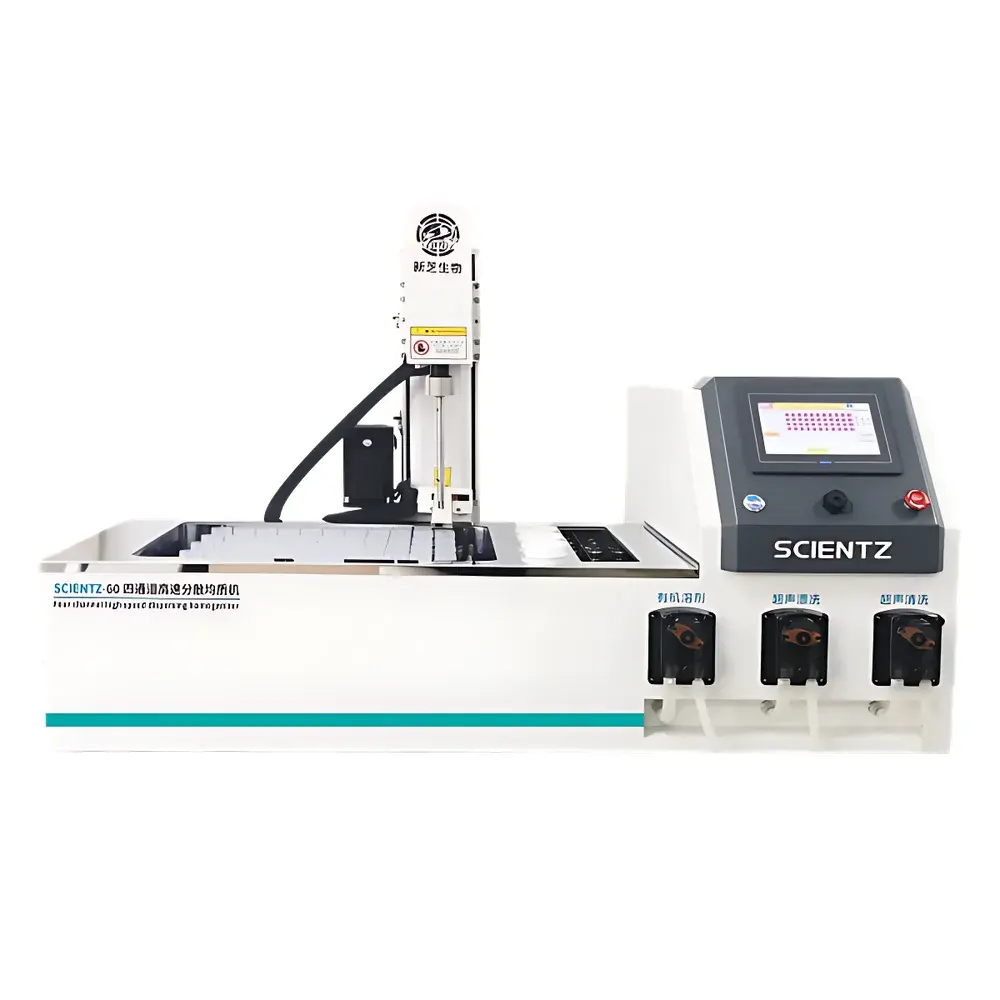
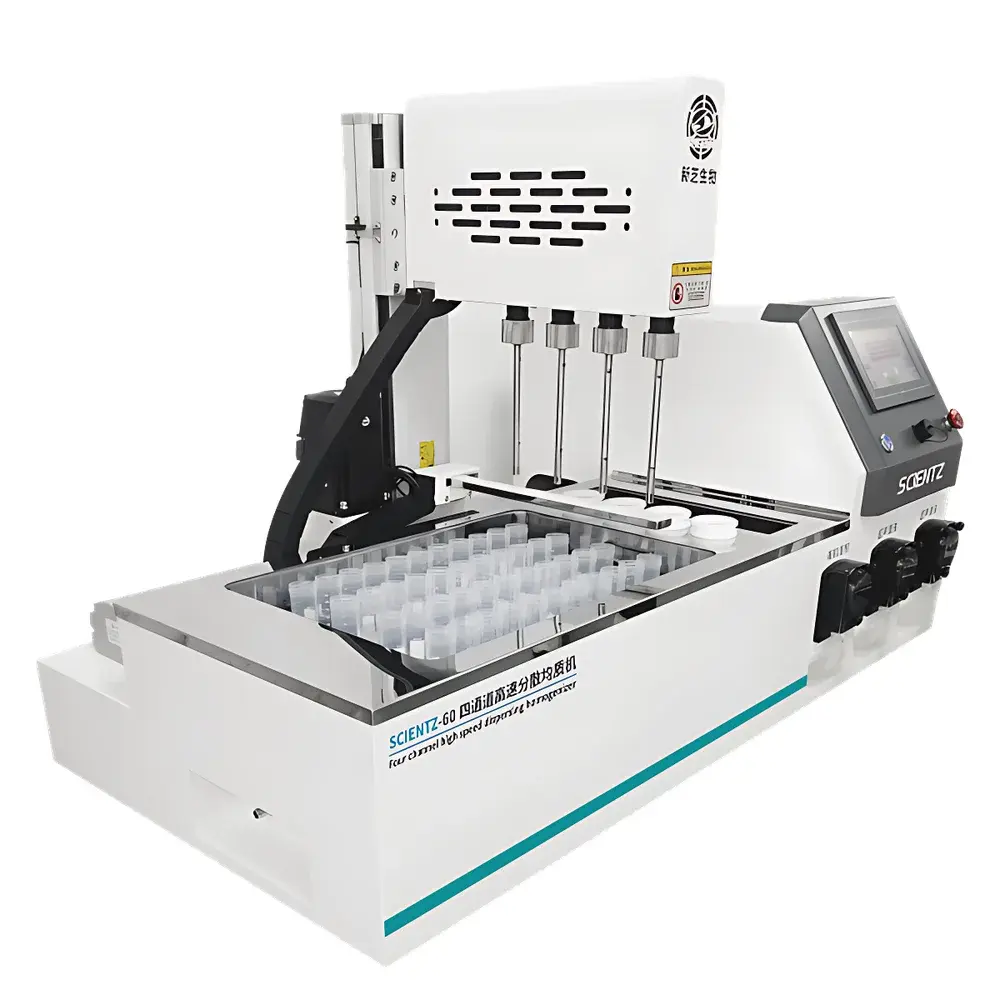
SCIENTZ-60 Four-Channel High-Speed Homogenizer by Ningbo Scientz Biotechnology Co., Ltd.
| Brand | Scientz |
|---|---|
| Origin | Zhejiang, China |
| Manufacturer | Yes |
| Instrument Type | High-Speed Rotor-Stator Homogenizer |
| Dimensions (W×D×H) | 280 × 440 × 260 mm |
| Maximum Throughput | 60 samples per run |
| Processing Volume Range | Up to 4800 mL total per batch |
| Power Supply | 220 V, 50/60 Hz |
| Motor Power | 1200 W (typical for SCIENTZ-60 class) |
| Speed Range | 0–30,000 rpm (digital control, ±50 rpm accuracy) |
| Material Contact Parts | 316L stainless steel probe shafts and sample holders |
| Probe Diameter Options | 10 mm, 12 mm, 15 mm (standard interchangeable) |
Overview
The SCIENTZ-60 Four-Channel High-Speed Homogenizer is an engineered solution for high-throughput, reproducible sample disruption and homogenization in analytical laboratories engaged in food safety testing, pharmaceutical quality control, agricultural residue analysis, and biomedical research. Unlike pressure-based homogenizers (e.g., French press or microfluidizers), the SCIENTZ-60 operates on the rotor-stator principle: a rapidly rotating probe generates intense shear forces, cavitation, and turbulent flow within the sample vessel—effectively lysing cells, dispersing aggregates, emulsifying immiscible phases, and reducing particle size distribution. Its four independent processing channels enable parallel operation with synchronized or staggered timing, supporting standardized workflows under GLP-compliant environments. Designed for routine use in QC labs handling hundreds of samples weekly—such as pesticide residue screening in fruits, veterinary drug quantification in milk, or genomic DNA extraction from tissue—this instrument delivers consistent mechanical energy input across all channels, minimizing inter-run variability.
Key Features
- Four-channel architecture with individually controllable motor drives—enabling simultaneous yet independent operation of up to four sample sets.
- Digital speed regulation (0–30,000 rpm) with real-time feedback and ±50 rpm repeatability, ensuring precise method transfer between instruments and labs.
- Modular probe system compatible with sterilizable 316L stainless steel probes (10 mm, 12 mm, 15 mm diameters); probe geometry optimized for viscous, fibrous, or particulate-laden matrices.
- Integrated safety interlocks: lid-closed detection, overheat protection, and automatic motor shutdown upon abnormal load or stall conditions.
- Compact footprint (280 × 440 × 260 mm) suitable for standard laboratory benches; low acoustic emission (<75 dB at 1 m) for shared lab spaces.
- Programmable protocol storage (up to 20 user-defined methods) with timestamped execution logs—supporting audit readiness per FDA 21 CFR Part 11 requirements when paired with compliant LIMS integration.
Sample Compatibility & Compliance
The SCIENTZ-60 accommodates a broad range of biological and industrial matrices—including soft tissues (liver, muscle), plant materials (leaves, seeds), dairy products (whole milk, yogurt), feed pellets, and environmental slurries—within standard centrifuge tubes (15–50 mL), conical-bottom vials, or custom containers up to 100 mL volume per channel. Residual carryover is minimized through probe geometry design and optional ultrasonic cleaning cycles between runs. The system complies with IEC 61000-6-2 (immunity) and IEC 61000-6-4 (emissions) standards. While not certified to ISO 17025 as a standalone device, its performance stability supports validation protocols aligned with AOAC Official Method 2007.01 (pesticide residue homogenization) and USP Analytical Instrument Qualification guidelines.
Software & Data Management
The embedded controller features a 5.7-inch TFT-LCD touchscreen interface with multilingual support (English, Chinese, Spanish). All operational parameters—including speed, duration, pause intervals, ramp profiles, and channel activation status—are logged with date/time stamps and stored internally (≥10,000 records). Export is supported via USB 2.0 to CSV or PDF format for traceability. When integrated into enterprise laboratory networks, the SCIENTZ-60 can transmit metadata (e.g., operator ID, sample ID, protocol version) to LIMS or ELN platforms using Modbus RTU or TCP/IP protocols—facilitating electronic record integrity and long-term data retention per ALCOA+ principles.
Applications
- Pre-analytical sample preparation for LC-MS/MS quantification of veterinary drugs in bovine milk and porcine liver.
- Routine homogenization of composite food samples (e.g., baby formula, pet food) prior to heavy metal digestion per EPA Method 3052.
- Cell lysis and organelle isolation in proteomics workflows requiring subcellular fractionation reproducibility.
- Dispersion of nanomaterial suspensions (e.g., TiO₂, SiO₂) for DLS and zeta potential characterization.
- Emulsification of lipid-based formulations during generic drug development under ICH Q5C stability protocols.
FAQ
What types of sample containers are compatible with the SCIENTZ-60?
Standard polypropylene or glass centrifuge tubes (15 mL, 50 mL), conical-bottom vials, and custom cylindrical vessels with stable base geometry—maximum height 150 mm, diameter ≤70 mm.
Can the SCIENTZ-60 be validated for GMP-regulated environments?
Yes—its programmable parameters, electronic audit trail, and mechanical consistency support IQ/OQ/PQ documentation; full qualification requires site-specific risk assessment and SOP development.
Is probe calibration required before each use?
No—rotor-stator homogenizers do not require periodic calibration like analytical balances or pipettes; however, visual inspection of probe tip wear and torque verification every 500 operating hours is recommended.
How is cross-contamination prevented between samples?
By combining probe geometry optimization (reduced surface area contact), automated post-run air purge (optional accessory), and strict adherence to validated cleaning procedures using ethanol/water or alkaline detergent solutions.
Does the instrument support remote monitoring or network connectivity?
Native Ethernet port enables connection to local lab networks; remote start/stop and status polling are supported via TCP/IP commands—integration with LabVantage or Thermo Fisher SampleManager requires middleware configuration.



