
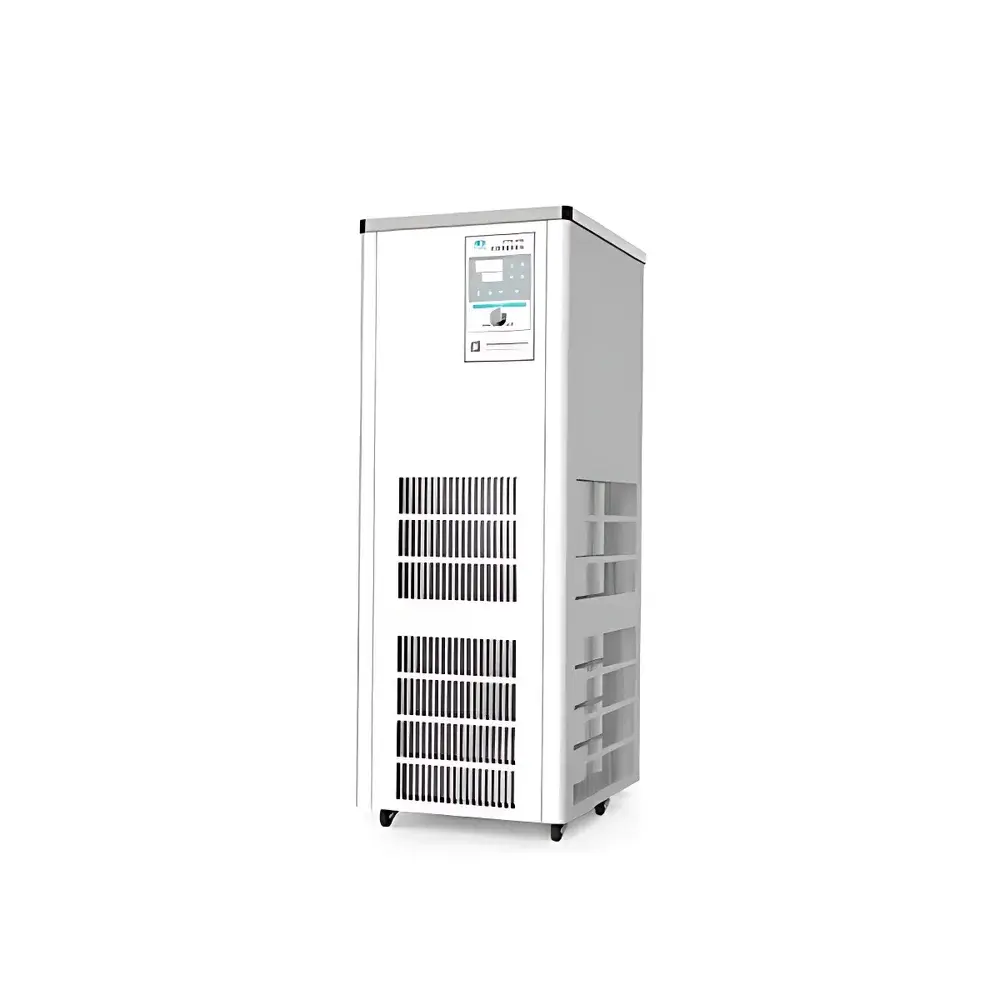
Scientz DLBC-8080 Precision Circulating Thermostatic Bath
| Brand | Scientz |
|---|---|
| Model | DLBC-8080 |
| Temperature Control Range | –80 °C to +80 °C |
| Temperature Stability | ±0.1 °C |
| Refrigerant | Environmentally Compliant (R-404A or R-507 Equivalent) |
| Cooling Method | Hermetically Sealed Compressor with PID-Controlled Heating Compensation |
| Circulation Pump Flow Rate | Adjustable up to 20 L/min |
| Reservoir Capacity | 80 L |
| Construction | 316 Stainless Steel Wetted Parts |
| Integrated Magnetic Stirring | Dual-Stage, Bottom-Mounted, Synchronized with External Vessel Stirring |
| Compliance | CE, ISO 9001, Designed for GLP/GMP-Compliant Labs |
Overview
The Scientz DLBC-8080 is a high-precision, dual-function circulating thermostatic bath engineered for laboratory environments requiring rigorous temperature control across a wide operational range (–80 °C to +80 °C). Unlike conventional water baths, the DLBC-8080 operates as a closed-loop thermal management system—capable of both internal sample conditioning and external temperature regulation of analytical instruments, reactors, or sensor calibration fixtures. Its core thermodynamic architecture integrates a hermetically sealed refrigeration circuit with an independent resistive heating system, enabling dynamic thermal balancing via microprocessor-driven PID algorithms. This design eliminates compressor cycling under low-load conditions, thereby enhancing long-term reliability and reducing thermal overshoot during setpoint transitions. The unit is specifically configured for applications demanding spatial temperature uniformity (<±0.05 °C gradient across working volume) and temporal stability (±0.1 °C over 24 h), making it suitable for metrology-grade calibration, kinetic studies, and temperature-sensitive synthesis protocols.
Key Features
- Wide temperature span: –80 °C to +80 °C, achieved using an environmentally compliant refrigerant blend compatible with international phase-out schedules (e.g., aligned with EU F-Gas Regulation Annex I)
- PID-controlled dual-mode thermal regulation: Compressor-based cooling actively balanced by precision resistive heating, minimizing mechanical wear and ensuring smooth ramping without thermal shock
- Dual-stage magnetic stirring system: Primary bottom-mounted stirrer drives a secondary stainless-steel stir plate, optimizing convective heat transfer and reducing axial temperature stratification in viscous or high-density media
- 80-liter reservoir constructed entirely from electropolished 316 stainless steel—resistant to cryogenic embrittlement, chloride-induced pitting, and organic solvent exposure
- Adjustable circulation pump (0–20 L/min, pressure-rated to 2.5 bar) with non-pulsating flow profile, certified for continuous operation in ISO Class 5 cleanroom-adjacent installations
- Integrated digital interface with real-time graphing capability, USB data logging, and optional Ethernet connectivity for LabVantage or Thermo Fisher SampleManager integration
Sample Compatibility & Compliance
The DLBC-8080 accommodates a broad spectrum of sample formats—including jacketed glass reactors (up to 5 L), calorimetry cells, viscometer spindles, and optical cuvettes—without compromising thermal fidelity. All fluid-contact surfaces meet ASTM A240/A240M standards for corrosion-resistant austenitic stainless steel. The system conforms to IEC 61010-1:2010 for electrical safety in laboratory equipment and includes redundant thermal cutoffs (mechanical and electronic) compliant with EN 60730-1. It supports audit-ready operation under FDA 21 CFR Part 11 when paired with validated software modules, and its temperature traceability is NIST-traceable via factory calibration certificates (optional on-site verification available).
Software & Data Management
The embedded controller runs Scientz’s proprietary ThermaLink™ firmware (v4.2+), supporting programmable multi-step temperature profiles, real-time deviation alarms, and automatic event logging (timestamp, setpoint, actual temp, pump speed, compressor status). Data export is native to CSV and XML formats; optional SciDataSuite™ software enables automated report generation compliant with ISO/IEC 17025 clause 7.7 (result reporting) and provides electronic signature workflows for GLP documentation. Audit trails record all parameter modifications, user logins, and calibration events with immutable timestamps—fully satisfying ALCOA+ data integrity principles.
Applications
- Calibration of platinum resistance thermometers (PRTs), RTDs, and thermocouples per ASTM E74 and ISO/IEC 17025
- Temperature-controlled reaction monitoring in catalytic hydrogenation, polymerization, and enzymatic assays
- Stabilization of laser sources, CCD detectors, and interferometric platforms in physical optics labs
- Thermal preconditioning of reference materials prior to DSC, TGA, or rheological characterization
- Supporting cold-trap operation in rotary evaporation systems and vacuum manifold setups
- Long-duration stability testing of pharmaceutical formulations under ICH Q5C stress conditions
FAQ
What is the maximum external load capacity supported by the DLBC-8080’s circulation system?
The unit maintains ±0.1 °C stability while delivering up to 2.5 kW thermal exchange capacity to external devices, assuming ≤3 m total tubing length and ≤15 mm inner diameter silicone or PTFE lines.
Can the magnetic stirring function operate independently of temperature control?
Yes—stirring speed (0–1200 rpm) and thermal setpoint are fully decoupled in manual mode, allowing concurrent optimization of mixing dynamics and thermal history.
Is remote monitoring supported via industry-standard protocols?
The DLBC-8080 supports Modbus TCP and OPC UA (via optional gateway module), enabling seamless integration into Siemens Desigo, Honeywell Experion, or Emerson DeltaV DCS environments.
Does the system include validation documentation for GxP environments?
Factory-installed IQ/OQ documentation packages are available upon request, including as-found/as-left test records, sensor linearity reports, and alarm response verification logs.
What maintenance intervals are recommended for compressor longevity?
Annual inspection of refrigerant charge, condenser coil cleaning, and pump seal integrity is advised; full service is recommended every 24 months or after 8,000 operating hours, whichever occurs first.



