
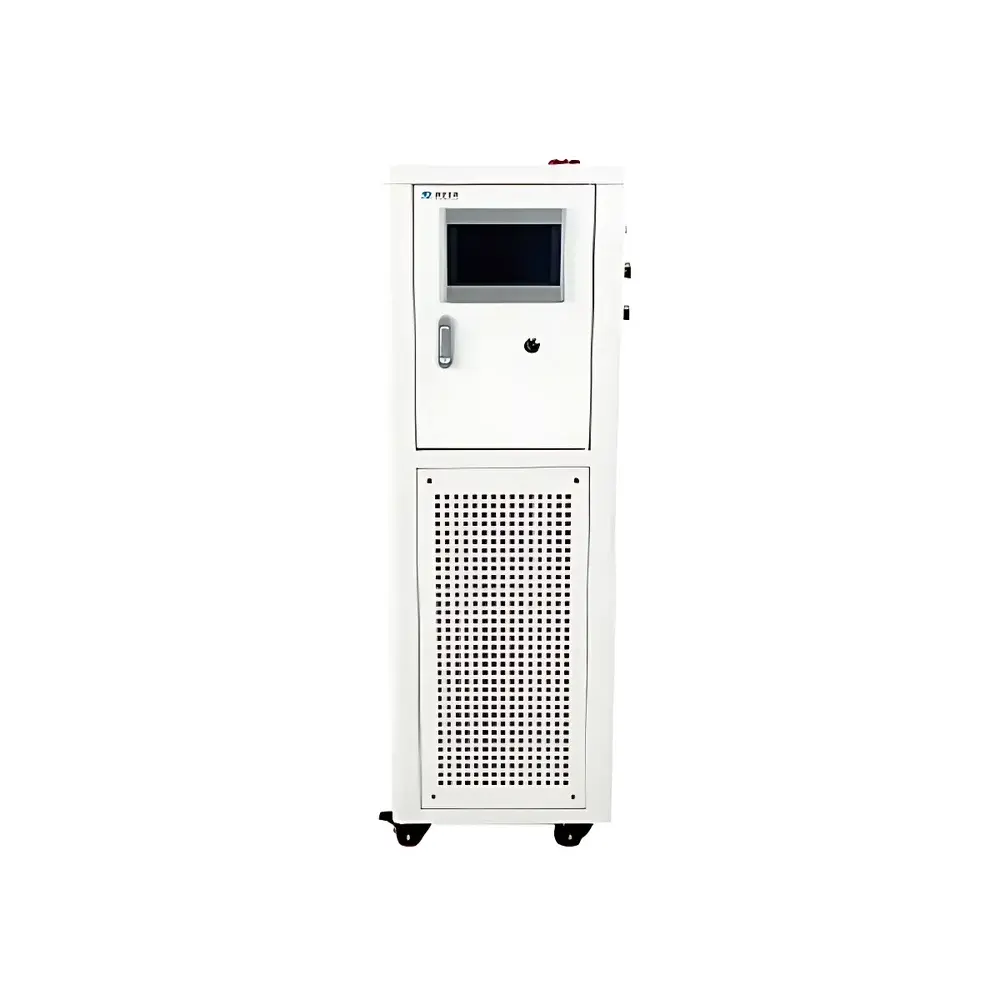
Scientz HL25-220 Series High-Low Temperature Circulating Chiller System
| Brand | Scientz |
|---|---|
| Origin | Zhejiang, China |
| Manufacturer Type | Direct Manufacturer |
| Country of Origin | China |
| Model | HL25-220 Series |
| Temperature Control Range | −25 °C to 200 °C |
| Temperature Accuracy | ±0.5 °C |
| Control Method | PID Fuzzy Logic |
| Display | 7-inch Color Touchscreen with Real-time Temperature Curve Logging |
| Communication Interface | RS-485 Modbus RTU Protocol |
| System Architecture | Fully Sealed Closed-Loop Circulation |
| Safety Protections | Compressor Overload Protection, High-Pressure Switch, Thermal Relay, Overtemperature Sensor Fault Detection, Low-Fluid-Level Alarm, Dual-Stage Overtemperature Cut-off |
| Programmability | Up to 5 Programs, Each with 30 Segments |
| Temperature Feedback Points | Internal Bath Temp (PT100), Outlet Fluid Temp (PT100), External Process Material Temp (PT100 Input) |
| ΔT Control Mode | Adjustable Differential Between Jacket and Process Material Temperature |
| Enclosure Material | Cold-Rolled Steel with Powder Coating |
Overview
The Scientz HL25-220 Series High-Low Temperature Circulating Chiller System is an engineered thermal management platform designed for precise, stable, and programmable temperature control across demanding life science, chemical process development, and advanced materials testing applications. Operating on a fully sealed closed-loop circulation principle, the system delivers consistent thermal energy transfer using a single heat-transfer fluid—eliminating the need for media switching between low- and high-temperature regimes. Its core thermodynamic architecture supports operation from −25 °C to 200 °C, enabling seamless transition between cryogenic cooling and high-temperature heating within one integrated unit. The system employs PID fuzzy logic control algorithms to dynamically adjust refrigeration and heating output in response to real-time load variations, ensuring minimal thermal overshoot and high reproducibility in process-critical environments such as jacketed reactor control, microchannel reaction optimization, and automotive component validation under extreme thermal stress.
Key Features
- Fully sealed closed-loop design prevents oil mist generation at elevated temperatures and moisture ingress during sub-zero operation—ensuring long-term fluid stability and reduced maintenance intervals.
- Triple-point PT100 temperature feedback: simultaneous monitoring of internal bath temperature, outlet fluid temperature, and externally mounted process material temperature (via user-supplied sensor input).
- ΔT (delta-T) control mode allows independent setpoint definition for the temperature difference between reactor jacket and actual process material—critical for exothermic reaction safety and kinetic fidelity.
- 7-inch color touchscreen interface with embedded data logging capability; supports real-time temperature curve visualization, historical trace replay, and CSV export via USB port.
- Modbus RTU over RS-485 enables seamless integration into centralized SCADA or LIMS platforms for automated batch reporting and regulatory-compliant audit trails.
- Comprehensive safety architecture includes dual-stage overtemperature cutoff, low-fluid-level detection, high-pressure refrigerant monitoring, thermal relay protection, and automatic fault diagnostics with on-screen error codes.
- Programmable multi-step temperature profiles: up to five distinct programs, each configurable with 30 individual segments—including ramp rates, dwell times, and conditional transitions.
Sample Compatibility & Compliance
The HL25-220 is compatible with a broad range of process vessels and instrumentation interfaces, including standard jacketed glass and stainless-steel reactors (e.g., 1–50 L capacity), microstructured flow reactors, calorimetric test cells, and environmental test chambers. Its modular fluid coupling design accommodates standard 1/2″–3/4″ quick-connect fittings and supports both silicone oil and synthetic heat-transfer fluids meeting ASTM D6799 and ISO 6743-12 specifications. From a compliance standpoint, the system’s deterministic control logic, non-volatile event logging, and user-accessible audit trail functionality align with GLP and GMP documentation requirements. While not pre-certified to FDA 21 CFR Part 11, its data export capabilities (timestamped, uneditable CSV logs) support validation protocols required for regulated QC/QA workflows in pharmaceutical process development and battery thermal testing labs.
Software & Data Management
No proprietary software installation is required—the HL25-220 operates autonomously via its onboard controller. All temperature data—including bath, outlet, and external process readings—is time-stamped and stored internally with a minimum resolution of 1 second. Logged datasets can be exported in comma-separated values (CSV) format directly to USB storage devices for downstream analysis in MATLAB, Python (Pandas), or commercial statistical process control (SPC) tools. For enterprise integration, the Modbus RTU protocol supports read/write access to all operational parameters (setpoints, actuals, alarms, program status) and enables synchronization with LabVIEW, Ignition SCADA, or custom MES systems. Audit-ready features include immutable log files, user login tracking (with configurable access levels), and timestamped alarm history with cause-code classification.
Applications
- Chemical Process Development: Precise thermal control for hydrogenation, nitration, sulfonation, and photochemical reactions in stirred-tank and microreactor configurations—enabling safe scale-up from lab to pilot plant.
- Pharmaceutical R&D: Controlled crystallization, polymorph screening, and dissolution testing under defined thermal gradients per ICH Q5A and USP <1058> guidelines.
- Battery & EV Component Testing: Thermal cycling of lithium-ion cells, power electronics modules, and thermal interface materials across −40 °C to +125 °C equivalent operating envelopes—supporting ISO 16750-4 and SAE J2380 validation protocols.
- Bioprocess Support: Temperature stabilization for fermenter jackets, chromatography column ovens, and cold-chain sample storage units where ±0.5 °C stability is critical for enzyme activity preservation.
- Materials Characterization: Dynamic mechanical analysis (DMA) sample conditioning, TGA/DTA reference calibration, and polymer curing profile validation.
FAQ
What is the maximum allowable working pressure of the HL25-220 circulation loop?
The system is rated for continuous operation at ≤3 bar (gauge) static pressure; dynamic pressure spikes must remain below 4 bar to maintain seal integrity and avoid triggering the high-pressure safety cutoff.
Can the HL25-220 be used with water-based heat-transfer fluids?
No—water or aqueous glycol mixtures are incompatible below 0 °C due to freezing risk and above 100 °C due to vapor pressure limitations. Only certified synthetic oils or silicone-based fluids with flash points >250 °C and pour points <−40 °C are recommended.
Is remote monitoring supported via Ethernet or Wi-Fi?
The standard configuration includes only RS-485 Modbus RTU. Optional Ethernet-to-Modbus gateways may be deployed externally to enable TCP/IP connectivity, but native IP stack support is not embedded in the controller firmware.
How often does the system require preventive maintenance?
Compressor oil and filter replacement is recommended every 12 months or 4,000 operating hours—whichever occurs first—under typical laboratory usage conditions (≤8 h/day, ambient ≤30 °C).
Does the HL25-220 meet CE or UL safety certification standards?
The unit complies with IEC 61000-6-2 (immunity) and IEC 61000-6-4 (emissions) for industrial environments. It carries CCC certification for the Chinese market; CE marking is available upon request for EU-bound units with additional conformity assessment documentation.




