
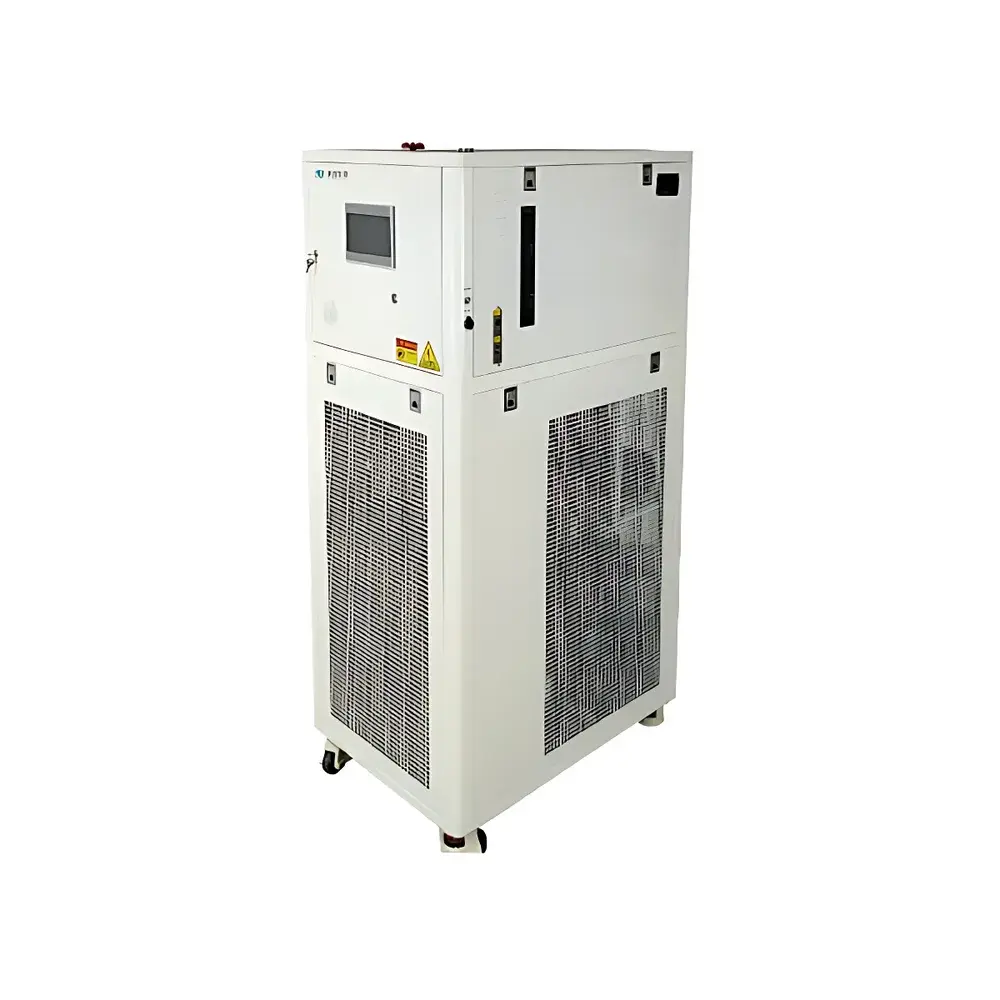
Scientz HL35-1010 Series Low-Temperature & High-Temperature Circulating Chiller System (-100 °C to 100 °C)
| Brand | Scientz |
|---|---|
| Origin | Zhejiang, China |
| Manufacturer Type | Direct Manufacturer |
| Country of Origin | China |
| Model | HL35-1010 Series |
| Temperature Control Range | -100 °C to 100 °C |
| Temperature Accuracy | ±0.5 °C (heat transfer medium) |
| Medium Temperature Range | -25 °C to 200 °C |
| Control Interface | 7-inch color touchscreen with real-time temperature curve display and logging |
| Communication Protocol | MODBUS RTU over RS-485 |
| Programmability | Up to 5 programs, each with up to 30 segments |
| Temperature Feedback Points | Three PT100 inputs — unit internal temperature, outlet temperature, and external reactor material temperature |
| Safety Protections | Compressor overload protection, high-pressure switch, thermal relay, overtemperature sensor fault detection, low-fluid-level alarm, and integrated self-diagnostic system |
| System Design | Fully sealed circulation loop preventing oil mist at high temperatures and moisture ingress at low temperatures |
Overview
The Scientz HL35-1010 Series is a precision-engineered, dual-range circulating chiller system designed for laboratory-scale and pilot-process temperature control in life science, chemical synthesis, and advanced materials testing environments. Operating across an extended thermal envelope of -100 °C to +100 °C, the system employs a closed-loop refrigeration architecture with cascade compression stages for sub-zero operation and robust heating elements for rapid, stable elevation above ambient. Its core function is to maintain precise thermal setpoints on external process equipment—such as jacketed reactors, microchannel reactors, calorimeters, or automotive component test fixtures—via forced circulation of a compatible heat transfer fluid (e.g., silicone oil, ethylene glycol/water mixtures). The system implements PID-based fuzzy logic control to minimize overshoot and stabilize temperature within ±0.5 °C of the setpoint at the fluid outlet, while maintaining ±1.0 °C accuracy at the process load interface when properly instrumented with an external PT100 sensor. This level of repeatability supports GLP-compliant experimental protocols and meets the thermal stability requirements of ASTM E2919 (Standard Practice for Thermal Stability Testing of Chemicals) and ISO 17025-accredited calibration workflows.
Key Features
- Fully sealed circulation system eliminates vaporization losses at elevated temperatures and prevents atmospheric moisture condensation during cryogenic operation
- Triple-point PT100 temperature monitoring: internal reservoir, outlet port, and externally mounted reactor probe—enabling differential temperature control between jacket and bulk material
- Intuitive 7-inch capacitive touchscreen HMI with real-time multi-curve plotting, historical data overlay, and timestamped event logging
- Programmable thermal profiles: five independent programs, each supporting up to 30 definable segments with ramp rate, hold time, and target temperature parameters
- Industrial-grade MODBUS RTU (RS-485) interface for integration into SCADA, LIMS, or PLC-controlled lab automation systems
- Comprehensive safety architecture including compressor overcurrent protection, high-pressure cut-off, redundant thermal fuses, low-fluid-level detection, and automatic fault diagnosis with on-screen error codes
Sample Compatibility & Compliance
The HL35-1010 accommodates a broad range of process vessels and instrumentation platforms. It interfaces seamlessly with glass and stainless-steel jacketed reactors (1–50 L), microstructured flow reactors requiring tight thermal gradients (<±0.3 °C), and multi-zone environmental test chambers used in automotive electronics qualification per ISO 16750-4 and SAE J2380. Its sealed design ensures compatibility with hygroscopic or oxygen-sensitive reactions, eliminating contamination risks associated with open-bath chillers. All electrical components comply with IEC 61010-1 safety standards for laboratory equipment. Firmware supports audit-trail-enabled operation per FDA 21 CFR Part 11 when paired with validated third-party data acquisition software, facilitating regulatory submissions in pharmaceutical development and contract manufacturing.
Software & Data Management
While the unit operates autonomously via its embedded controller, raw temperature logs (timestamp, setpoint, actual outlet temp, reactor temp, system status) are exportable via USB flash drive in CSV format. The MODBUS register map provides full read/write access to all operational parameters—including program execution state, alarm history, and real-time sensor values—enabling custom scripting in Python, LabVIEW, or MATLAB for automated experiment sequencing. For enterprise deployment, Scientz offers optional OPC UA gateway firmware (sold separately) to enable secure, encrypted data routing to cloud-based analytics platforms compliant with ISO/IEC 27001 information security frameworks.
Applications
- Chemical process development: exothermic nitration, hydrogenation, and photochemical reactions in jacketed batch reactors
- Continuous flow chemistry: thermal management of microchannel reactors during scale-up of API intermediates
- Materials science: low-temperature tensile testing of polymer composites and battery electrolyte characterization across -40 °C to +85 °C
- Automotive R&D: climatic validation of ADAS sensors, power electronics, and thermal interface materials under dynamic thermal cycling profiles
- Biopharmaceutical manufacturing support: cold storage simulation for fill-finish line qualification and lyophilizer shelf temperature mapping
FAQ
What heat transfer fluids are compatible with the HL35-1010 system?
The system is rated for use with silicone oils (e.g., DC200 series), polyalphaolefins (PAOs), and aqueous glycol solutions. Fluid selection must align with the target operating temperature range and viscosity constraints at extreme endpoints.
Can the HL35-1010 be integrated into a GMP-compliant facility?
Yes—when configured with MODBUS-enabled data capture, electronic signature-capable HMI firmware, and validated backup logging procedures, it satisfies key elements of Annex 11 and EU GMP Chapter 4 for computerized system validation.
Is remote monitoring supported out of the box?
No native Ethernet or Wi-Fi module is included; however, RS-485-to-Ethernet gateways can be deployed to enable TCP/IP-based supervision using standard industrial protocols.
What maintenance intervals are recommended?
Compressor oil and filter replacement every 12 months or 3,000 operating hours; annual verification of PT100 sensor calibration traceable to NIST standards.
Does the system support simultaneous heating and cooling?
No—it operates in either heating or cooling mode at any given time; transition between modes requires manual confirmation or programmable sequence logic to prevent thermal shock to connected equipment.



