
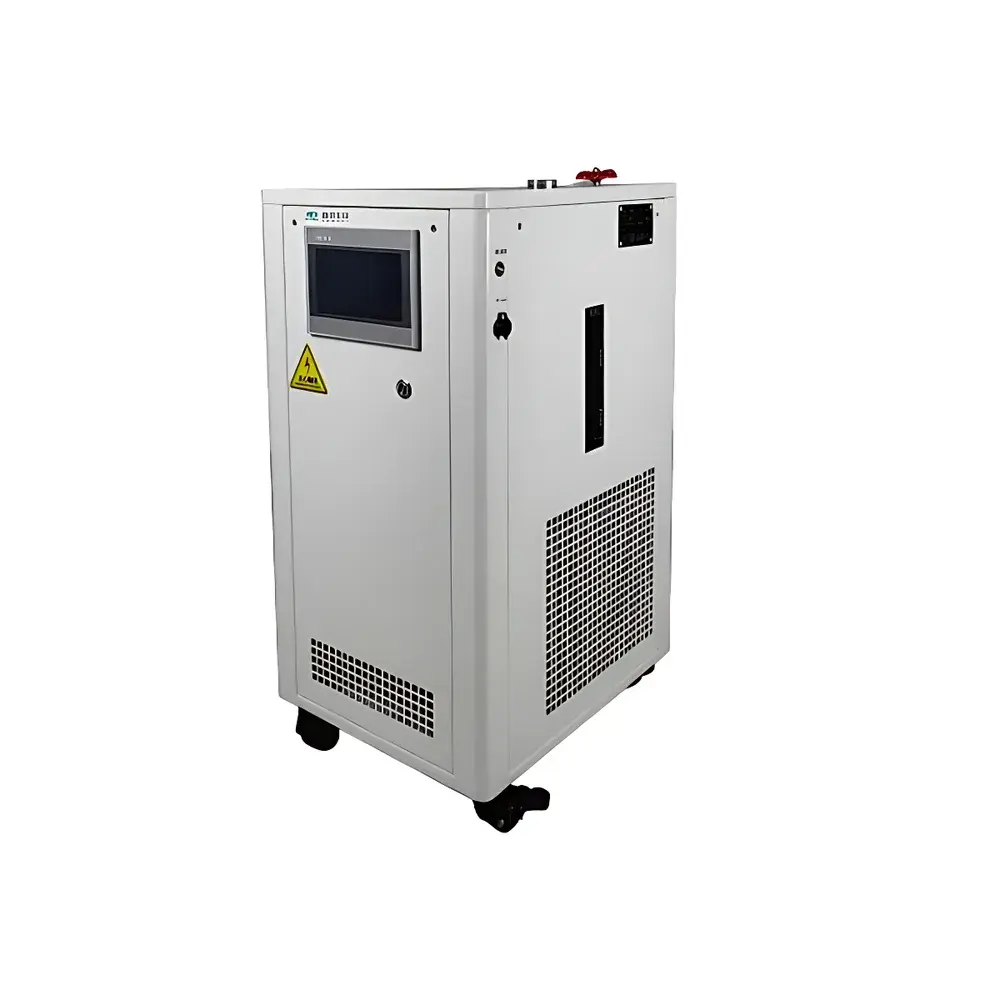
Scientz L1.5-2 Precision Temperature Control System (-25 °C to Room Temperature)
| Brand | Scientz |
|---|---|
| Origin | Zhejiang, China |
| Manufacturer Type | Direct Manufacturer |
| Country of Origin | China |
| Model | L1.5-2 |
| Temperature Range | -25 °C to RT (Room Temperature) |
| Temperature Accuracy | ±0.5 °C (heat transfer medium) |
| Temperature Uniformity | Contact manufacturer for specification |
| Dimensions (W×D×H) | 400 × 600 × 1150 mm |
| Maximum Power Consumption | 1.8 kW |
| Control Interface | 7-inch color touchscreen |
| Communication Protocol | MODBUS RTU over RS-485 |
| Safety Protections | High-pressure switch, overload relay, thermal protection, low-fluid-level detection, high-temperature sensor fault protection, self-diagnostic system |
| Control Logic | PID fuzzy control |
| Programmability | Up to 5 programs, each with up to 30 segments |
| Temperature Feedback Points | Medium inlet temperature, medium outlet temperature, and external PT100 probe (for reactor material temperature) |
| System Design | Fully sealed closed-loop circulation |
Overview
The Scientz L1.5-2 Precision Temperature Control System is an engineered solution for laboratory- and pilot-scale thermal management of chemical reactors, microreactors, and automotive component test benches. Designed around a fully sealed, single-fluid closed-loop architecture, it delivers stable, programmable temperature control across a wide operational range—from -25 °C to ambient room temperature—without requiring media exchange or atmospheric exposure. Its core thermodynamic design leverages forced-circulation heat transfer using a compatible synthetic heat transfer fluid, enabling rapid heating and cooling response while maintaining tight thermal stability. Unlike open-bath systems, the L1.5-2 eliminates vapor loss at elevated temperatures and moisture ingress at sub-ambient conditions—critical for reproducible reaction kinetics, long-duration stability testing, and GLP-compliant data acquisition.
Key Features
- PID fuzzy logic control algorithm ensures dynamic adaptation to load variations and minimizes overshoot during ramping phases.
- Triple-point temperature monitoring: real-time acquisition of internal bath temperature, outlet fluid temperature, and externally measured process material temperature via optional PT100 sensor input.
- Intuitive 7-inch color touchscreen interface with embedded temperature curve visualization, historical trend logging, and on-device parameter editing.
- Configurable dual-mode operation: user-selectable control target—either heat transfer medium outlet temperature or actual reactor material temperature—enabling precise exothermic/endothermic compensation.
- Programmable thermal profiles: supports up to five independent protocols, each containing up to thirty definable segments with ramp rate, hold time, and setpoint parameters.
- Comprehensive safety architecture includes high-pressure cut-off, compressor overload protection, thermal fuse, low-fluid-level interlock, and sensor fault detection with automatic shutdown and event logging.
- MODBUS RTU communication over RS-485 enables integration into centralized SCADA or LIMS environments for remote supervision and audit-ready data traceability.
Sample Compatibility & Compliance
The L1.5-2 is compatible with jacketed glass reactors (1–50 L), stainless-steel pilot reactors, microstructured flow reactors, and multi-channel environmental test fixtures. Its closed-loop design meets ISO 17025 requirements for thermal calibration traceability when used with NIST-traceable PT100 probes. The system supports compliance workflows aligned with FDA 21 CFR Part 11 (when paired with validated software platforms), ASTM E2877 (for thermal stability assessment of battery modules), and IEC 60068-2-1/2 (environmental testing standards for electronic components). All electrical components conform to CE and RoHS directives; explosion-proof variants (BT4/CT4) are available under separate configuration codes upon request.
Software & Data Management
While the L1.5-2 operates autonomously via its embedded controller, optional PC-based software (Scientz TempLink Pro v3.2) provides extended functionality—including automated report generation (PDF/CSV), alarm history export, multi-device synchronization, and electronic signature support for 21 CFR Part 11 compliance. All temperature logs include timestamps, operator ID fields, and checksum-verified metadata. Audit trails record parameter changes, manual overrides, and system faults with immutable timestamps—fully satisfying GLP/GMP documentation requirements for regulated laboratories and quality control departments.
Applications
- Chemical Synthesis: Precise thermal control for exothermic nitration, sulfonation, hydrogenation, and photochemical reactions in batch and continuous-flow reactors.
- Pharmaceutical Development: Maintaining strict thermal profiles during crystallization, polymorph screening, and API stability studies per ICH Q1 guidelines.
- Advanced Materials Testing: Thermal cycling of battery cells, power electronics, and composite materials across -25 °C to +25 °C under controlled humidity-free conditions.
- Microreactor Optimization: Enabling millisecond-resolved thermal response in segmented flow chemistry, especially for highly energetic transformations.
- Bioprocess Support: Auxiliary temperature stabilization for enzyme assays, cell lysis protocols, and cold-chain validation studies where ambient drift must be eliminated.
FAQ
What is the recommended heat transfer fluid for the L1.5-2 system?
Scientz specifies silicone oil or polyalphaolefin (PAO)-based synthetic fluids rated for continuous operation between -30 °C and +100 °C. Fluid selection must comply with flash point, viscosity, and thermal stability requirements of the application.
Can the L1.5-2 be integrated into a distributed control system (DCS)?
Yes—the built-in MODBUS RTU interface allows bidirectional communication with industry-standard DCS/PLC platforms. Register mapping documentation and protocol conformance test reports are provided upon request.
Is remote firmware update supported?
Firmware updates require local USB connection and authenticated access credentials. Over-the-air updates are not implemented to maintain regulatory integrity and system validation status.
Does the system support external temperature feedback from third-party sensors?
It accepts standard 2-/3-/4-wire PT100 inputs (IEC 60751 Class B) with configurable linearization and offset compensation. Sensor calibration certificates must be maintained per ISO/IEC 17025.
What maintenance intervals are recommended?
Annual inspection of refrigerant charge, pump seal integrity, and electrical insulation resistance is advised. Filter replacement and fluid analysis should occur every 12 months or after 2000 operating hours—whichever comes first.
Related Products




