
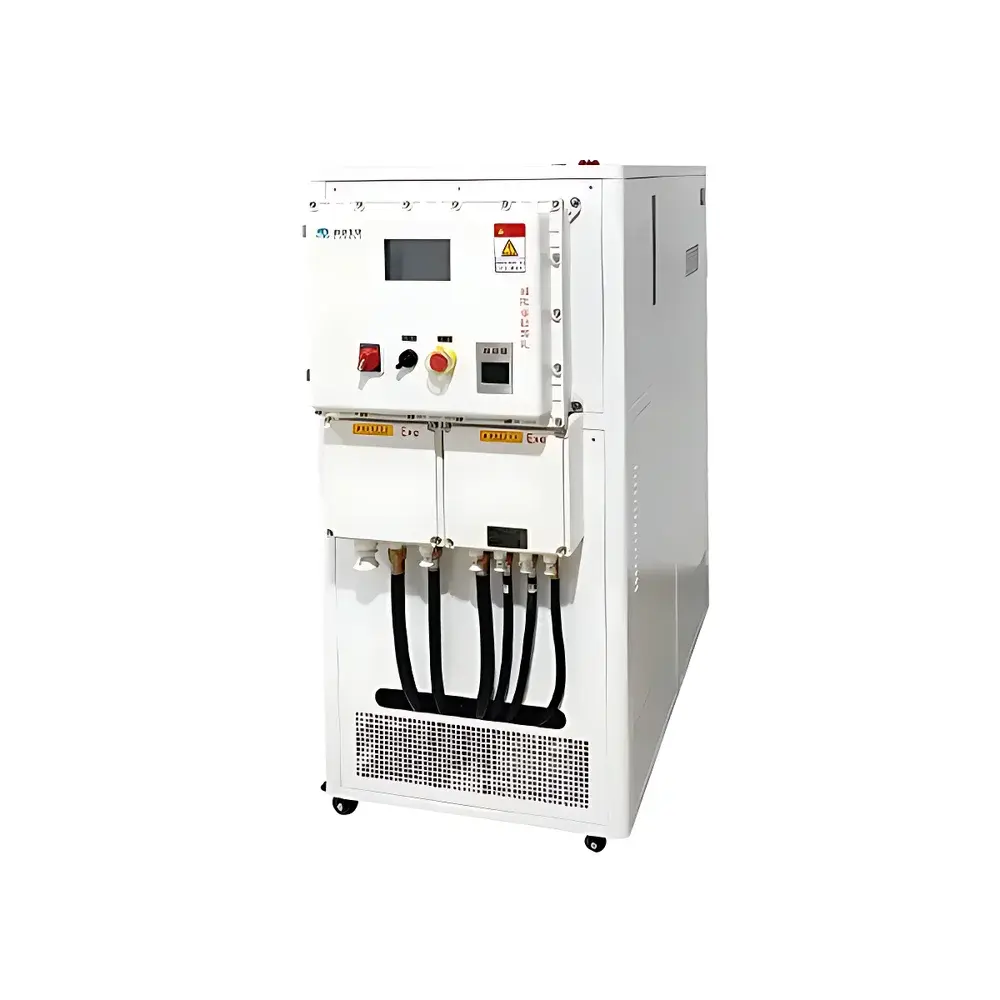
Scientz L1.5-4 Series Low-Temperature Circulating Chiller System (–40 °C to Room Temperature)
| Brand | Scientz |
|---|---|
| Origin | Zhejiang, China |
| Manufacturer Type | Direct Manufacturer |
| Country of Origin | China |
| Model | L1.5-4 Series |
| Temperature Range | –40 °C to RT (Room Temperature) |
| Temperature Accuracy | ±0.5 °C |
| Control Algorithm | PID Fuzzy Control |
| Display | 7-inch Color Touchscreen with Real-time Temperature Curve Plotting and Logging |
| Communication Interface | RS-485 with MODBUS RTU Protocol |
| Heat Transfer Medium Temperature Range | –25 °C to 200 °C |
| Programmable Profiles | 5 Programs × 30 Segments Each |
| Temperature Feedback Points | Three PT100 Sensors (Unit Internal Temp, Outlet Temp, External Reactor Material Temp) |
| Safety Protections | Compressor Overload Protection, High-Pressure Switch, Thermal Relay, Overtemperature Sensor Fault Detection, Low-Fluid-Level Protection, High-Temp Cut-off |
| System Design | Fully Sealed Closed-Loop Circulation |
Overview
The Scientz L1.5-4 Series Low-Temperature Circulating Chiller System is an engineered thermal management solution designed for precise, stable, and programmable temperature control across demanding life science, chemical synthesis, and materials testing applications. Operating on a closed-loop circulation principle, the system delivers consistent thermal energy transfer using a single heat transfer fluid—eliminating the need for medium switching across wide operational ranges. Its core architecture integrates a high-efficiency refrigeration compressor, precision expansion valve, and multi-point PT100 temperature sensing to achieve ±0.5 °C accuracy in bath or outlet temperature control and ±1 °C accuracy in process material temperature regulation. Unlike open-bath chillers, the fully sealed design prevents moisture ingress at sub-zero conditions and suppresses volatile emissions at elevated temperatures—ensuring long-term fluid stability, reduced maintenance frequency, and compliance with laboratory safety protocols.
Key Features
- Advanced PID fuzzy logic control algorithm ensures rapid thermal response and minimal overshoot during dynamic ramping or hold phases.
- 7-inch color touchscreen interface with intuitive navigation supports real-time temperature curve visualization, historical data review, and on-device parameter configuration.
- Triple-point temperature monitoring: internal chiller temperature, outlet fluid temperature, and external reactor material temperature (via optional external PT100 probe).
- Programmable thermal profiles—up to five independent programs, each containing up to thirty user-defined segments with ramp rate, dwell time, and target temperature parameters.
- Modbus RTU communication over RS-485 enables seamless integration into centralized lab automation systems, SCADA platforms, or LIMS environments for remote monitoring and audit-trail generation.
- Comprehensive safety architecture includes compressor overload protection, high-pressure cut-off switch, thermal relay, low-fluid-level sensor, overtemperature fault detection, and redundant temperature sensor validation.
Sample Compatibility & Compliance
The L1.5-4 series is compatible with glass and stainless-steel jacketed reactors (including pilot-scale and microreactor systems), calorimeters, environmental test chambers, and battery cell thermal test fixtures. Its sealed circulation loop meets ISO 17025 requirements for measurement traceability when used with calibrated PT100 sensors. The system supports GLP/GMP-aligned workflows through its programmable logging capability and timestamped temperature records—enabling compliance with FDA 21 CFR Part 11 when deployed with validated software interfaces. While not certified to UL/CE as a standalone unit, it conforms to IEC 61000-6-2 (immunity) and IEC 61000-6-4 (emissions) standards for laboratory-grade electrical equipment.
Software & Data Management
Onboard firmware stores temperature logs with timestamps, program execution history, and alarm event records. Data export is supported via USB flash drive in CSV format for post-processing in MATLAB, Python, or Excel. When connected to a host PC via RS-485-to-USB converter, the device accepts Modbus register reads for integration with LabVIEW, Python-based control scripts, or enterprise MES systems. All logged data includes metadata such as profile ID, segment number, setpoint, actual temperature, and deviation—facilitating root-cause analysis during process qualification or deviation investigations.
Applications
- Chemical Process Development: Precise jacket temperature control for exothermic nitration, sulfonation, hydrogenation, and photochemical reactions in batch and continuous flow reactors.
- Pharmaceutical R&D: Maintaining strict thermal conditions during crystallization, polymorph screening, and lyophilization cycle development per USP & ICH Q5C guidelines.
- Materials Testing: Simulating extreme ambient conditions (-40 °C to +85 °C) for automotive component validation, battery thermal runaway testing, and polymer aging studies.
- Bioprocess Support: Stabilizing bioreactor jackets during fermentation or cell culture processes where temperature-sensitive enzymes or mammalian cells require tight thermal tolerance.
- Microreactor Integration: Providing single-fluid, high-dynamic-range thermal control for silicon- or metal-based microchannel devices operating under high surface-area-to-volume ratios.
FAQ
What is the maximum allowable working temperature of the heat transfer fluid?
The system supports heat transfer media rated up to 200 °C; however, operation above 120 °C requires silicone oil or synthetic aromatic fluids—not water or glycol mixtures.
Can the unit maintain temperature stability during rapid exothermic reactions?
Yes—the dual-sensor feedback loop (outlet + material) combined with adaptive PID tuning enables active compensation for sudden thermal loads, typically stabilizing within ±1 °C of setpoint under controlled reaction conditions.
Is external temperature sensor calibration traceable to NIST standards?
The system accepts standard PT100 sensors; users must supply NIST-traceable calibration certificates for external probes to satisfy ISO/IEC 17025 documentation requirements.
Does the chiller support automatic fluid level top-up?
No—it features low-level detection and shutdown but does not include an auto-refill mechanism; manual replenishment is required following manufacturer-recommended fluid specifications.
How is data integrity ensured during power interruption?
All critical logs and active program states are retained in non-volatile memory; upon restart, the unit resumes from last valid checkpoint without data loss.




