
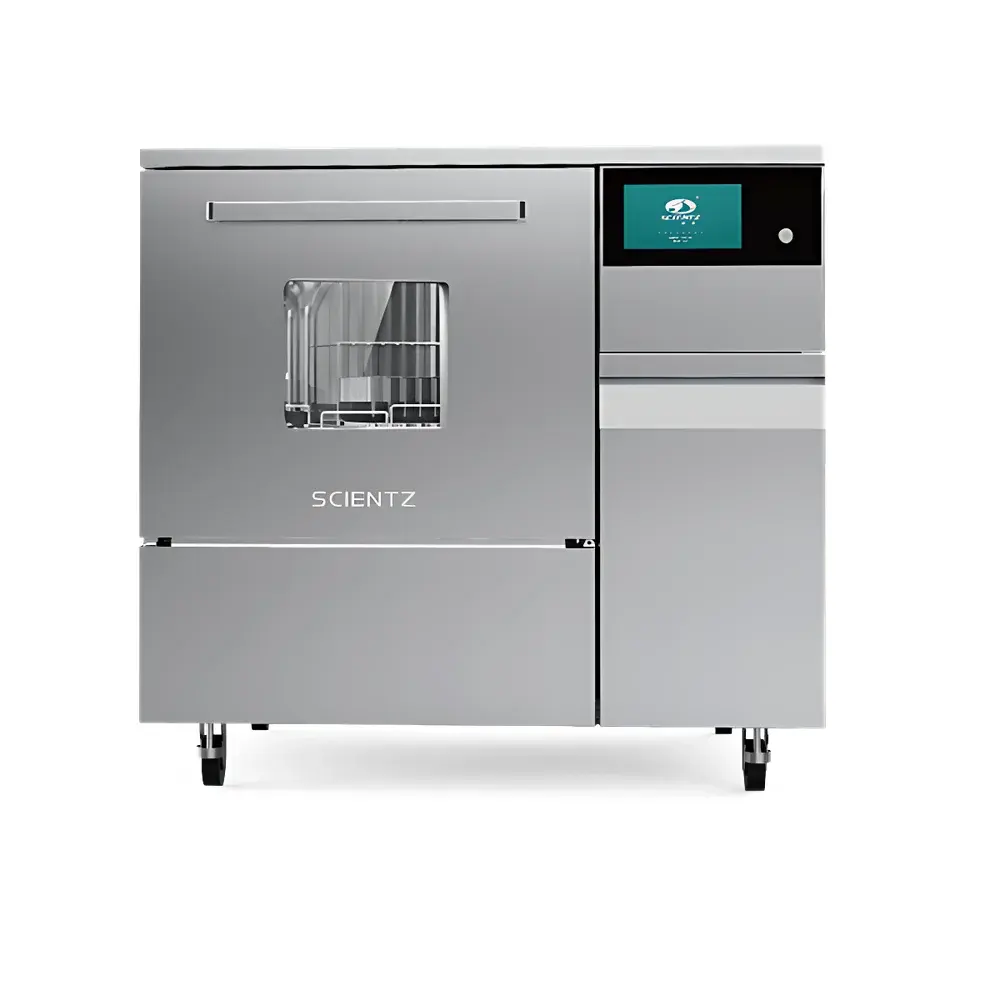
Scientz LGW-100 Laboratory Glassware Washer
| Brand | Scientz |
|---|---|
| Origin | Zhejiang, China |
| Manufacturer Type | Direct Manufacturer |
| Country of Origin | China |
| Model | LGW-100 |
| Chamber Volume | 396 L |
| Heating Power | 6 kW |
| Temperature Range | Ambient to 95°C |
| External Dimensions (L×W×D) | 710 × 933 × 1665 mm |
Overview
The Scientz LGW-100 Laboratory Glassware Washer is an integrated, fully automated cleaning, disinfection, and drying system engineered for precision laboratories requiring reproducible, traceable, and compliant glassware reprocessing. It operates on the principle of dynamic fluid mechanics combined with thermally enhanced chemical action: pressurized wash solution—delivered via rotating spray arms and bottom-mounted spray nozzles—is circulated at controlled flow rates and temperatures to achieve 360° impingement on all interior and exterior surfaces of labware. This dual-action mechanism (mechanical shear + surfactant-mediated emulsification) ensures reliable removal of organic residues, proteins, salts, and particulates from volumetric flasks, culture tubes, pipettes, reaction vessels, and other ISO-standard laboratory glassware. Designed in accordance with EN ISO 15883-1/2 for washer-disinfectors used in healthcare and research settings, the LGW-100 supports thermal disinfection at ≥93°C for ≥1 minute—a validated threshold for inactivation of vegetative microorganisms per international hygiene standards.
Key Features
- Stainless steel construction: 304 stainless steel chassis with fingerprint-resistant finish; seamless, mirror-polished 316L stainless steel chamber with radius-cornered geometry to prevent biofilm accumulation and facilitate cleaning validation.
- 10.1-inch capacitive LCD touchscreen interface with real-time display of cycle phase, temperature profiles, fault diagnostics, and parameter status.
- 100 user-programmable wash protocols—each configurable for pre-rinse duration, wash temperature, detergent dosing volume (via dual standard peristaltic pumps, expandable to four), rinse count, final rinse conductivity monitoring, and drying setpoints.
- Three-tier password-protected access control (operator, supervisor, administrator) enabling full audit trail compliance per FDA 21 CFR Part 11 and GLP/GMP requirements.
- Integrated safety systems: ESL-controlled door interlock with automatic power cutoff upon forced opening; programmable safe-door temperature lockout; overtemperature and low-water-level protection; HEPA-filtered drying air (99.99% efficiency at 0.3 µm) with filter life monitoring and visual alarm.
- Self-cleaning chamber design with internal rinse cycles; steam condenser to prevent humid exhaust discharge; triple-layer stainless steel filtration system with quick-release mechanism for routine maintenance.
Sample Compatibility & Compliance
The LGW-100 accommodates standard laboratory glassware up to 1 L capacity—including Erlenmeyer flasks, graduated cylinders, Petri dishes, serum bottles, and reusable chromatography vials—when loaded on compatible modular baskets. Its chamber geometry and adjustable spray dynamics support heterogeneous loads without compromising cleaning efficacy. All materials in contact with wash media meet USP Class VI biocompatibility criteria. The system complies with EN ISO 15883-1/2 for performance verification, and its thermal disinfection cycle satisfies EN 285-defined A0-value requirements (>600) when operated at 93°C for ≥1 min. Optional deionized water module enables residue-free final rinsing aligned with ASTM E2961 and ISO 13485 cleanroom-grade validation protocols.
Software & Data Management
Embedded firmware supports USB-based data export of complete cycle logs—including timestamps, temperature curves, pump actuation events, detergent consumption, and fault codes—for integration into LIMS or electronic lab notebooks. Optional thermal printer module generates hard-copy cycle reports with operator ID, batch number, and pass/fail indicators. All process parameters are stored with immutable timestamps and user attribution, satisfying regulatory expectations for data integrity under ALCOA+ principles. Firmware updates are performed via secure USB import with digital signature verification.
Applications
The LGW-100 is routinely deployed in environmental testing labs (EPA Method-compliant sample bottle reprocessing), biopharmaceutical QC/QA facilities (USP analytical instrument qualification), food safety laboratories (AOAC-certified residue analysis workflows), and academic core facilities managing high-throughput assay plate regeneration. Its programmability supports method-specific cleaning validation for ELISA plates, HPLC vials, and cell culture flasks—reducing carryover risk and minimizing manual intervention across regulated workflows.
FAQ
What types of detergents are compatible with the LGW-100?
The system accepts low-foaming, non-corrosive alkaline or enzymatic formulations certified for laboratory washer use—e.g., Alconox® Liquinox®, SoluTabs™, or Tergazyme®. Detergent concentration is precisely metered via calibrated peristaltic dosing.
Does the LGW-100 support connection to facility hot water supply?
Yes—it features dual-inlet plumbing (cold + hot or DI water) with programmable inlet selection per cycle phase to optimize energy use and ramp time.
Is validation documentation available for IQ/OQ/PQ execution?
Scientz provides a comprehensive validation support package including URS templates, FAT/SAT checklists, calibration certificates for PT100 sensors, and test protocols aligned with ISO 13485 and GAMP 5 guidelines.
Can the unit be integrated into a building management system (BMS)?
While native BACnet or Modbus is not standard, analog 4–20 mA outputs and dry-contact relays are available as factory options for remote status monitoring and alarm relay integration.
What maintenance intervals are recommended?
Daily: Filter inspection and basket cleaning. Weekly: Spray arm rotation check and detergent reservoir flush. Quarterly: HEPA filter replacement and temperature sensor calibration verification per ISO/IEC 17025 procedures.



