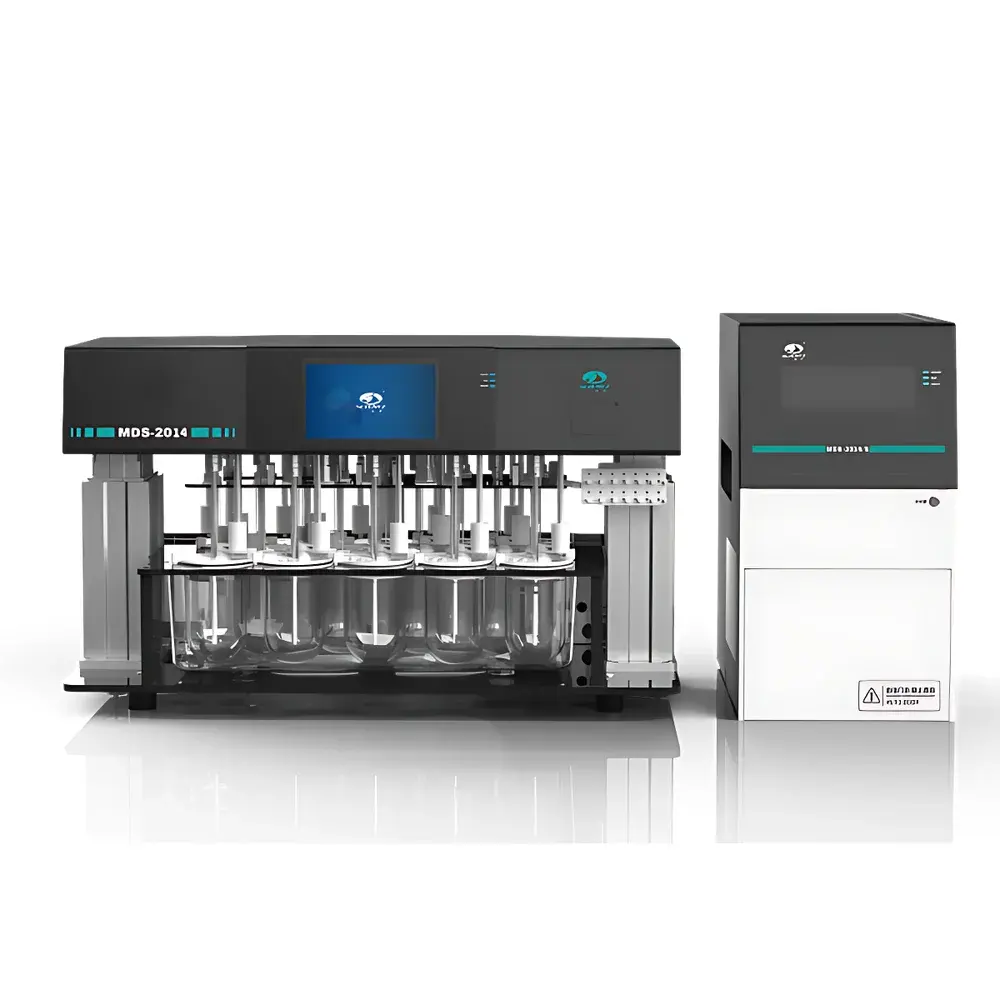
Scientz MDS-2014 Automated On-Line Dissolution Testing System
| Brand | Scientz |
|---|---|
| Origin | Zhejiang, China |
| Manufacturer Type | Direct Manufacturer |
| Product Category | Domestic |
| Model | MDS-2014 |
| Instrument Type | On-Line Dissolution Tester |
| Dissolution Vessels | 6 or 8 |
| Temperature Range | Ambient to 45.0 °C |
| Temperature Accuracy | ≤ ±0.2 °C |
| Rotational Speed Range | 25.0–250.0 rpm |
| Paddle Wobble Amplitude | ≤ 0.5 mm |
| Basket Wobble Amplitude | ≤ 1.0 mm |
| Water Bath Temperature Control Range | Ambient to 45.0 °C |
| Water Bath Temperature Resolution | 0.1 °C |
| Water Bath Volume | 28 L |
Overview
The Scientz MDS-2014 is an automated on-line dissolution testing system engineered for compliance with pharmacopeial standards—including USP , EP 2.9.3, and JP 17—and designed for operation within Good Manufacturing Practice (GMP) and Good Laboratory Practice (GLP) environments. It implements the paddle and basket dissolution methodologies defined by regulatory frameworks, delivering precise, reproducible, and auditable performance across solid oral dosage forms and advanced drug delivery systems. The system integrates real-time temperature monitoring, independent vessel control, mechanical validation readiness, and full audit-trail capability—ensuring data integrity in accordance with FDA 21 CFR Part 11 and Annex 11 requirements. Its modular architecture supports seamless integration into centralized laboratory information management systems (LIMS) and quality management systems (QMS), making it suitable for QC laboratories, formulation development units, and regulatory submission support.
Key Features
- On-line, fully automated dissolution testing with integrated sampling, filtration, dilution, and fluid handling—eliminating manual intervention and operator variability.
- Dual independent experimental zones (7 × 2 configuration), each supporting programmable rotational speeds (25.0–250.0 rpm) and temperature profiles (ambient to 45.0 °C) for parallel method development or comparative studies.
- 14 individually calibrated PT100 temperature sensors—retractable during dissolution—to enable real-time, vessel-specific thermal monitoring with ±0.2 °C accuracy and 0.1 °C resolution.
- Vessel stabilization system featuring multi-point 316L stainless steel guide rods, embedded cup clamping rings, and diagonal alignment fixtures—ensuring consistent verticality, centering, and mechanical repeatability per USP mechanical calibration guidelines.
- Modular, segmented 316L stainless steel shaft assembly compatible with paddles, baskets, rotating cylinders, and low-volume accessories—enabling rapid tool interchange without re-leveling or height recalibration.
- 10-inch color touchscreen interface with multilingual support (English/Chinese), method storage for up to 144 protocols, USB-based method import/export, and screen-lock security with three-tier user permission management (Administrator, Supervisor, Operator).
- V-type anti-evaporation lid design, optional amber glass dissolution vessels (1000 mL), and built-in photosensitive illumination—supporting light-sensitive compound testing per ICH Q5C stability guidance.
Sample Compatibility & Compliance
The MDS-2014 accommodates a broad spectrum of dosage forms: immediate- and extended-release tablets, hard/soft gelatin capsules, transdermal patches, semisolid preparations (e.g., ointments, gels), microspheres, and implantable depot systems. All wetted components—including PTFE-transparent microbore tubing, ceramic-coated syringes, and stainless-steel fluid paths—are chemically inert and validated for minimal adsorption or leaching. The system meets ISO 9001 manufacturing standards and is supplied with comprehensive documentation packages for Installation Qualification (IQ), Operational Qualification (OQ), and Performance Qualification (PQ), including mechanical verification reports aligned with USP and ASTM E2503. Optional AIQ certification services are available to support regulatory submissions.
Software & Data Management
Embedded firmware supports time-stamped, tamper-evident logging of all operational events—including temperature setpoints, rotation speed changes, sampling timestamps, maintenance alerts, and user logins. Data export is performed via encrypted USB transfer; logs are stored in a proprietary binary format readable only through Scientz’s validated PC software, which enforces electronic signature workflows and full audit-trail reconstruction. The system supports 21 CFR Part 11-compliant electronic records through configurable digital signature prompts, role-based access controls, and immutable event history. Optional LIMS connectivity modules enable direct data push to enterprise databases using ASTM E1384-compliant HL7 or CSV-over-FTP protocols.
Applications
- Comparative dissolution profiling of generic and reference listed drugs (RLDs) under multiple media conditions (pH 1.2, 4.5, 6.8, simulated intestinal fluid).
- IVIVC (in vitro–in vivo correlation) model development and validation for modified-release formulations.
- Stability-indicating dissolution method development under photolytic, oxidative, and hydrolytic stress conditions.
- Quality-by-Design (QbD) parameter mapping—evaluating impact of paddle/basket geometry, agitation rate, and medium composition on release kinetics.
- Automated batch release testing in GMP production environments with full traceability from raw material to finished product.
FAQ
Does the MDS-2014 comply with USP and mechanical calibration requirements?
Yes—the system includes factory-certified mechanical verification documentation and supports on-site PQ execution using NIST-traceable gauges and USP-recommended test protocols.
Can the instrument perform sequential or simultaneous dosing across all vessels?
Yes—its dual-mode automatic dosing module supports both synchronized eight-vessel loading and programmable staggered dosing with adjustable delay intervals.
Is the water bath design compatible with microbial control protocols?
Yes—the seamless, cornerless injection-molded bath with quick-drain fittings enables complete drainage and steam sterilization-compatible cleaning cycles per EU GMP Annex 1.
What level of data integrity assurance does the system provide?
It delivers ALCOA+ compliant data: Attributable, Legible, Contemporaneous, Original, Accurate—with electronic signatures, audit trails, and role-based permissions fully implemented per 21 CFR Part 11.
Are brown glass dissolution vessels included as standard equipment?
Amber 1000 mL vessels are optional accessories; standard configurations include clear borosilicate glass vessels in 250 mL and 1000 mL volumes.