
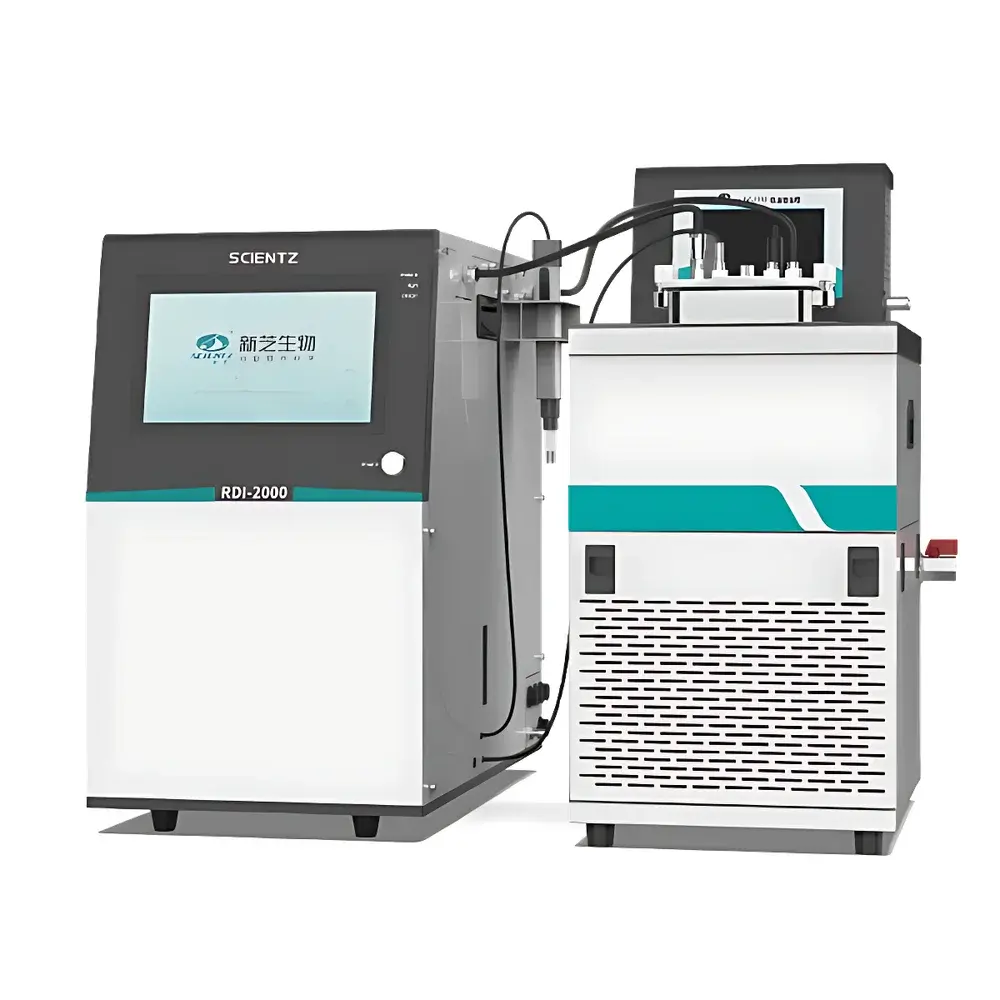
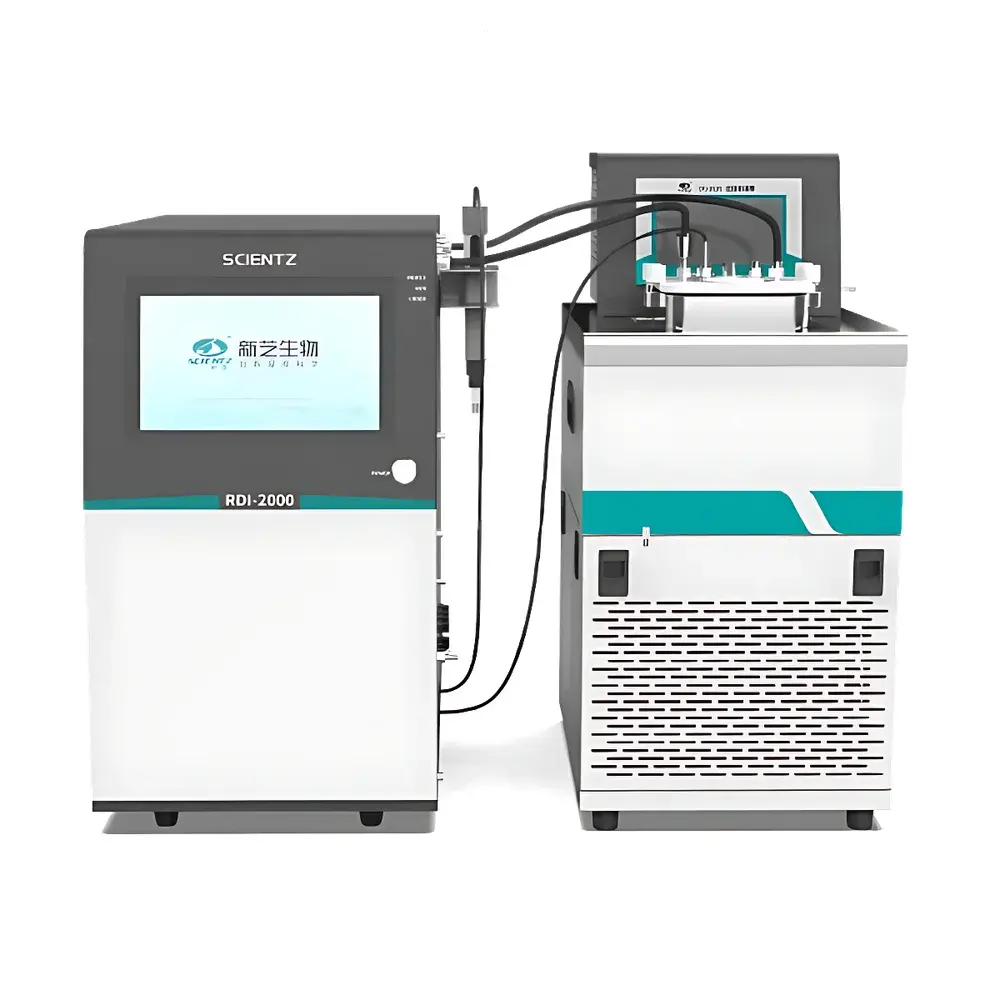
Scientz RDI-2000 Real-Time Degassing and Precision Dispensing System
| Brand | Scientz |
|---|---|
| Origin | Zhejiang, China |
| Manufacturer Type | OEM Manufacturer |
| Country of Origin | China |
| Model | RDI-2000 |
| Pricing | Upon Request |
Overview
The Scientz RDI-2000 Real-Time Degassing and Precision Dispensing System is an integrated laboratory platform engineered for applications requiring strict dissolved oxygen (DO) control, temperature stability, real-time process monitoring, and repeatable volumetric dispensing. It operates on the principle of membrane-based vacuum degassing—utilizing hydrophobic polymeric membranes (PM membranes) with low gas permeability to selectively remove dissolved oxygen from liquid streams under controlled negative pressure. Unlike conventional batch degassers, the RDI-2000 enables continuous inline degassing at flow rates up to 18 mL/s, maintaining dissolved oxygen concentrations ≤1.0 mg/L throughout operation. This performance is critical for oxygen-sensitive processes including microfluidic assay development, electrochemical sensor calibration, fuel cell electrolyte conditioning, and anaerobic cell culture media preparation. The system’s architecture integrates thermal management, optical or electrochemical DO sensing, gravimetric or piston-driven dispensing mechanics, and embedded industrial-grade control logic—all within a compact, lab-bench compatible footprint.
Key Features
- Continuous membrane degassing with adjustable flow rate (0–18 mL/s), optimized for low-oxygen retention and minimal post-degassing reoxygenation
- Integrated dissolved oxygen monitoring using calibrated electrochemical sensors with ±2% full-scale accuracy and real-time data logging
- Precision dispensing module with programmable volume range (1–10 mL per dispense) and volumetric accuracy of ±1% at 10 mL, with dispensing speed adjustable from 0.1 to 1 mL/s
- Onboard temperature regulation via internal heating elements; optional integration with external recirculating chillers or thermostatic baths for precise sample thermal control (±0.5°C typical)
- Real-time liquid level detection in reservoir tanks to prevent dry-run dispensing and ensure process continuity
- Automated fluid path conditioning sequence—including pre-wet, rinse, purge, and air-dry cycles—to minimize carryover, biofilm formation, and cross-contamination between runs
- Barcode-enabled consumables tracking: supports scanning of reagent bottles, tubing batches, or membrane cartridges for full traceability and audit-ready documentation
Sample Compatibility & Compliance
The RDI-2000 accommodates aqueous buffers, organic solvents (e.g., ethanol, isopropanol, acetonitrile), electrolyte solutions, and low-viscosity biological media (e.g., PBS, DMEM without serum). Its wetted path employs chemically resistant materials—including PTFE, PEEK, and 316L stainless steel—ensuring compatibility with aggressive solvents and sterilization protocols. The system conforms to general laboratory safety standards (IEC 61010-1) and supports GLP/GMP-aligned workflows through configurable audit trails, electronic signatures, and secure user role assignment. While not certified to ISO 13485 or FDA 21 CFR Part 11 out-of-the-box, its software architecture provides foundational capabilities for validation—including immutable log export (via USB), time-stamped event records, and parameter change history—enabling qualification per institutional SOPs or regulatory requirements.
Software & Data Management
The embedded control interface features a 7-inch capacitive touchscreen with intuitive navigation and multilingual support (English, Chinese, German). All operational parameters—including DO setpoints, dispensing volumes, temperature profiles, and sensor calibration offsets—are stored in non-volatile memory. The system logs timestamped data for reservoir temperature, dissolved oxygen concentration, liquid level, dispensing events, and maintenance cycles. Export formats include CSV and Excel-compatible XLSX files, suitable for trend analysis in third-party tools such as MATLAB, JMP, or LabArchives. Role-based access control implements three-tier permissions (Administrator, Technician, Operator), restricting configuration changes, calibration adjustments, and data deletion functions accordingly. Audit trail entries record user ID, action type, timestamp, and pre-/post-values—meeting ALCOA+ principles for data integrity.
Applications
- Microfluidic device priming and bubble-free loading for droplet generation, organ-on-chip, and digital PCR platforms
- Preparation of deaerated electrolytes for electrochemical impedance spectroscopy (EIS), cyclic voltammetry, and fuel cell testing
- Controlled atmosphere cell culture media conditioning prior to hypoxia studies or anaerobic fermentation
- Calibration standard preparation for dissolved oxygen meters and optical DO probes
- High-reproducibility reagent dispensing in automated assay development workflows where oxygen-induced degradation affects signal stability
FAQ
What is the maximum allowable viscosity for liquids processed by the RDI-2000?
The system is validated for liquids with dynamic viscosity up to 10 mPa·s at 25°C (e.g., 1× PBS, 0.1 M KCl, 5% glycerol in water). Higher viscosities may reduce degassing efficiency and require flow rate derating.
Can the RDI-2000 be connected to a LIMS or ELN?
Yes—via RS-232 or optional Ethernet interface, the system supports ASCII command protocol for remote triggering, status polling, and data retrieval, enabling integration into broader laboratory informatics ecosystems.
Is the DO sensor autoclavable?
No—the electrochemical DO sensor is not autoclavable; however, it is compatible with 70% ethanol wipe disinfection and can be sterilized in situ using 0.5% sodium hypochlorite solution followed by thorough rinsing.
How often does the PM membrane require replacement?
Under continuous operation with clean aqueous solutions, membrane service life exceeds 6 months; frequency increases with particulate load or solvent exposure—monitoring DO rebound rate is recommended as a predictive maintenance indicator.



