
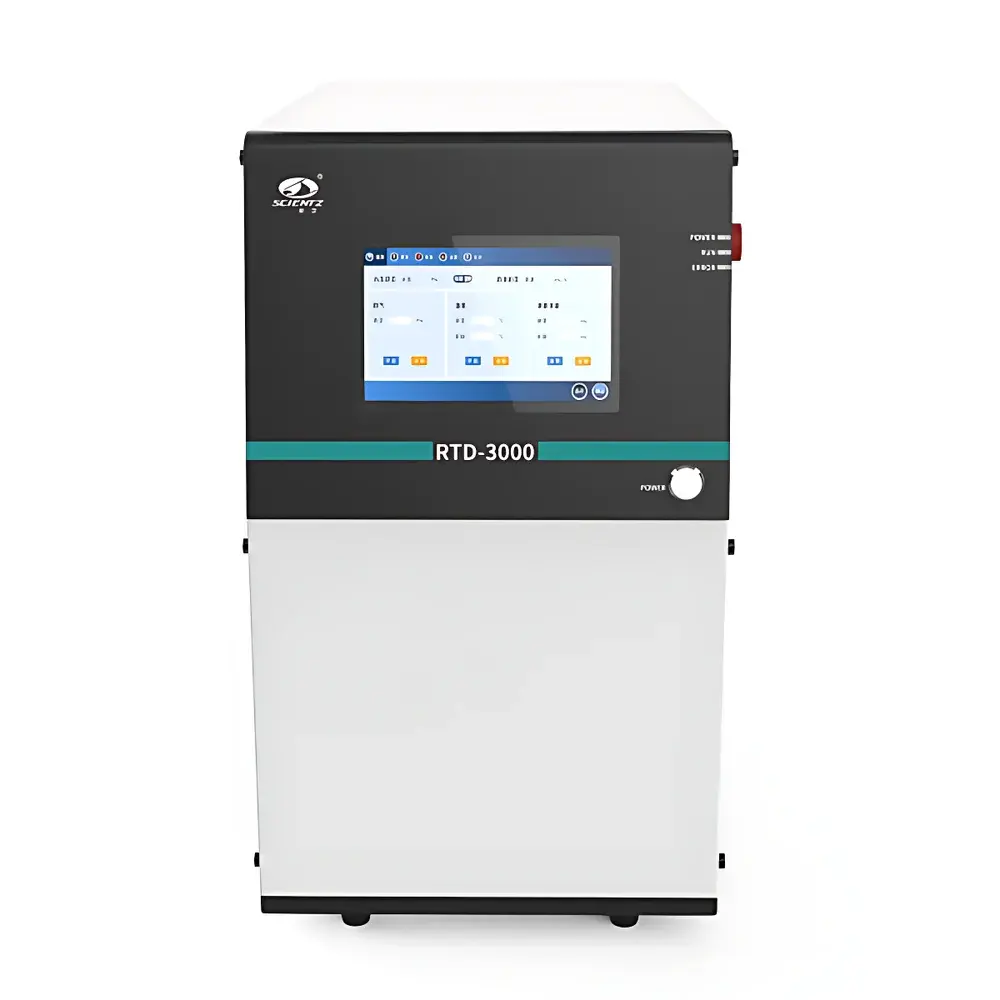
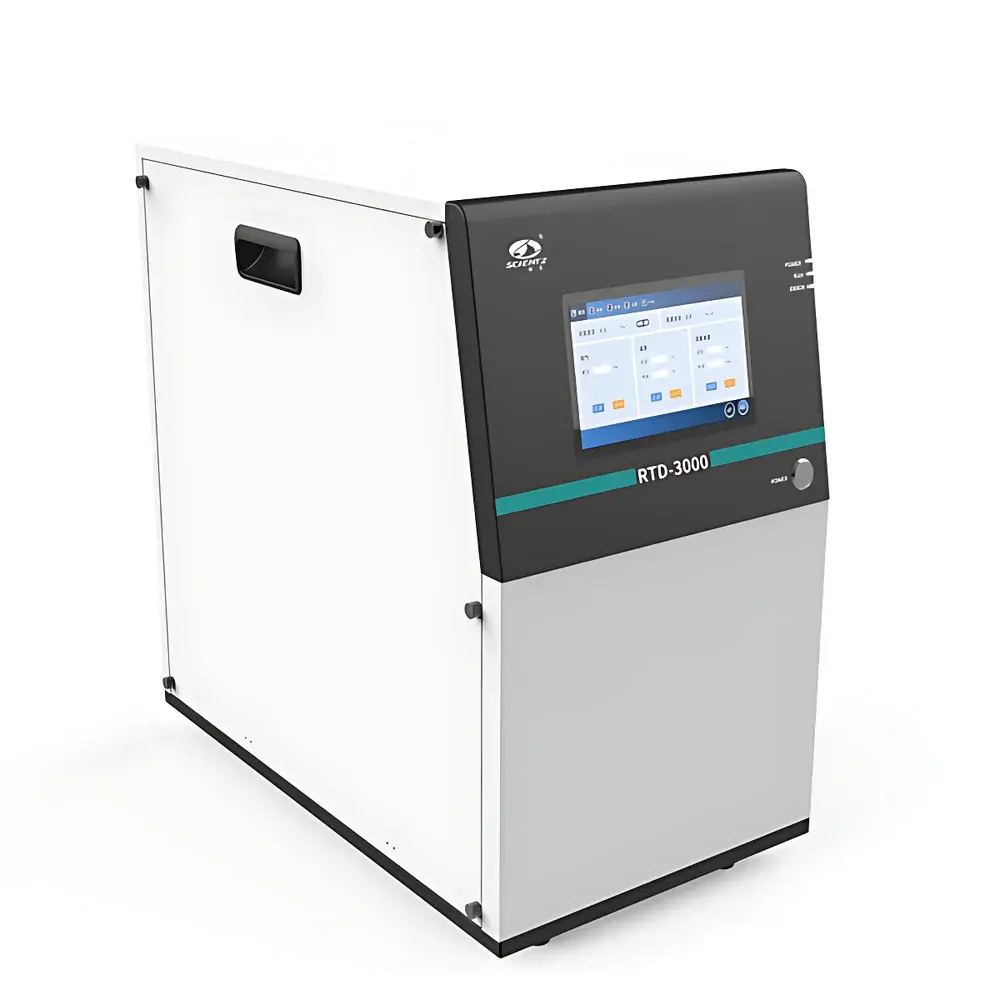
Scientz RTD-3000 Real-Time Temperature-Controlled Membrane Degasser
| Brand | Scientz |
|---|---|
| Origin | Zhejiang, China |
| Manufacturer Type | Direct Manufacturer |
| Country of Origin | China |
| Model | RTD-3000 |
| Pricing | Available Upon Request |
| Degassing Flow Rate | 1500 mL/min |
| Temperature Control Accuracy | ±0.5°C |
| Single-Dose Dispensing Accuracy | ±1% @ 1000 mL |
| Max. Heating Rate | 30°C per cycle |
| Integrated Filtration | Yes |
| Auto-Switching Inlet Mode | Self-Priming & External Pressure |
| Audit Trail | Yes |
| Compliance | Designed for GLP/GMP-aligned dissolution testing environments |
Overview
The Scientz RTD-3000 Real-Time Temperature-Controlled Membrane Degasser is an engineered solution for the precise, continuous removal of dissolved gases—including oxygen, nitrogen, and carbon dioxide—from aqueous and organic solvent-based dissolution media used in pharmaceutical dissolution testing, analytical sample preparation, and high-performance liquid chromatography (HPLC) mobile phase conditioning. Unlike thermal or sonication-based degassing methods, the RTD-3000 employs a hydrophobic hollow-fiber membrane contactor operating under controlled vacuum and real-time thermal regulation. This principle relies on selective gas permeability: while liquid-phase solvents are retained within the lumen of the microporous fibers, dissolved gases diffuse across the fiber wall into the evacuated shell side, where they are continuously extracted by an integrated vacuum pump. Simultaneously, the degassed medium passes through a dual-stage heating system—ensuring consistent temperature stabilization prior to delivery—thereby eliminating both gaseous interference and thermal variability that compromise dissolution rate reproducibility and assay sensitivity.
Key Features
- Integrated triple-function architecture: simultaneous vacuum-driven degassing, precision temperature control, and closed-loop circulation—eliminating off-line handling and minimizing re-aeration risk.
- Real-time temperature management via a proprietary two-stage heating system, achieving ±0.5°C stability across the operational range (typically 25–45°C), critical for USP Apparatus 1/2 compliance and pH-sensitive formulations.
- Hollow-fiber membrane module with >99.8% dissolved gas removal efficiency at flow rates up to 1500 mL/min, validated per ASTM D3695 and ISO 8573-6 for residual gas quantification.
- Intuitive 7-inch color touchscreen interface with context-aware navigation, pre-configured dissolution protocols, and parameter lockout functionality for operator-defined SOP enforcement.
- Automated fluid handling sequence: self-priming or externally pressurized inlet detection, quantitative aspiration (±1% volumetric accuracy at 1000 mL), in-line pre-heating, membrane degassing, final temperature equilibration, and metered dispensing—all executed without manual intervention.
- Onboard hydraulic pressure sensor enables automatic inlet mode switching between gravity-fed (self-priming) and pump-assisted (external pressure) configurations—adapting seamlessly to lab infrastructure constraints.
- Integrated 5-µm particulate filter upstream of the membrane module ensures protection against suspended solids, extending membrane service life and maintaining flow consistency over extended operation cycles.
Sample Compatibility & Compliance
The RTD-3000 is validated for use with pharmacopeial dissolution media including 0.1 N HCl, phosphate buffers (pH 4.5–7.4), surfactant-containing solutions (e.g., SDS), deionized water, distilled water, and common HPLC-grade organic-aqueous mixtures (e.g., acetonitrile/water ≤40% v/v). It meets functional requirements outlined in USP , Ph. Eur. 2.9.40, and JP 17 for degassed medium preparation. The embedded audit trail logs all user actions, parameter changes, runtime events, and error states with timestamped entries—supporting 21 CFR Part 11 compliance when deployed in regulated environments. System validation documentation (IQ/OQ/PQ templates) and calibration certificates for temperature and volume delivery are available upon request.
Software & Data Management
The instrument’s embedded firmware supports local data retention of ≥10,000 operational records, exportable via USB to CSV format for LIMS integration. All log entries include operator ID (optional PIN authentication), method name, start/end timestamps, setpoints vs. actuals (temperature, flow, vacuum level), and alarm history. No cloud connectivity or remote access is implemented—ensuring full data sovereignty and alignment with institutional IT security policies. Optional RS-232 or Ethernet interfaces enable programmable control from external dissolution apparatus controllers (e.g., Hanson, Distek, Sotax) using ASCII command protocol.
Applications
- Preparation of degassed dissolution media for USP Apparatus 1 (basket) and Apparatus 2 (paddle) testing in QC labs.
- Mobile phase conditioning for HPLC and UPLC systems requiring low-gas-content solvents to prevent bubble formation in pumps and detectors.
- Sample pretreatment for electrochemical analysis, oxygen-sensitive enzymatic assays, and trace metal speciation studies.
- Supporting accelerated stability studies where dissolved O₂ accelerates oxidative degradation pathways in solid oral dosage forms.
- Research-scale formulation development involving supersaturated solutions, nanosuspensions, or lipid-based delivery systems requiring strict gas exclusion.
FAQ
Does the RTD-3000 require periodic membrane replacement?
Yes—membrane service life is typically 6–12 months depending on usage frequency, solvent composition, and particulate load. A maintenance alert triggers at 500 operational hours; replacement kits include calibrated flow verification protocols.
Can the unit be integrated with automated dissolution testers?
Yes—via optional serial or TCP/IP communication, enabling synchronized start/stop commands and real-time status feedback to the dissolution system controller.
Is validation support provided for GMP environments?
Scientz supplies IQ/OQ documentation templates, traceable calibration procedures, and a Certificate of Conformance. Full PQ execution requires site-specific performance qualification under end-user supervision.
What safety protections are built into the system?
Over-temperature cutoff, vacuum loss detection, dry-run prevention via liquid-level sensing, and automatic shutdown during abnormal pressure differentials—all logged and reported in the audit trail.
Does it support non-aqueous solvents such as ethanol or isopropanol?
Yes, for concentrations ≤30% v/v in water; higher organic content requires prior consultation to verify membrane compatibility and vacuum performance limits.



