
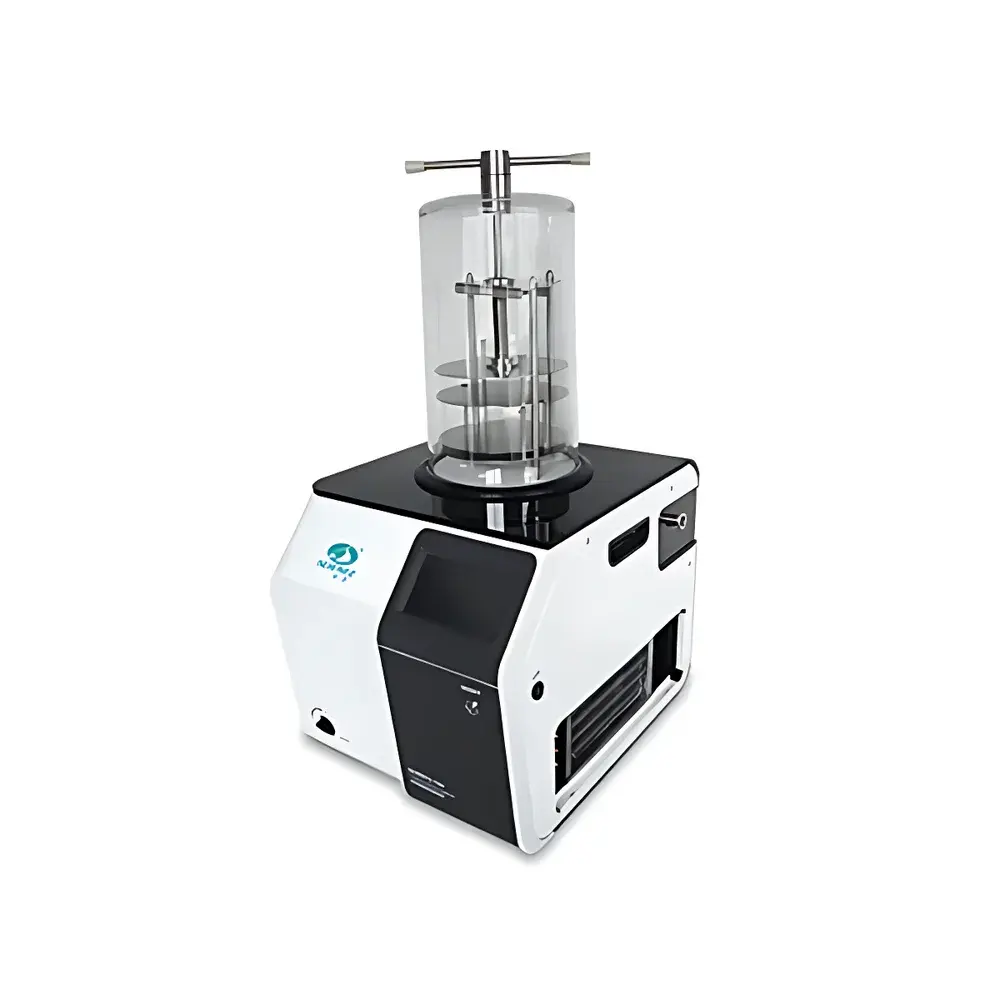
Scientz SCIENTZ-10ND/B Benchtop Shelf-Type Freeze Dryer with Heated Chambers
| Brand | Scientz |
|---|---|
| Origin | Zhejiang, China |
| Manufacturer Type | Direct Manufacturer |
| Instrument Type | Shelf-Type (Press-Seal) Freeze Dryer |
| Application Scope | Laboratory Use |
| Lyophilization Area | 0.12 m² |
| Ultimate Vacuum | ≤5 Pa (at no-load) |
| Condensate Capacity | 3 kg/24 h |
| Cold Trap Temperature | ≤−56 °C (at no-load) |
| Dimensions (L×W×H) | 590 × 460 × 400 mm + 440 mm (chamber height) |
Overview
The Scientz SCIENTZ-10ND/B is a benchtop shelf-type freeze dryer engineered for precision lyophilization in research and development laboratories. It operates on the principle of sublimation under deep vacuum—where frozen water transitions directly from solid to vapor without passing through the liquid phase—preserving structural integrity, biological activity, and chemical stability of heat-sensitive samples. Designed for reproducible process development, this unit integrates a heated shelf system with PID-controlled temperature ramping, enabling precise thermal management during primary and secondary drying stages. Its compact footprint (under 0.13 m² floor space) makes it suitable for space-constrained lab environments while maintaining industrial-grade performance standards. The system complies with core design principles aligned with ISO 22042 (freeze-drying equipment), and supports protocol documentation required for GLP-compliant workflows.
Key Features
- Heated aluminum shelves with independent PID temperature control (range: −50 °C to +60 °C), ensuring uniform heat transfer and eliminating thermal overshoot during ramping
- Imported high-efficiency hermetic compressor delivering stable cold trap temperatures ≤−56 °C (standard); optional −80 °C dual-stage cascade refrigeration system available
- 7-inch full-color capacitive touchscreen interface with embedded industrial OS; real-time display of critical parameters including shelf temperature, chamber pressure, cold trap temperature, and vacuum level
- Transparent polycarbonate drying chamber (one-piece molded, corrosion-resistant, high optical clarity) allowing full visual monitoring of sublimation progress and ice formation
- Intelligent vacuum management: automatic pump start/stop logic triggered only when cold trap reaches setpoint, extending vacuum pump service life and reducing oil contamination risk
- Integrated inert gas backfill valve (N₂ or Ar compatible) for controlled reconstitution environment and oxidation-sensitive sample handling
- Onboard data logging with ≥10,000-cycle storage capacity; USB export for offline analysis using Scientz FreezeView™ desktop software (Windows-compatible)
Sample Compatibility & Compliance
The SCIENTZ-10ND/B accommodates vials (standard 13–22 mm diameter), bulk trays, and custom containers up to 0.12 m² surface area. It supports lyophilization of biologics (monoclonal antibodies, vaccines, enzymes), nucleic acids, cell lysates, microbial cultures, plant extracts, pharmaceutical intermediates, and environmental matrices (soil, sludge, food homogenates). All wetted parts comply with USP Class VI-certified materials where applicable. The system architecture enables traceable operation per FDA 21 CFR Part 11 requirements when paired with audit-trail-enabled software configuration. Validation-ready design supports IQ/OQ documentation packages aligned with ASTM F2667-20 (Standard Guide for Validation of Freeze Drying Processes).
Software & Data Management
FreezeView™ control software provides multi-user access control, electronic signature support, and automated report generation (PDF/CSV). Each lyophilization cycle is timestamped and stored with metadata including ramp rates, hold durations, pressure profiles, and deviation alerts. Historical curve comparison tools facilitate DOE-based optimization of drying protocols. Data export conforms to ALCOA+ principles (Attributable, Legible, Contemporaneous, Original, Accurate, Complete, Consistent, Enduring, Available). Optional integration with LIMS via OPC UA protocol supports centralized laboratory informatics infrastructure.
Applications
This instrument serves as a scalable platform for formulation development across academic, regulatory, and industrial settings:
- Pharmaceutical R&D: lyophilized powder formulation of peptides, recombinant proteins, and mRNA-LNP complexes
- Biobanking: long-term stabilization of bacterial/fungal strains, viral vectors, and primary tissue explants
- Food science: nutrient retention studies, flavor compound preservation, and dehydration kinetics modeling
- Materials science: preparation of porous scaffolds, aerogels, and catalyst supports without particle agglomeration
- Environmental analysis: pre-concentration and stabilization of trace analytes in aqueous soil extracts prior to GC-MS or ICP-MS
- Diagnostic assay development: stabilization of enzyme-conjugated reagents and lateral flow test components
FAQ
What is the maximum batch capacity for vial-based lyophilization?
Up to 8 standard 22 mm vials (with optional manifold kit); bulk tray capacity supports ≤1.2 L total volume at recommended loading density.
Does the system support validation-grade temperature mapping?
Yes—shelves are equipped with calibrated PT100 sensors (±0.3 °C accuracy); optional calibrated thermocouple ports enable third-party mapping per ISO 13485 Annex A.
Can the freeze dryer operate unattended overnight?
Yes—fully autonomous cycle execution with auto-shutdown, over-temperature alarms, and vacuum failure detection ensures safe extended operation.
Is remote monitoring supported?
Ethernet connectivity enables SNMP-based status polling and alarm notification via email/SNMP traps when integrated with facility SCADA systems.
What maintenance intervals are recommended for the vacuum pump?
Oil change every 500 operating hours; filter replacement every 1,000 hours; annual calibration verification of pressure and temperature sensors recommended.



