
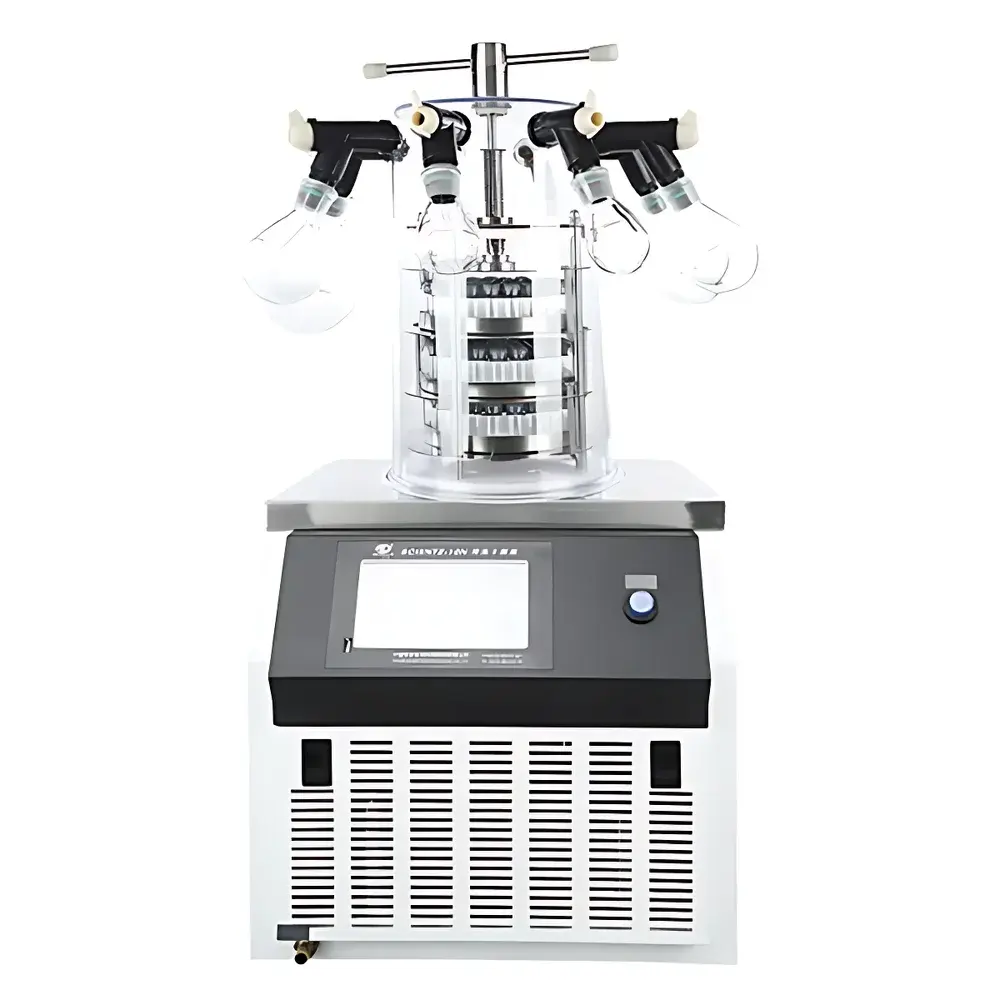
Scientz SCIENTZ-12N/D Manifold-Type Bell Jar Freeze Dryer with Stoppering Capability
| Brand | Scientz |
|---|---|
| Origin | Zhejiang, China |
| Manufacturer Type | Direct Manufacturer |
| Instrument Type | Manifold Freeze Dryer |
| Application | Laboratory-Scale Lyophilization |
| Shelf Area | 0.08 m² |
| Ultimate Vacuum | ≤5 Pa |
| Condensate Capacity (24 h) | 4 kg/24 h |
| Cold Trap Temperature (No Load) | ≤−56 °C |
| Dimensions (L×W×H) | 600 × 450 × 720 mm + 440 mm (Bell Jar Height) |
Overview
The Scientz SCIENTZ-12N/D is a compact, high-performance manifold-type bell jar freeze dryer engineered for precise, reproducible lyophilization of small- to medium-batch biological, pharmaceutical, and material science samples in academic, governmental, and industrial laboratory environments. It operates on the fundamental principle of sublimation under deep vacuum: frozen water (or other volatile solvents) transitions directly from solid to vapor phase without passing through the liquid state—preserving structural integrity, bioactivity, and chemical conformation of heat-labile substances. This process minimizes denaturation, aggregation, or oxidation, making it indispensable for stabilizing proteins, enzymes, vaccines, nucleic acids, microbial cultures, plant tissues, nanomaterials, and food matrices. The system integrates a robust single-stage or optionally dual-stage cascade refrigeration architecture, enabling stable cold trap operation at ≤−56 °C (standard) or −80 °C (optional), critical for low-eutectic-point formulations and high-moisture-content samples.
Key Features
- Compact footprint (600 × 450 × 720 mm base + 440 mm bell jar) optimized for space-constrained laboratories while delivering 0.08 m² effective drying area and 4 kg/24 h condensate capacity.
- High-efficiency imported hermetic compressor with intelligent thermal management; supports optional −80 °C cold trap configuration for demanding applications such as monoclonal antibody formulations or cryopreserved cell lines.
- 7-inch true-color capacitive touchscreen interface with industrial-grade embedded OS: real-time display of cold trap temperature, chamber pressure (≤5 Pa), shelf temperature (if equipped), and process time; supports multi-step program storage and execution.
- Transparent, one-piece polycarbonate bell jar with corrosion-resistant O-ring sealing: enables full visual monitoring of sublimation progress, ice formation, and cake morphology without compromising vacuum integrity.
- Manifold configuration with eight standard 24/29-threaded ports; compatible with internationally standardized lyophilization flasks (e.g., Kimble, Wheaton) and stoppered vials via optional stoppering adapter kits.
- Intelligent vacuum control logic: vacuum pump activation is gated by cold trap temperature threshold, extending pump service life and reducing oil backstreaming risk; optional automatic pressure differential valve and oil mist filter available.
Sample Compatibility & Compliance
The SCIENTZ-12N/D accommodates diverse sample formats—including bulk solutions in trays, individual vials, ampoules, and custom containers—across life sciences, agriculture, environmental, and materials research. Its design aligns with core principles of Good Laboratory Practice (GLP) and supports traceability requirements under FDA 21 CFR Part 11 when paired with validated data export protocols (USB-based curve export, timestamped log files). While not certified for GMP manufacturing, its consistent performance, repeatable cycle parameters, and audit-ready data logging make it suitable for preclinical R&D, method development, stability testing, and analytical sample preparation per ISO 22000, USP , and ASTM F2370-19 guidelines.
Software & Data Management
All freeze-drying cycles are automatically timestamped and stored internally (≥10,000 records). Users can define, save, and recall up to 50 customizable programs with ramp/soak profiles for shelf temperature (if applicable), vacuum setpoints, and hold durations. Process data—including real-time pressure, cold trap temperature, and elapsed time—is exportable via USB flash drive in CSV format for post-processing in Excel or MATLAB. Optional PC-based upper-computer software enables remote monitoring, advanced curve analysis, deviation alerts, and PDF report generation with digital signature support—facilitating documentation for internal QA audits or regulatory submissions.
Applications
- Biological preservation: lyophilization of bacterial/viral stocks, yeast cultures, primary cells, and tissue explants for long-term storage without cryoprotectant-induced stress.
- Pharmaceutical R&D: formulation screening of protein therapeutics, vaccine candidates, and peptide-based drugs; preparation of sterile powders for dissolution kinetics and stability assessment.
- Food & agricultural science: dehydration of fruits, herbs, meat extracts, and microbial inoculants while retaining volatile aromas, antioxidants, and enzymatic activity.
- Environmental analysis: stabilization of soil, sediment, and wastewater sludge samples prior to heavy metal speciation or organic contaminant quantification (e.g., EPA Method 8270).
- Materials engineering: solvent removal from nanoparticle dispersions, hydrogels, and aerogel precursors—preventing capillary collapse and maintaining nanostructural fidelity.
- Academic teaching labs: hands-on demonstration of phase diagrams, mass transfer limitations, and critical process parameters in freeze-drying science.
FAQ
What is the maximum batch size this unit can handle?
Based on a typical loading density of 5–10 mL per vial and 8 ports, the SCIENTZ-12N/D supports up to ~80 mL total volume per run; for tray drying, the 0.08 m² surface allows uniform distribution of up to 400–600 mL depending on solution viscosity and freezing protocol.
Is the system compatible with inert gas backfilling?
Yes—the integrated purge valve accepts dry nitrogen or argon for oxygen-sensitive samples; flow rate and timing are manually adjustable during the final drying or stoppering phase.
Can I monitor sample temperature during lyophilization?
While the base model does not include direct sample thermocouples, optional PT100 probes with feedthrough connectors are available for real-time product temperature tracking, enabling optimization of primary drying endpoints.
Does the system meet CE or UL safety standards?
The SCIENTZ-12N/D complies with IEC 61010-1:2010 for electrical safety in laboratory equipment; CE marking is provided for EU export configurations upon request with full technical documentation package.
What maintenance intervals are recommended for the vacuum pump and refrigeration system?
Vacuum pump oil should be changed every 500 operating hours or annually (whichever occurs first); cold trap defrosting is automated via electric heating element—cycle duration typically ranges from 20–40 minutes depending on ice load.



