
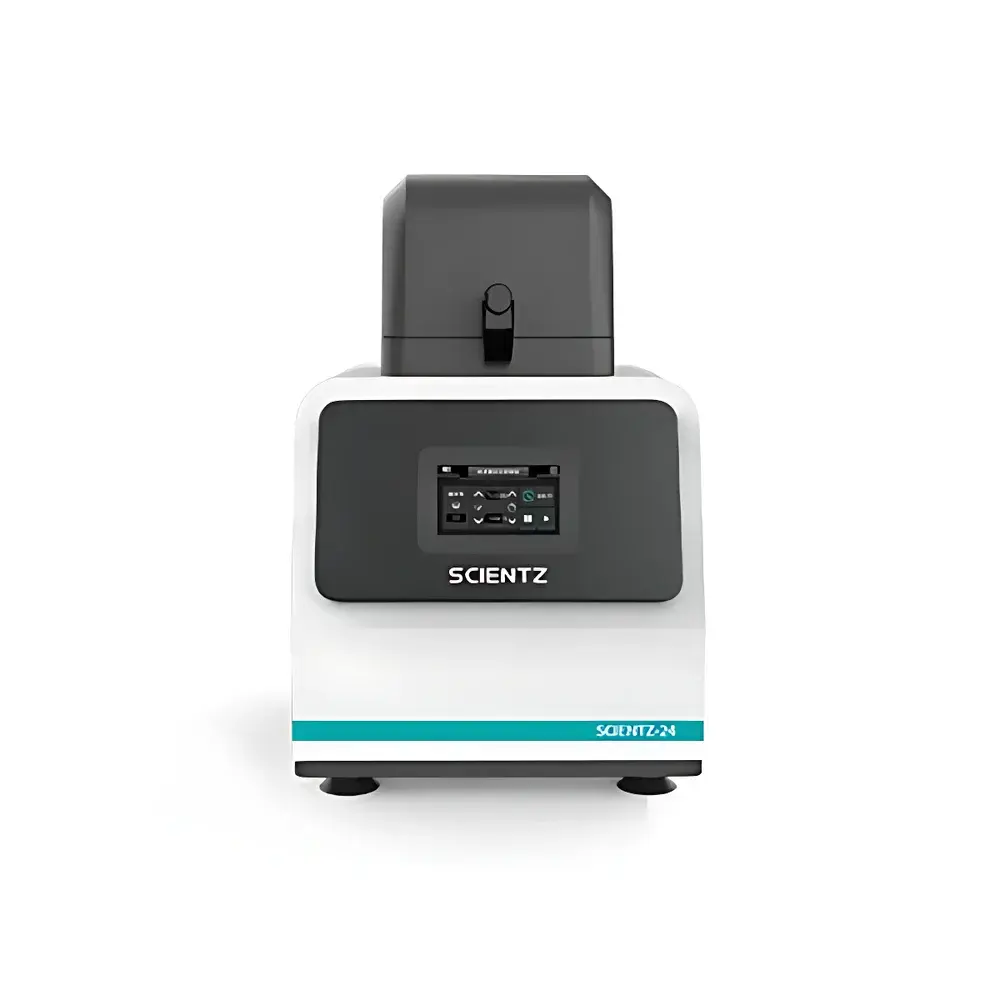
Scientz SCIENTZ-24 High-Throughput Tissue Grinder
| Brand | Scientz |
|---|---|
| Origin | Zhejiang, China |
| Manufacturer Type | Direct Manufacturer |
| Country of Origin | China |
| Model | SCIENTZ-24 |
| Pricing | Upon Request |
Overview
The Scientz SCIENTZ-24 High-Throughput Tissue Grinder is an engineered vertical-axis oscillation homogenizer designed for rapid, reproducible mechanical disruption of biological and non-biological samples under controlled, low-temperature conditions. It operates on the principle of high-frequency reciprocating impact and shear force generation between grinding beads and sample material contained within sealed centrifuge tubes. This mechanism enables efficient cell lysis, tissue homogenization, and matrix disintegration—critical prerequisites for downstream nucleic acid (DNA/RNA) isolation, protein extraction, metabolite profiling, and elemental analysis. Unlike rotor-stator or ultrasonic systems, the SCIENTZ-24 avoids localized heating and foaming, preserving thermolabile biomolecules and minimizing enzymatic degradation. Its vertical oscillation architecture ensures uniform energy distribution across all 24 sample positions simultaneously, delivering high inter-sample consistency essential for quantitative omics workflows and regulated QC/QA environments.
Key Features
- 24-position high-throughput capacity with interchangeable tube adapters (0.2–50 mL formats supported)
- Programmable digital controller enabling precise adjustment of frequency (100–1800 rpm), cycle duration (1–99 min), and pause intervals
- Hermetically sealed grinding chamber with interlocked safety door and automatic motor cutoff upon lid opening
- Low-noise operation (<65 dB(A)) achieved via vibration-damping chassis and balanced drive assembly
- Cryogenic compatibility: direct loading of pre-frozen tubes (−80 °C compatible); optional liquid nitrogen cooling jacket available
- Tool-free adapter exchange system for rapid configuration changes between tube sizes and bead types
- Stainless-steel housing with IP20-rated enclosure for laboratory-grade durability and chemical resistance
Sample Compatibility & Compliance
The SCIENTZ-24 accommodates a broad spectrum of sample matrices without requiring method revalidation: soft tissues (liver, brain, muscle), fibrous plant materials (roots, stems, seeds), microbial pellets (E. coli, yeast, spores), environmental solids (soil, sludge, sediment), pharmaceutical tablets, polymers (PE, PS, PET), and forensic specimens (hair, bone fragments). All grinding protocols comply with standard operating procedures aligned with ISO/IEC 17025 analytical validity requirements. When used in conjunction with RNase/DNase-free consumables and validated bead sets, the system supports workflows compliant with FDA 21 CFR Part 11 (electronic records/signatures) and GLP/GMP documentation standards—particularly when integrated with LIMS-linked data capture modules. Cross-contamination risk is minimized through independent tube motion and absence of shared grinding surfaces.
Software & Data Management
The built-in microprocessor controller stores up to 20 user-defined protocols with timestamped execution logs, including start/stop time, actual frequency deviation (<±2 rpm), and total runtime. Optional USB data export enables traceable protocol transfer and audit-ready reporting. While no proprietary cloud platform is embedded, the device outputs standardized CSV-formatted logs compatible with laboratory information management systems (LIMS) and electronic lab notebooks (ELN) such as LabArchives or Benchling. Audit trail functionality meets ALCOA+ principles (Attributable, Legible, Contemporaneous, Original, Accurate) when paired with validated instrument qualification documentation (IQ/OQ/PQ).
Applications
- Genomic DNA and total RNA extraction from mammalian tissues prior to qPCR, RNA-Seq, or methylation analysis
- Proteome preparation for SDS-PAGE, Western blotting, or LC-MS/MS quantification
- Metabolite recovery from plant leaves or microbial biofilms for GC-MS or HILIC-UPLC
- Homogenization of soil samples for heavy metal speciation (EPA Method 3050B/3051A)
- Particle size reduction of pharmaceutical excipients for dissolution testing (USP <711>)
- Preparation of certified reference materials (CRMs) for inter-laboratory proficiency testing
FAQ
What bead materials are recommended for RNA isolation from liver tissue?
Oxide zirconia (ZrO₂) or tungsten carbide (WC) beads are preferred due to high density, minimal leaching, and superior lysis efficiency at low temperatures. Avoid stainless steel for transcriptome studies where iron-mediated RNA oxidation is a concern.
Can the SCIENTZ-24 be validated for GMP-compliant production environments?
Yes—when deployed with documented IQ/OQ/PQ protocols, calibrated frequency verification, and change-controlled firmware, it satisfies Annex 11 and PIC/S TR 13 requirements for ancillary equipment in pharmaceutical manufacturing support labs.
Is liquid nitrogen cooling integrated or optional?
Liquid nitrogen cooling is optional and implemented via external cryo-jacket attachment; the base unit supports dry ice or chilled aluminum blocks for sub-zero operation.
How is cross-contamination prevented between samples?
Each tube undergoes independent orbital motion within its dedicated well; no mechanical linkage exists between positions. Sealed tube design eliminates aerosol transmission, and adapter wells are chemically resistant to ethanol and bleach decontamination.
Does the system support 2 mL deep-well plates?
No—the SCIENTZ-24 is configured exclusively for individual centrifuge tubes (0.2–50 mL). For plate-based high-throughput grinding, Scientz offers the SCIENTZ-48 series with 96-well plate adapters.



