
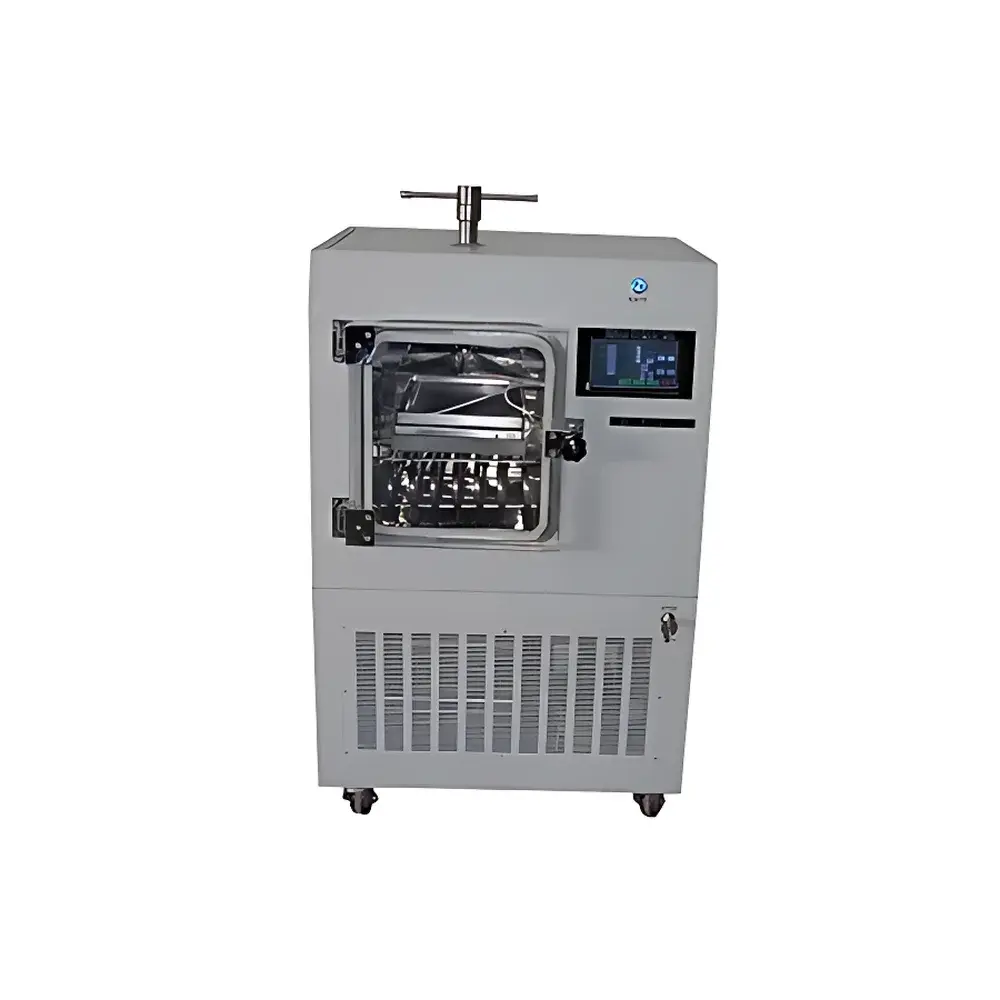
Scientz SCIENTZ-30YD/B In-Situ Electrically Heated Pilot-Scale Freeze Dryer
| [Brand | Scientz |
|---|---|
| Origin | Zhejiang, China |
| Manufacturer Type | Direct Manufacturer |
| Instrument Type | Stoppering Freeze Dryer |
| Application Scale | Pilot-Scale |
| Shelf Area | 0.3 m² |
| Ultimate Vacuum (Empty) | ≤5 Pa |
| Condensate Capacity | 6 kg/24 h |
| Cold Trap Temperature (Empty) | ≤−56 °C |
| Overall Dimensions | L1100 × W760 × H1460 mm] |
Overview
The Scientz SCIENTZ-30YD/B is a pilot-scale, in-situ electrically heated freeze dryer engineered for reproducible lyophilization process development and small-batch production under controlled laboratory or GMP-adjacent environments. It operates on the fundamental principles of sublimation-based drying: frozen aqueous samples are subjected to low-pressure conditions within a sealed drying chamber, while heat is precisely delivered via electrically heated shelves to drive ice phase transition directly from solid to vapor—bypassing the liquid phase. This in-situ heating architecture eliminates manual shelf transfer, significantly reducing contamination risk and enabling real-time thermal profiling across multiple shelf layers. Designed for scalability from R&D to early-stage manufacturing, the system supports systematic optimization of critical process parameters—including shelf temperature ramping, vacuum setpoints, and primary drying endpoints—making it suitable for formulation scientists, QC/QA teams, and process engineers validating lyophilized biologics, diagnostics, pharmaceuticals, and high-value research reagents.
Key Features
- Electrically heated stainless-steel shelves (−50 °C to +60 °C, empty) with PID-controlled thermal regulation and ±0.5 °C uniformity across all three shelves (430 × 240 mm each, 70 mm spacing).
- High-efficiency dual-stage cascade refrigeration system using Tecumseh (France) compressors, achieving cold trap temperatures ≤−56 °C (empty) and stable operation at ≤5 Pa ultimate vacuum.
- 7-inch full-color industrial touchscreen interface powered by an industrial PLC controller; supports up to 99 customizable freeze-drying protocols, each containing up to 40 programmable temperature/vacuum segments.
- Real-time data acquisition and storage: all process variables—including shelf temperature, chamber pressure, condenser temperature, and time—are logged continuously and exportable via USB to external PCs for analysis using Scientz’s proprietary software suite.
- Transparent acrylic chamber door with integrated lighting enables full visual monitoring of cake formation, collapse events, and drying front progression without compromising vacuum integrity.
- Integrated inert gas backfill valve (N₂ or Ar compatible) with adjustable flow control for oxygen-sensitive formulations and terminal sterilization-compatible stoppering cycles.
- Multi-level user authentication (administrator, operator, technician) with audit trail capability compliant with GLP documentation requirements.
Sample Compatibility & Compliance
The SCIENTZ-30YD/B accommodates standard pharmaceutical-grade vials (Φ12 mm: 1950 units; Φ16 mm: 1160 units; Φ22 mm: 615 units per batch) as well as bulk solutions up to 3 L per cycle. Its shelf geometry and load capacity align with ICH Q5C stability testing guidelines and support comparative lyophilization studies required during formulation development. The system meets mechanical safety standards per GB/T 19001–2016 (equivalent to ISO 9001) and electromagnetic compatibility per GB/T 18268.21–2010. While not certified for full cGMP manufacturing, its architecture—including traceable parameter logging, password-protected protocol editing, and configurable alarm thresholds—supports alignment with FDA 21 CFR Part 11 expectations when deployed in qualified environments.
Software & Data Management
The embedded control software provides synchronized graphical display of real-time drying curves (shelf temp vs. time, pressure vs. time, condenser temp vs. time), overlayable historical runs, and automatic endpoint detection based on pressure rise test (PRT) logic. Raw CSV-formatted datasets are stored internally and retrievable via USB flash drive for post-processing in MATLAB, Python, or commercial statistical platforms. Optional software add-ons include automated e-signature integration, electronic batch record (EBR) templates, and deviation alert escalation workflows—facilitating compliance with internal SOPs and regulatory review readiness.
Applications
- Process development and cycle optimization for monoclonal antibodies, vaccines, and enzyme-based therapeutics.
- Stability studies per ICH Q1A(R3) and accelerated degradation modeling under varied shelf temperature profiles.
- Lyophilization of diagnostic kits, reference standards, and cell culture media components requiring residual moisture <1.5% w/w.
- Academic research into cryoprotectant efficacy, ice nucleation kinetics, and mass transfer limitations in porous matrices.
- Pre-commercial manufacturing of clinical trial materials where batch sizes range from 1–5 kg (dry basis) per cycle.
FAQ
What is the maximum batch capacity for vial-based lyophilization?
The unit supports up to 1950 × Φ12 mm vials, 1160 × Φ16 mm vials, or 615 × Φ22 mm vials per cycle—based on full shelf coverage and recommended fill depth.
Does the system support automated pressure control during primary drying?
Yes—vacuum level can be dynamically regulated via feedback-controlled vacuum valve modulation, enabling controlled heat input and minimizing product collapse risk.
Is the data logging compliant with 21 CFR Part 11 requirements?
The base system logs timestamped, user-attributed events and process data with non-erasable storage. Full Part 11 compliance requires optional software modules enabling electronic signatures, audit trails, and role-based access enforcement.
Can the cold trap accommodate aggressive solvents such as acetone or ethanol?
The condenser is designed for aqueous systems only; solvent-laden vapors may compromise oil lubrication in the compressor train and are not recommended without prior consultation and hardware modification.
What maintenance intervals are recommended for long-term reliability?
Compressor oil inspection every 1,000 operating hours; vacuum pump oil replacement every 500 hours (if using rotary vane pump); annual calibration verification of PT100 shelf sensors and Pirani gauge accuracy.
Related Products



