
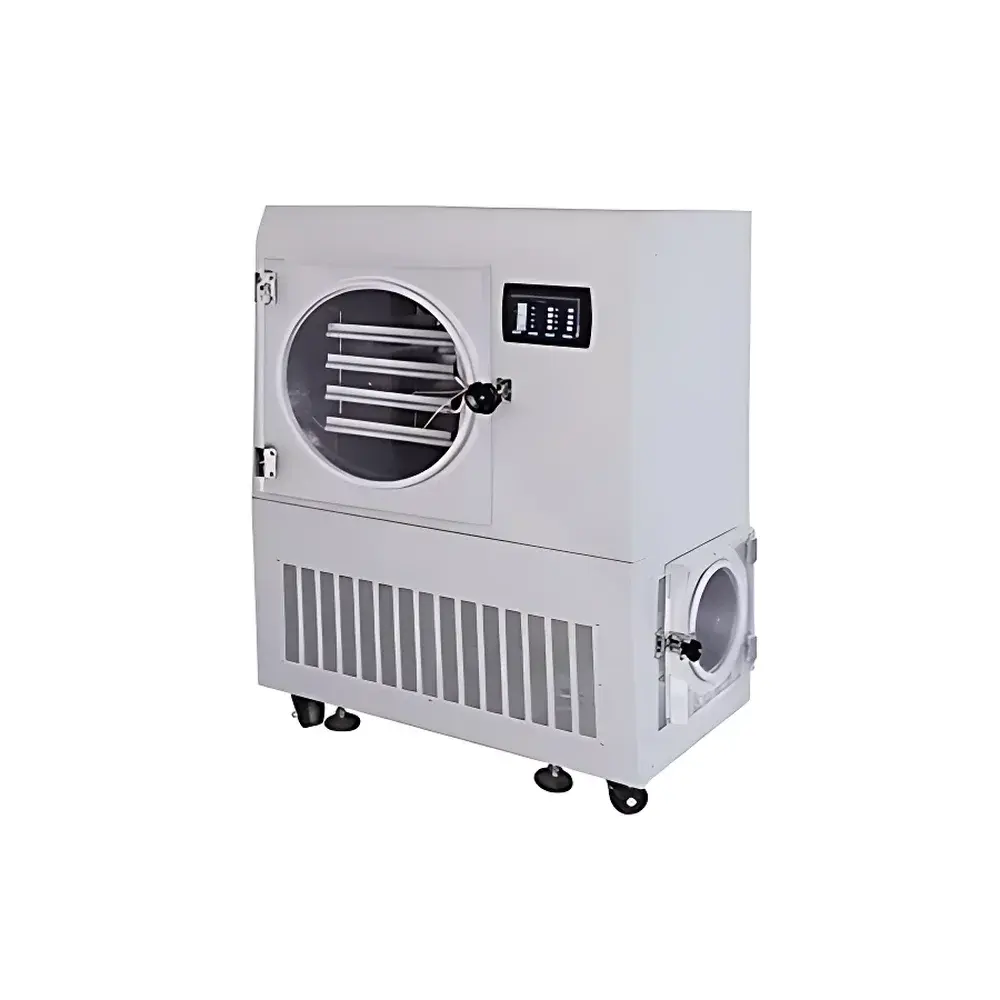
Scientz SCIENTZ-50YD/A In-Situ Electrically Heated Pilot-Scale Freeze Dryer
| Brand | Scientz |
|---|---|
| Origin | Zhejiang, China |
| Manufacturer Type | Direct Manufacturer |
| Product Type | In-Situ Shelf-Type Freeze Dryer |
| Application Scale | Pilot-Scale |
| Lyophilization Area | 0.5 m² |
| Ultimate Vacuum (No Load) | ≤5 Pa |
| Condensate Capacity (24 h) | 10 kg/24 h |
| Cold Trap Temperature (No Load) | ≤−56 °C |
| Overall Dimensions | 1000 × 760 × 1460 mm |
| Shelf Temperature Range (No Load) | −50 to +60 °C |
| Shelf Configuration | 4 shelves, 430 × 300 mm each, 70 mm spacing |
| Power Supply | 3.0 kW (380 V) |
| Weight | 256 kg |
| Electrical Defrost | Standard |
| Auto Drain | Standard |
Overview
The Scientz SCIENTZ-50YD/A is an in-situ electrically heated pilot-scale freeze dryer engineered for reproducible, scalable lyophilization under controlled thermal and vacuum conditions. It operates on the fundamental principles of sublimation-based primary drying: frozen aqueous samples are subjected to low-pressure environments (<5 Pa) while shelf temperature is precisely regulated (−50 to +60 °C) to enable ice removal without melting. Unlike traditional manifold or stoppering-based systems, this unit integrates heating directly into the stainless-steel shelves—eliminating external heat transfer inefficiencies and enabling accurate process parameter mapping essential for technology transfer from lab to production. Designed for GMP-aligned development workflows, the SCIENTZ-50YD/A supports full-cycle process documentation, real-time curve monitoring, and repeatable thermal ramping across up to 40 programmable segments per cycle—making it suitable for formulation optimization, stability studies, and pre-commercial batch processing in pharmaceutical R&D, biologics development, and academic translational research.
Key Features
- Integrated electric shelf heating with PID-controlled temperature regulation—ensures uniform thermal distribution and precise control over primary and secondary drying phases.
- Industrial-grade PLC controller paired with a 7-inch true-color touchscreen interface—supports multi-level user access, audit-trail-enabled operation logs, and intuitive graphical programming of complex lyophilization cycles.
- Dual-stage refrigeration system using Tecumseh (France) compressors—achieves cold trap temperatures ≤−56 °C (no load), ensuring efficient vapor capture during high-moisture-load cycles.
- Transparent acrylic drying chamber door—enables real-time visual monitoring of cake formation, collapse behavior, and drying front progression without compromising vacuum integrity.
- Standardized external port interfaces—compatible with third-party vacuum gauges, inert gas manifolds (N₂/Ar), and optional residual moisture analyzers (e.g., tunable diode laser sensors).
- Onboard data logging with USB export capability—stores complete cycle datasets including shelf temperature, chamber pressure, condenser temperature, and time-stamped event markers; compatible with Windows-based analysis software for trend evaluation and comparative reporting.
- Configurable freeze-drying protocols—up to 99 user-defined programs, each supporting 40 independent temperature/time segments and vacuum setpoints for fine-tuned process development.
Sample Compatibility & Compliance
The SCIENTZ-50YD/A accommodates diverse sample formats: vials (Φ12 mm: 3690 units; Φ16 mm: 1940; Φ22 mm: 1020), trays (max. 6 L solution volume), and open pans. Its design conforms to core elements of ISO 22042:2016 (freeze dryer performance qualification), ASTM F2476-20 (lyophilization cycle validation), and supports alignment with FDA 21 CFR Part 11 requirements when used with validated software configurations and electronic signature protocols. The system’s electrical defrost and auto-drain functions reduce manual intervention, lowering contamination risk in GLP/GMP environments. Optional co-located coalescing filters and oil-free vacuum pump integration further enhance suitability for sterile or high-purity applications.
Software & Data Management
The embedded control firmware records all critical process variables at configurable intervals (default: 10 s) and retains historical data for ≥100 cycles. Exported .csv files contain timestamped columns for shelf T(°C), chamber P(Pa), condenser T(°C), valve status, and alarm flags—facilitating statistical process control (SPC) analysis and root-cause investigation. Optional Scientz LyoView™ desktop application provides overlay plotting, deviation alerts, and automated report generation compliant with ALCOA+ data integrity principles. Audit trails include operator ID, timestamp, parameter changes, and cycle start/stop events—fully traceable for internal QA review or regulatory inspection.
Applications
- Pharmaceutical formulation development—optimizing excipient ratios, annealing steps, and drying endpoints for monoclonal antibodies, vaccines, and small-molecule APIs.
- Biotherapeutics process scale-up—generating representative batches (0.5 m² area ≈ 5–10% of commercial-scale units) for stability testing per ICH Q5C guidelines.
- Academic cryobiology research—studying ice nucleation kinetics, glass transition behavior (Tg’), and structural preservation in sensitive biomaterials.
- Natural product stabilization—preserving enzymatic activity, volatile compounds, and phytochemical profiles in botanical extracts and probiotic cultures.
- Diagnostic reagent manufacturing—producing stable, room-temperature-storable lateral flow assay components and ELISA standards.
FAQ
What is the maximum batch capacity for vial-based lyophilization?
The unit supports up to 3690 × Φ12 mm vials, 1940 × Φ16 mm vials, or 1020 × Φ22 mm vials per cycle—based on standard loading density and uniform heat transfer assumptions.
Does the system support controlled ice nucleation or annealing steps?
Yes—via programmable shelf temperature ramps and holds, including sub-Tg’ annealing protocols to improve crystallinity and drying homogeneity.
Can the vacuum level be actively regulated during drying?
Yes—the integrated vacuum control module enables dynamic pressure modulation (e.g., pressure rise test, controlled venting) synchronized with shelf temperature profiles.
Is remote monitoring supported?
Local Ethernet connectivity allows integration into facility SCADA networks; remote access requires additional firewall-configured VPN infrastructure and IT validation.
What maintenance intervals are recommended for the refrigeration system?
Compressor oil and filter replacement every 24 months; cold trap cleaning after every 50 cycles or visible frost accumulation beyond 80% surface coverage.



