
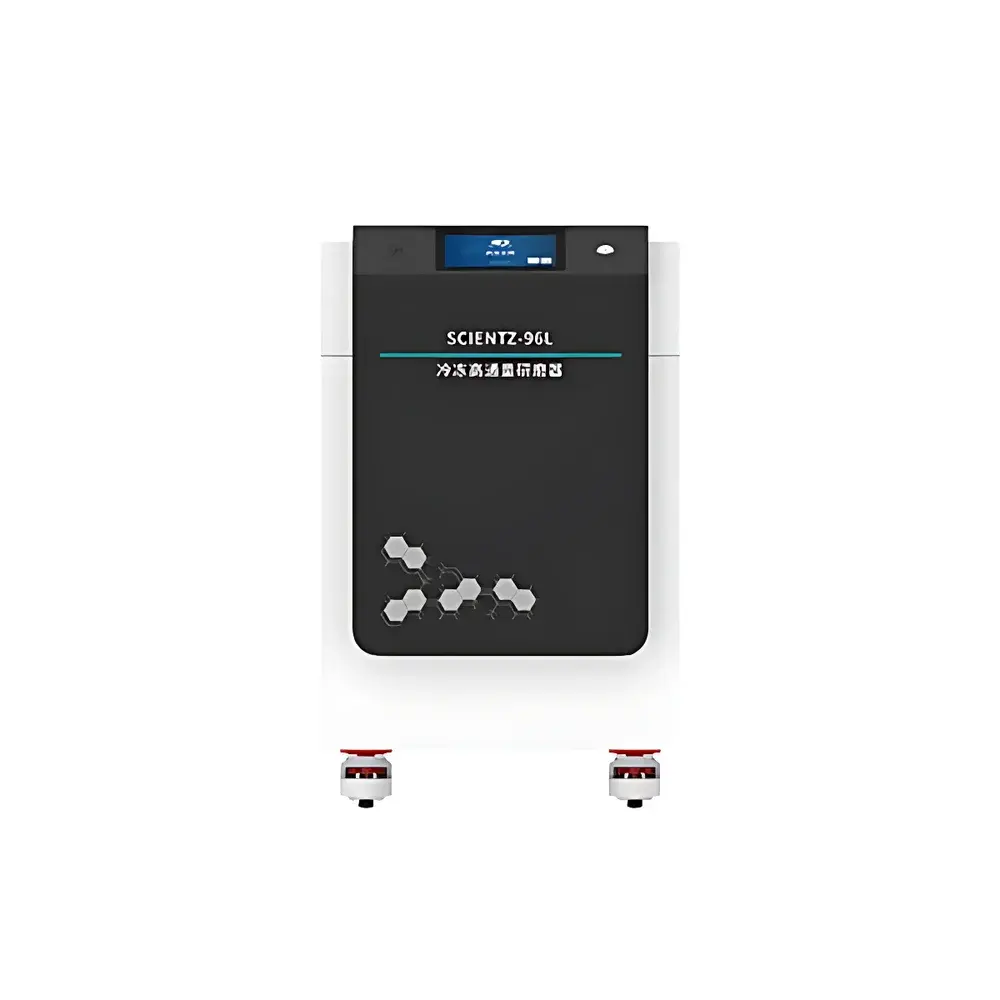
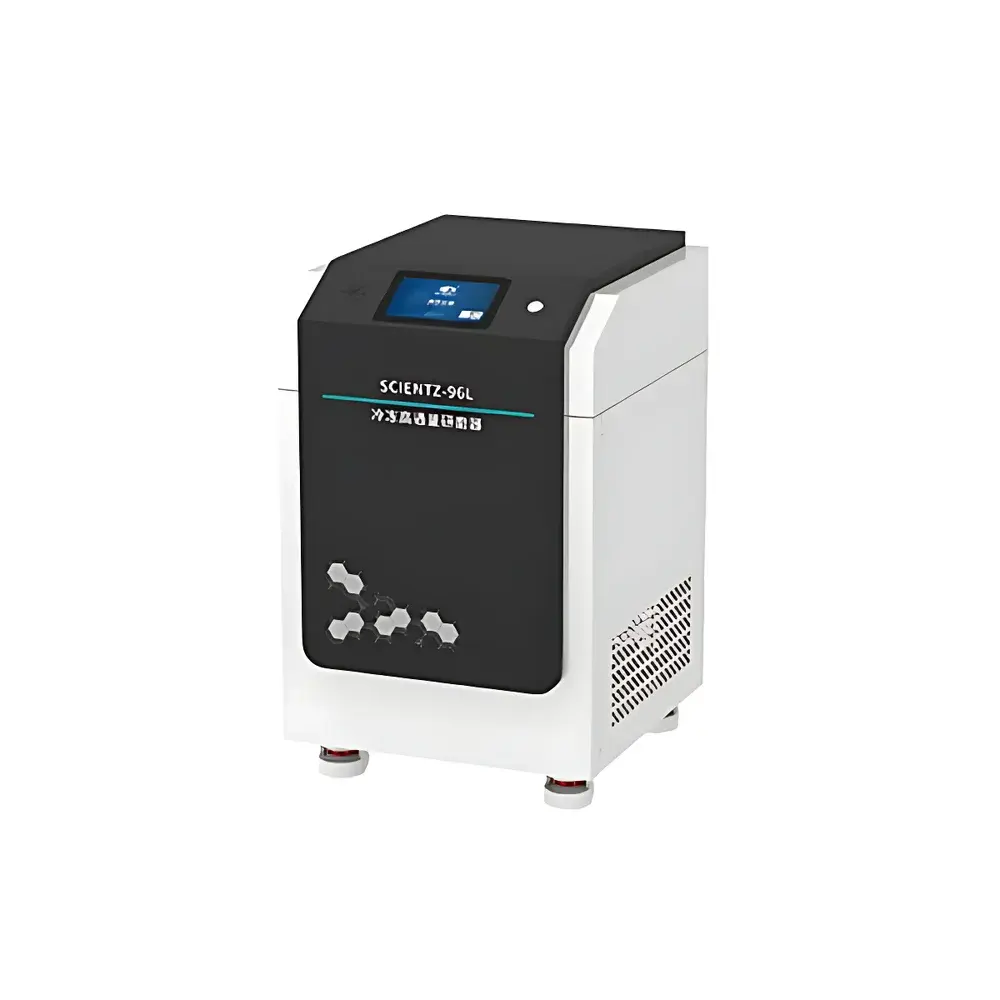
Scientz SCIENTZ-96L High-Throughput Tissue Grinder
| Brand | Scientz |
|---|---|
| Origin | Zhejiang, China |
| Manufacturer Type | Direct Manufacturer |
| Country of Origin | China |
| Model | SCIENTZ-96L |
| Pricing | Available Upon Request |
Overview
The Scientz SCIENTZ-96L High-Throughput Tissue Grinder is an engineered solution for rapid, reproducible mechanical homogenization of biological and non-biological samples under controlled conditions. It operates on the principle of high-frequency vertical oscillation—generating intense kinetic energy through collision and shear forces between grinding beads and sample material contained within sealed centrifuge tubes. This mechanism enables efficient cell lysis, tissue disruption, and matrix homogenization without compromising nucleic acid integrity or protein conformation. Integrated refrigeration (compressor-based cooling system) maintains sample temperature below 4 °C during operation, mitigating thermal degradation of labile biomolecules such as RNA, native enzymes, and post-translationally modified proteins. Designed for scalability and parallel processing, the SCIENTZ-96L accommodates up to 96 individual samples simultaneously in standard 0.2–2.0 mL tubes, making it suitable for high-volume genomics, proteomics, metabolomics, and quality control workflows in regulated environments.
Key Features
- High-throughput capability: Simultaneous processing of up to 96 samples per run using standardized tube formats (e.g., 96-well deep-well plates or individual microcentrifuge tubes)
- Programmable touch interface: Intuitive color LCD touchscreen with preloaded protocols, adjustable amplitude (0–5 mm), frequency (100–2000 rpm), and duration (1 s–99 min)
- Cryogenic compatibility: Built-in compressor-based cooling system maintains chamber temperature between –10 °C and +4 °C; supports pre-chilled adapters and cryo-tubes
- Contamination control: Fully enclosed grinding chamber with independent motion of each sample tube; no cross-contamination between wells or runs
- Safety architecture: Interlocked safety door with automatic motor shutdown upon opening; overheat and overload protection circuits
- Noise reduction: Acoustic damping enclosure and balanced drive mechanism reduce operational noise to <65 dB(A) at 1 m distance
- Mechanical stability: Rigid aluminum alloy frame with precision-machined vertical drive shaft ensures consistent amplitude delivery across all positions
Sample Compatibility & Compliance
The SCIENTZ-96L supports diverse sample types including animal tissues (liver, brain, kidney, muscle, bone), plant materials (roots, leaves, seeds), microbial cultures (E. coli, yeast, fungi, spores), environmental matrices (soil, sludge, feces), food products (meat, dairy, grains), pharmaceutical tablets, polymers (PE, PS, PET), and geological specimens (coal, shale). Compatible grinding media include stainless steel, hardened steel, tungsten carbide, zirconia, alumina, agate, and PTFE beads—each selected based on hardness (HV/Mohs), density, chemical inertness, and contamination profile. The system meets general laboratory safety standards (IEC 61010-1) and supports GLP/GMP-aligned workflows when paired with audit-trail-capable software. While not certified to ISO/IEC 17025 or FDA 21 CFR Part 11 out-of-the-box, its hardware design facilitates integration into validated environments through external data logging and electronic record systems.
Software & Data Management
The SCIENTZ-96L features an embedded microcontroller-based operating system with non-volatile memory for storing ≥100 user-defined protocols. Each protocol includes timestamped execution logs (start time, duration, frequency, amplitude, temperature setpoint). Optional USB export allows transfer of run history to LIMS or ELN platforms. For advanced traceability, third-party software integrations (e.g., LabArchives, Benchling) can be configured via serial or Ethernet interfaces. All parameter changes are recorded with operator ID (if enabled via network authentication), supporting basic 21 CFR Part 11 compliance requirements for electronic signatures and audit trails when deployed with appropriate IT infrastructure.
Applications
- Genomic DNA/RNA extraction from fibrous or lipid-rich tissues prior to qPCR, RNA-seq, or long-read sequencing
- Protein solubilization and complex dissociation for native PAGE, co-immunoprecipitation, or mass spectrometry analysis
- Microbial cell wall disruption for metagenomic library preparation from soil or gut microbiota samples
- Homogenization of pharmacopeial reference standards and finished dosage forms for HPLC/UPLC assay validation
- Particle size reduction of polymer blends and composite materials for SEM/EDS characterization
- Routine QC grinding of agricultural commodities (grains, spices) prior to mycotoxin or pesticide residue testing
FAQ
What types of grinding beads are recommended for RNA isolation?
Zirconia (ZrO₂) or agate beads are preferred for RNA work due to low metal ion leaching and minimal RNase activation. Stainless steel beads may be used if downstream chelation steps are included.
Can the SCIENTZ-96L process frozen samples directly?
Yes—the instrument accepts pre-frozen tubes mounted in cryo-adapters; however, avoid condensation inside the chamber by equilibrating tubes to –20 °C before loading.
Is calibration required before use?
No routine calibration is specified by the manufacturer; however, amplitude verification using a laser vibrometer is recommended annually for ISO 17025-compliant labs.
What is the maximum recommended fill volume per tube?
For optimal bead-to-sample ratio and energy transfer, fill tubes to 10–30% capacity with sample material and grinding beads combined.
How does the SCIENTZ-96L compare to bead-beating systems using horizontal orbital shaking?
Vertical oscillation delivers higher peak acceleration (>30 g) and more uniform energy distribution across multi-well formats, resulting in improved inter-sample reproducibility and reduced run-to-run variability.
Related Products



